[SIGNALS WEEKLY] Edge Brokers, Ephemeral Supply Chains, and Control-Plane Pivots
Reconstruct short update-tampering windows, trace edge access into virtualization, and separate payload blocking from credential access.

The fast read
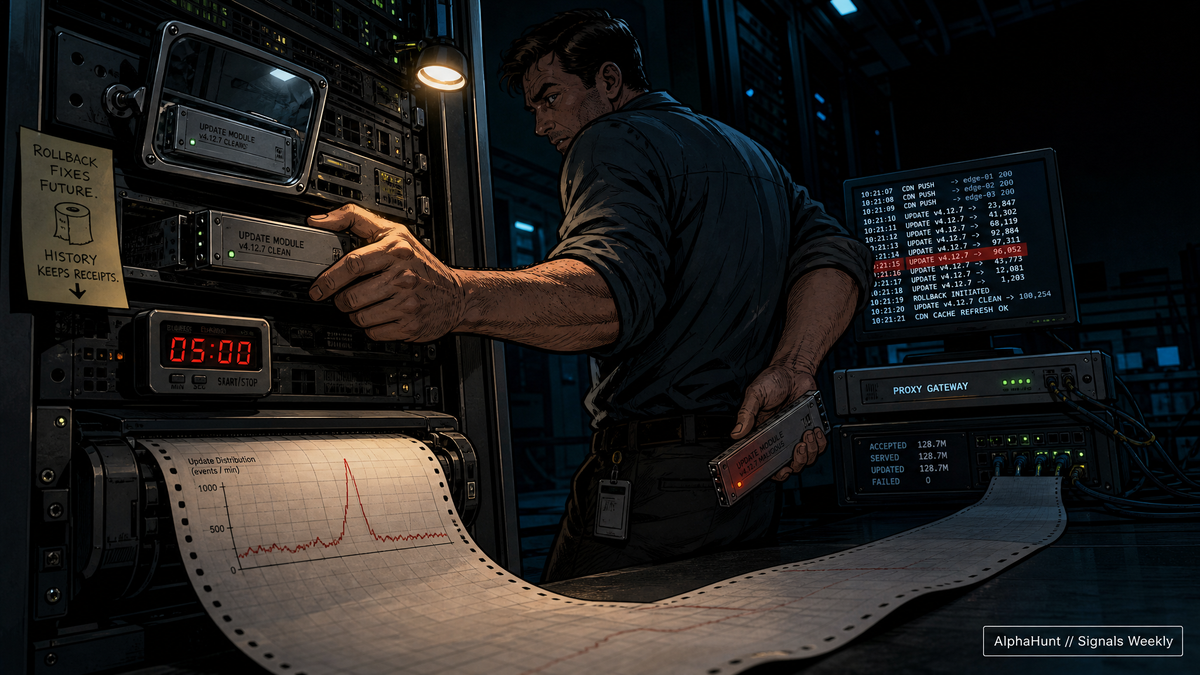
An update server can return clean content by the time an investigation begins without having served clean content when an endpoint downloaded from it. GTIG/Mandiant's reporting on AOMEI describes tampering windows of just 5–10 minutes. That makes the download timeline more useful than a fresh visit to the URL. [1]
Elsewhere this week, reported exploitation of BeyondTrust Remote Support and PAN-OS GlobalProtect puts remote-access systems—and the virtualization controls reachable from them—at the front of the queue. Separate reporting on cloud-tenant brokers, Central Asian espionage and election phishing deserves attention where the targeting or infrastructure matches your environment, not equal urgency everywhere. [2–7]
Our judgment: Prioritize historical evidence and downstream access paths over a reassuring snapshot of what an exposed system looks like now.
A clean update server cannot clear an earlier download
GTIG/Mandiant describes “hit-and-revert” manipulation of AOMEI update infrastructure: change the distribution state, deliver during a short window, then restore it. The reported 5–10-minute window is the operational distinction. A point-in-time URL or content check after rollback can be accurate and still fail to answer what an endpoint received. [1]
The finding establishes a reason to reconstruct the download, not proof that every machine using the updater was compromised. Start with the updater's execution and retrieval timestamps, then correlate endpoint activity with proxy or web application firewall (WAF) and DNS records. An ordinary response today does not resolve a suspicious execution yesterday; the useful evidence is what was fetched and what happened next.
The same campaign used NTLM coercion through WebDAV to capture NetNTLMv2 authentication material. Payload execution and credential access are different questions. Blocking the delivered payload does not establish that the parallel authentication path was blocked too. Look for unusual updater or notification-process retrieval/execution chains alongside unexpected WebDAV or UNC-style access. [1]
This gives a bounded starting point: identify the relevant update window and preserve the evidence around it before deciding whether a clean current response justifies closure. The server has an alibi. The timestamps deserve a hearing.
The member continuation separates immediate edge-response work from the other signals, then brings the practical checks into one list for this week.
Edge response has to reach beyond the appliance
Fixing the entry point and understanding the access already obtained are different parts of the response.