Strategic Cyber Threats: Chinese, Russian, and North Korean APTs.. How are they different?
Recent trends indicate a shared interest among these state-sponsored groups in exploiting vulnerabilities and utilizing AI tools like Google's Gemini to improve their cyberattack capabilities.

That moment... you fall down the rabbit hole.
TL;DR
Key Points
-
- Chinese APTs are aligning cyber operations with national economic goals, targeting sectors like biotechnology and semiconductors.
- Implement EDR solutions to detect and mitigate these sophisticated threats.
-
- Russian APTs focus on political influence through credential harvesting and disinformation.
- Strengthen incident response protocols to counteract these short-term disruptive tactics.
-
- North Korean APTs, driven by financial motives, are evolving tactics for cryptocurrency theft.
- Enhance awareness training to recognize social engineering and phishing attempts.
-
- All APT groups exploit vulnerabilities and use AI tools to enhance cyberattack capabilities.
- Regularly update systems and participate in threat intelligence sharing to stay ahead of emerging threats.
Research
The analysis of Advanced Persistent Threat (APT) groups from China, Russia, and North Korea has been refined based on feedback. This report highlights the distinct operational methodologies, TTPs, and motivations of each group, while addressing areas for improvement.
Chinese APTs are strategically targeting sectors aligned with the country's Five-Year Plans, such as biotechnology and semiconductors, using custom-built malware and legitimate software like SoftEther VPN for persistence. Their operations involve extensive reconnaissance and are primarily focused on economic espionage and intellectual property theft.
Russian APTs leverage political events to conduct credential harvesting and disinformation campaigns, often exploiting one-day vulnerabilities. Their operations are characterized by high-profile, short-term disruptions aimed at cyber espionage and undermining adversaries.
North Korean APTs, particularly the Lazarus Group, are financially motivated, engaging in cryptocurrency theft and using advanced social engineering tactics. They exploit outdated vulnerabilities for long-term persistence and are increasingly using AI tools to enhance their operations.
Recent trends indicate a shared interest among these state-sponsored groups in exploiting vulnerabilities and utilizing AI tools like Google's Gemini to improve their cyberattack capabilities. The report recommends implementing advanced endpoint detection and response solutions, establishing rigorous patch management processes, and developing comprehensive incident response protocols. Additionally, it emphasizes the importance of targeted awareness training and active participation in threat intelligence sharing platforms to mitigate the risks posed by these APT groups.
Chinese APT Groups
-
TTPs:
-
Behavioral Characteristics: Chinese APTs align operations with the Chinese government's Five-Year Plans, targeting sectors like biotechnology, semiconductors, and renewable energy.
-
Malware: Commonly used malware includes custom-built tools and zero-day exploits. Recent reports indicate the use of legitimate software like SoftEther VPN for persistence, allowing attackers to blend into legitimate traffic.
-
Operational Phases: Extensive reconnaissance is conducted, often involving months of preparation. For example, the Cloud Hopper attack involved infiltrating managed IT service providers to access client networks.
-
Recent Activities: Groups like MirrorFace have expanded their target lists to include organizations in the European Union, employing spear-phishing tactics related to significant events (e.g., EXPO 2025).
-
-
Strategic Objectives:
- Focused on economic espionage, intellectual property theft, and gaining technological advantages to support national interests.
Russian APT Groups
-
TTPs:
-
Political Influence: Russian APTs leverage political events to enhance operations, often engaging in credential harvesting and disinformation campaigns.
-
Malware: They exploit one-day vulnerabilities in webmail servers and utilize spear-phishing emails containing cross-site scripting exploits.
-
Operational Phases: Russian groups often execute high-profile, short-term disruptions, contrasting with the more patient approach of North Korean APTs.
-
-
Strategic Objectives:
- Aimed at broad-scope cyber espionage, suppression of dissent, and undermining adversaries, particularly in geopolitical contexts.
DPRK APT Groups
-
TTPs:
-
Financial Motivations: North Korean APTs, particularly the Lazarus Group, engage in financially motivated cybercrime, including cryptocurrency theft, to fund state activities.
-
Malware Delivery: They employ advanced social engineering tactics, such as the DEV#POPPER campaign targeting developers, and exploit outdated vulnerabilities for long-term persistence.
-
Emerging Tactics: Groups like Emerald Sleet are using new methods, such as tricking targets into executing PowerShell commands to gain access.
-
-
Strategic Objectives:
- Focused on generating revenue through cybercrime, bypassing international sanctions, and conducting espionage to support the regime.
Similarities Among APT Groups
-
Common Operational Methodologies: All three groups engage in extensive reconnaissance and utilize social engineering tactics to gain initial access to target networks.
-
Motivations: While their primary objectives differ (economic espionage for China, political influence for Russia, and financial gain for North Korea), all groups share a common goal of undermining adversaries and enhancing their national interests.
Recent Trends
-
Exploitation of Vulnerabilities: A recent unpatched Windows zero-day flaw has been exploited by multiple state-sponsored groups, including those from China, Russia, and North Korea, indicating a shared interest in leveraging vulnerabilities for data theft and espionage.
-
Use of AI Tools: State-sponsored APTs are increasingly utilizing AI tools like Google's Gemini to enhance their operational capabilities across various phases of cyberattacks. This includes reconnaissance, tool weaponization, and post-compromise activities.
Recommendations, Actions, Suggested Pivots, Forecasts and Next Steps..
(Subscribers Only)
Recommendations
-
Implement Advanced Endpoint Detection and Response (EDR) Solutions: Deploy EDR tools such as CrowdStrike Falcon or SentinelOne to monitor for unusual software installations and network traffic patterns. These tools can help detect the use of legitimate software like SoftEther VPN, which is being exploited by Chinese APTs for persistence. EDR solutions should be configured to alert on suspicious behaviors indicative of APT activities, such as the use of zero-day exploits and custom malware.
-
Establish a Rigorous Patch Management Process: Develop a systematic approach to regularly update and patch systems, focusing on critical vulnerabilities identified in the CISA Known Exploited Vulnerabilities (KEV) catalog. This includes immediate action on unpatched zero-day vulnerabilities, as highlighted by the recent exploitation trends among state-sponsored groups. Tools like Qualys or Tenable can assist in vulnerability management and prioritization.
-
Create Comprehensive Incident Response Protocols: Formulate and regularly update incident response protocols that specifically address the TTPs of the identified APT groups. This should include detailed playbooks for responding to incidents involving social engineering tactics, such as those used by North Korean APTs. Collaborate with international partners to share threat intelligence and improve collective defense strategies.
-
Develop Targeted Awareness Training Programs: Implement regular training sessions for all staff on recognizing social engineering tactics and phishing attempts, utilizing real-world examples from recent APT activities. For instance, training could include case studies of the DEV#POPPER campaign by Lazarus Group, which targets developers through social engineering. This training should be tailored to the specific threats posed by the APT groups discussed in the report.
-
Engage with Threat Intelligence Sharing Platforms: Actively participate in industry and governmental threat intelligence sharing platforms to stay updated on emerging threats and vulnerabilities. This collaboration can enhance the organization's ability to anticipate and mitigate risks associated with APT activities, particularly those involving cross-collaboration among different threat actors.
MITRE ATTACK IDs
T1070, T1071, T1071.001, T1071.002, T1071.003, T1203, T1203.001, T1203.002, T1203.003, T1499, T1499.001, T1499.002, T1499.003, T1566, T1566.001
Followup Research
Suggested Pivots
-
What specific software vulnerabilities, such as those in Windows or popular webmail servers, have been exploited by the APT groups mentioned, and how can organizations implement targeted patch management strategies to address these vulnerabilities?
-
How are AI tools specifically utilized by APT groups during different phases of cyberattacks, such as reconnaissance, execution, and exfiltration, and what countermeasures can organizations adopt to mitigate these advanced tactics?
-
What successful incident response strategies or frameworks have been implemented by organizations facing similar threats from APT groups, and how can these be adapted to enhance current protocols against the tactics employed by the Lazarus Group and others?
-
How do geopolitical factors, such as international sanctions and diplomatic relations, influence the operational tactics and target selection of APT groups, and what implications does this have for organizations operating in affected regions?
-
In what ways can public-private partnerships improve the sharing of threat intelligence related to APT activities, particularly in light of recent trends in collaboration among state-sponsored groups?
Forecast
Short-Term Forecast (3-6 months)
-
Increased Targeting of Critical Sectors by Chinese APTs
-
Chinese APT groups will intensify their focus on critical sectors such as biotechnology, semiconductors, and renewable energy, aligning with the Chinese government's Five-Year Plans. The recent expansion of groups like MirrorFace into the European Union indicates a strategic shift to exploit vulnerabilities in these high-value sectors. This trend will likely be exacerbated by geopolitical tensions, as these sectors are crucial for technological advancement and economic competitiveness.
-
Examples:
-
The Cloud Hopper attack, which targeted managed IT service providers, serves as a precedent for how Chinese APTs infiltrate networks to access sensitive information. This attack involved extensive reconnaissance and the use of legitimate software for persistence, demonstrating the sophistication of these groups.
-
The recent targeting of a diplomatic organization in the EU by MirrorFace, using spear-phishing tactics related to EXPO 2025, highlights the evolving nature of their operations and the potential for increased espionage activities in Europe.
-
-
-
Rise in Credential Harvesting and Disinformation Campaigns by Russian APTs
-
Russian APTs will likely ramp up credential harvesting and disinformation campaigns, particularly in the lead-up to significant political events or elections in various countries. The operational methodologies of these groups suggest a focus on short-term disruptions that can influence public opinion or political outcomes.
-
Examples:
- Historical instances, such as the interference in the 2016 U.S. elections, demonstrate the effectiveness of these tactics in achieving political objectives. Recent reports indicate that Russian APTs are increasingly exploiting one-day vulnerabilities in webmail servers, using spear-phishing emails containing cross-site scripting exploits to gain access to sensitive information.
-
Long-Term Forecast (12-24 months)
-
Evolution of North Korean APT Tactics Towards Advanced Financial Cybercrime
-
North Korean APT groups, particularly the Lazarus Group, will likely evolve their tactics to incorporate more sophisticated financial cybercrime methods, including the use of AI tools for executing complex attacks. This evolution will be driven by the need to generate revenue to support the regime amidst ongoing international sanctions.
-
Examples:
-
The DEV#POPPER campaign targeting developers illustrates the potential for North Korean APTs to leverage social engineering in new ways, which may become more prevalent as they refine their techniques. This campaign has successfully deceived individuals into downloading malicious software disguised as legitimate tools.
-
The increasing use of cryptocurrency theft as a funding mechanism will likely lead to more targeted attacks on cryptocurrency exchanges and financial institutions, as seen in the recent surge of phishing attacks aimed at key employees in the cryptocurrency sector.
-
-
-
Collaborative Threat Landscape Among State-Sponsored APTs
-
There will be a notable increase in collaboration among state-sponsored APT groups from China, Russia, and North Korea, as they share tactics, techniques, and procedures (TTPs) to enhance their operational effectiveness. This collaboration may manifest in joint operations or coordinated attacks against common adversaries, particularly in response to geopolitical events.
-
Examples:
-
The recent exploitation of a shared unpatched Windows zero-day flaw by multiple state-sponsored groups indicates a trend towards collective action in leveraging vulnerabilities for espionage and data theft. This shared interest in exploiting vulnerabilities highlights the interconnected nature of these threat actors.
-
Historical precedents, such as the cooperation between Russia and China in cyber operations, suggest that this trend will continue to evolve, posing a significant threat to global cybersecurity.
-
-
MITRE ATTACK IDs
T1070, T1071, T1071.001, T1071.002, T1071.003, T1203, T1203.001, T1203.002, T1203.003, T1499, T1499.001, T1499.002, T1499.003, T1566, T1566.001
Appendix
References
- (2025-02-03) - Google Reveals Gemini AI Use by More Than 40 State-Sponsored APTs
- (2023-06-28) - A Look at Advanced Persistent Threats (APTs) Related to Chinese Proxies
- (2024-11-07) - China's Elite Hackers Expand Target List to European Union
- (2024-10-08) - Nation-State Cyber Actors
- (2024-10-08) - Cooperation Between China, Iran, North Korea, and Russia: Current and Potential Future Threats to America
- (2024-10-09) - Crypto & Social Engineering: North Korean APTs in 2024
- (2025-02-12) - North Korea-linked APT Emerald Sleet is Using a New Tactic
- (2025-03-18) - Unpatched Windows Zero-Day Flaw Exploited by 11 State-Sponsored Threat Groups
MITRE ATTACK
Techniques
-
T1070 (Indicator Removal on Host) - Techniques that adversaries use to remove or alter indicators of compromise (IoCs) on a host.
- This technique is relevant as APT groups often seek to cover their tracks after gaining access to a network, especially in prolonged campaigns. For example, APT28 has been known to clear logs to hide their activities.
-
T1071 (Application Layer Protocol) - Adversaries use application layer protocols to communicate with compromised systems.
- This is particularly relevant for Chinese APTs using legitimate software like SoftEther VPN to blend in with normal traffic. The use of such tools allows them to maintain persistence without raising suspicion.
- Sub-techniques:
- T1203 (Exploitation for Client Execution) - Exploiting software vulnerabilities to execute code on a client.
- This technique is relevant as APT groups often exploit vulnerabilities in software to gain initial access, as seen in spear-phishing campaigns targeting Microsoft Office documents.
- Sub-techniques:
- T1499 (Network Denial of Service) - Adversaries may use network denial of service techniques to disrupt services.
- This technique is relevant for Russian APTs that may engage in disruptive operations as part of their strategy, particularly during geopolitical tensions.
- Sub-techniques:
- T1566 (Phishing) - Adversaries use phishing to obtain user credentials or deliver malware.
- This technique is particularly relevant for North Korean APTs that utilize social engineering tactics to gain access, such as the DEV#POPPER campaign targeting developers.
- Sub-techniques:
Tactics
-
TA0001 (Initial Access) - The tactic that adversaries use to gain initial access to a network.
- This is crucial for understanding how APT groups initiate their attacks, particularly through phishing and exploitation.
-
TA0002 (Execution) - Techniques that result in the execution of adversary-controlled code on a local or remote system.
- Relevant as APTs often execute malicious code after gaining access, such as through the exploitation of vulnerabilities.
-
TA0003 (Persistence) - Techniques that adversaries use to maintain their foothold on systems across restarts, changed credentials, and other interruptions.
- This is particularly relevant for APTs that use legitimate software for persistence, allowing them to remain undetected.
PROCEDURES
-
T1070.001 (Clear Windows Event Logs) - Adversaries may clear Windows event logs to hide their activities.
- This procedure is relevant as it highlights the lengths APTs go to in order to avoid detection, particularly in long-term campaigns.
-
T1203.001 (Malicious Microsoft Office Document) - Using malicious documents to exploit vulnerabilities in Microsoft Office.
- This procedure is relevant for understanding how APTs deliver malware, especially in spear-phishing attacks.
SOFTWARE
-
SoftEther VPN - A legitimate VPN software that has been exploited by APT groups for persistence.
- This software is relevant as it demonstrates how APTs can blend in with legitimate traffic, making detection more challenging.
-
Cobalt Strike - A legitimate penetration testing tool that is often abused by threat actors.
- This software is relevant as it is commonly used by APT groups for post-exploitation activities, allowing them to maintain control over compromised systems.
MITIGATIONS
-
M1030 (User Training) - Training users to recognize phishing attempts and social engineering tactics.
- This mitigation is crucial for reducing the risk of initial access through phishing, particularly for organizations targeted by APT groups.
-
M1040 (Application Isolation and Sandboxing) - Isolating applications to prevent malicious code execution.
- This is relevant for protecting against exploitation of vulnerabilities, especially in environments where sensitive data is handled.
GROUPS
-
G0007 (APT28) - A Russian cyber espionage group known for its sophisticated attacks.
- This group is relevant due to its history of targeting political entities and conducting disinformation campaigns, particularly during elections.
-
G0032 (Lazarus Group) - A North Korean group involved in financially motivated cybercrime.
- This group is relevant for its use of social engineering and exploitation tactics, particularly in cryptocurrency theft.
-
G0045 (APT10) - A Chinese cyber espionage group known for targeting managed service providers.
- This group is relevant for its extensive reconnaissance and operational methodologies, particularly in the context of economic espionage.
AlphaHunt
(Have feedback? Did something resonate with you? Did something annoy you? Just hit reply! :))
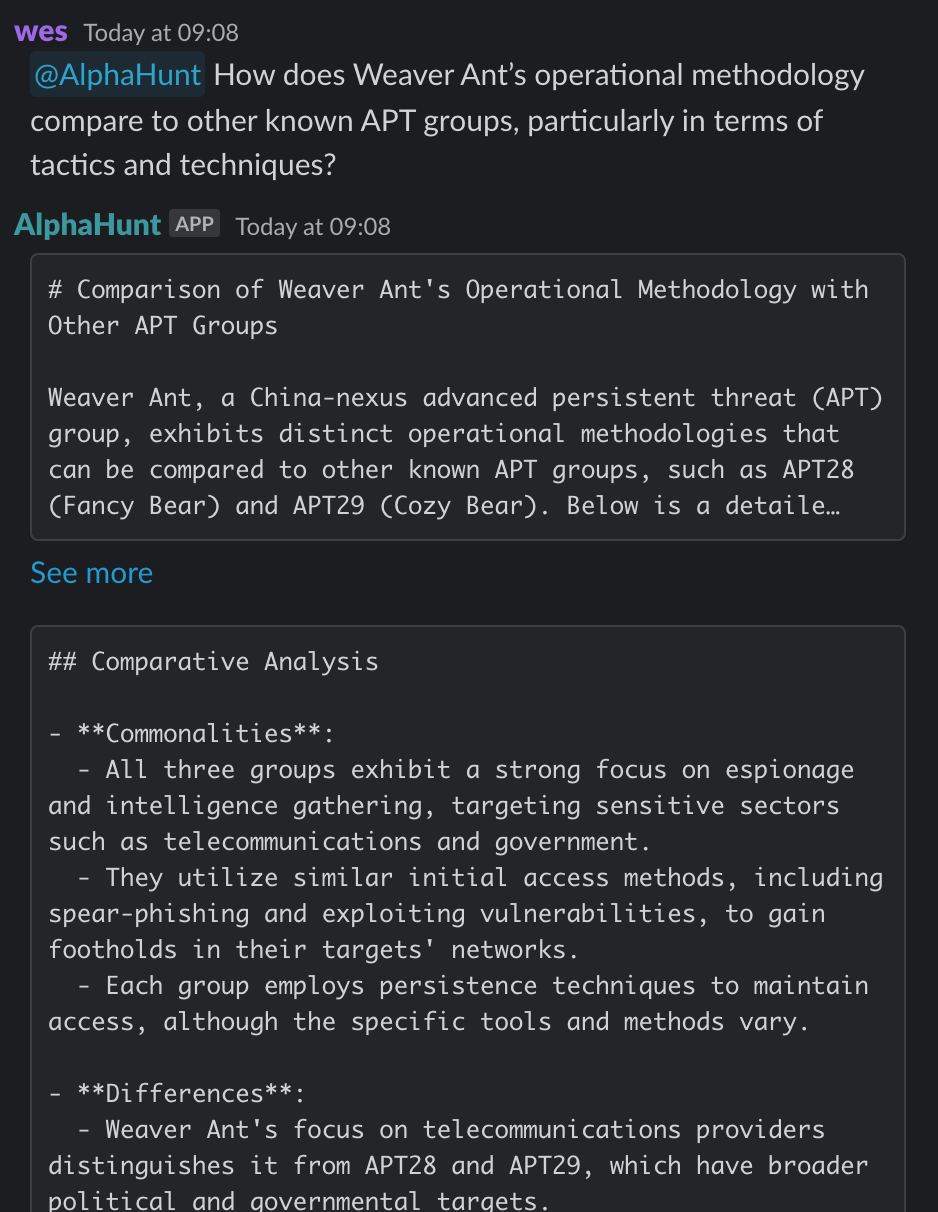
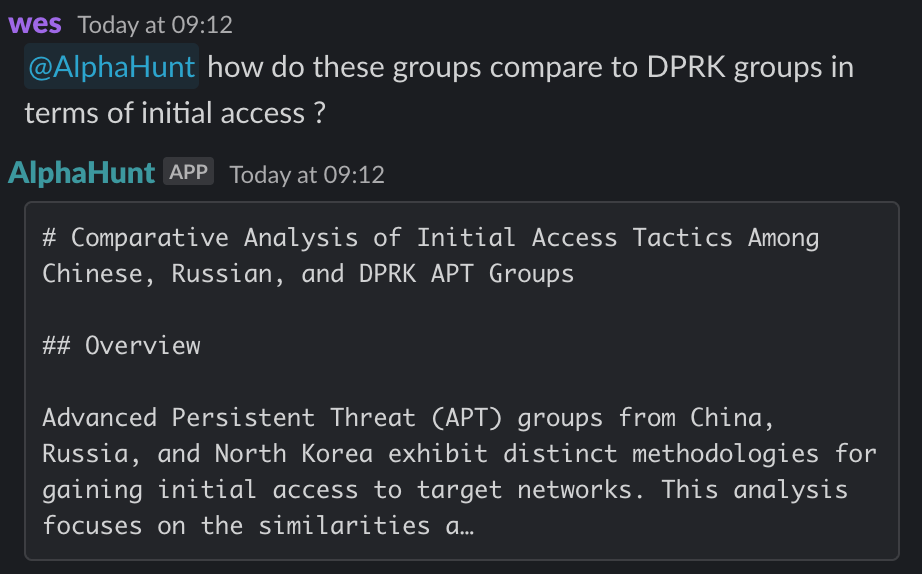
Get compound questions like this:
- How does Weaver Ant’s operational methodology compare to other known APT groups, particularly in terms of tactics and techniques?
- how do these groups compare to DPRK groups in terms of initial access ?
Does it take a chunks out of your day? Would you like help with the research?
This baseline report was thoughtfully researched and took 10 minutes.. It's meant to be a rough draft for you to enhance with the unique insights that make you an invaluable analyst.
We just did the initial grunt work..
Are you ready to level up your skillset? Get Started Here!
Did this help you? Forward it to a friend!
(c) 2025 CSIRT Gadgets, LLC
License - CC BY-SA 4.0
![[GAME THEORY] The Contractor Is Becoming the Intrusion Supply Chain](https://storage.ghost.io/c/06/e5/06e5730b-7d78-4713-9cec-6cba31d297f5/content/images/size/w600/2026/10/alphahunt-game-theory-the-contractor-is-becoming-the-intrusion-supply-chain-hero-2026-10-12.png)
![[SIGNALS WEEKLY] Edge Compromise, Real-Time Phishing, and Evidence Gaps](https://storage.ghost.io/c/06/e5/06e5730b-7d78-4713-9cec-6cba31d297f5/content/images/size/w600/2026/10/alphahunt-signals-weekly-edge-compromise-real-time-phishing-and-evidence-gaps-hero-2026-10-13.png)
![[GAME THEORY] The exploit is only one part of the business](https://storage.ghost.io/c/06/e5/06e5730b-7d78-4713-9cec-6cba31d297f5/content/images/size/w600/2026/10/alphahunt-game-theory-the-exploit-is-only-one-part-of-the-business-hero-2026-10-13.png)
![[GAME THEORY] The OAuth Prompt Is Becoming the New Diplomatic Pouch](https://storage.ghost.io/c/06/e5/06e5730b-7d78-4713-9cec-6cba31d297f5/content/images/size/w600/2026/10/alphahunt-game-theory-the-oauth-prompt-is-becoming-the-new-diplomatic-pouch-hero-2026-10-08.png)