RomCom’s WinRAR Exploit: Persistent Startup Folder Attacks and Encrypted C2 Exfiltration Targeting Critical Sectors
Russian-linked RomCom is abusing a critical WinRAR bug to quietly persist in networks, move laterally, and siphon data over encrypted channels — hitting government, finance, and telecom sectors hard. Patch lag is keeping doors wide open.

(Have feedback? Did something resonate with you? Did something annoy you? Just hit reply! :))
Tired of explaining what "our RomCom risk" is? ChatGPT not helping you with the peer review?
What are the specific persistence (e.g., MITRE ATT&CK T1547) and data exfiltration (e.g., T1041) techniques employed by RomCom malware variants exploiting WinRAR CVE-2025-8088, and how do these techniques evolve across different campaigns? write a report targeting strategic stakeholders
Does it take a chunks out of your day? Would you like help with the research?
This baseline report was thoughtfully researched and took 15 minutes.. It's meant to be a rough draft for you to enhance with the unique insights that make you an invaluable analyst.
We just did the initial grunt work.. and the peer review.
Are you ready to level up your skillset? Get Started Here!
Did this help you? Forward it to a friend!
TL;DR
- Exploit WinRAR CVE-2025-8088 to drop malware in Windows Startup folders (T1547.001), ensuring auto-execution at logon.
- Deliver via spearphishing with malicious RAR attachments (T1566.001) exploiting the flaw for instant compromise.
- Move laterally using Impacket tools (SMBExec, WMIExec) to harvest creds and spread.
- Exfiltrate data over encrypted C2 channels (T1041) with evolving obfuscation to dodge detection.
- Blend espionage & ransomware — dual-purpose ops targeting Western critical sectors.
Why it matters
- SOC: Hunt for executable creation in Startup folders, Impacket tool execution, and anomalous encrypted outbound traffic.
- IR: Preserve RAR attachments, WinRAR versions <7.13, registry run key changes, and C2 traffic captures.
- SecOps: Enforce WinRAR patch to 7.13+, block RAR attachments, and restrict outbound encrypted traffic to known destinations.
Suggested Pivots
- How will RomCom .. (upgrade to unlock!) .. becomes widespread?
- What detection .. (upgrade to unlock!) .. from normal HTTPS?
- How could you .. (upgrade to unlock!) .. against Impacket-based attacks?
Executive Summary
RomCom (Storm-0978/Tropical Scorpius/UNC2596) is exploiting CVE-2025-8088 in WinRAR to persist by planting malware in Windows Startup folders. Initial access comes via spearphishing with malicious RARs, followed by lateral movement using Impacket frameworks. Data is exfiltrated through encrypted C2 channels with sophisticated encoding to evade detection.
Targets include government, military, finance, and telecom sectors in Europe and North America — especially those linked to Ukrainian affairs. This mix of espionage and financially driven ransomware makes RomCom a flexible and enduring threat.
See it in your telemetry
Mail: RAR attachments; subjects tied to urgent or official business; uncommon senders.
Endpoint: Creation of .exe in C:\Users<user>\AppData\Roaming\Microsoft\Windows\Start Menu\Programs\Startup; Impacket SMBExec/WMIExec process trees.
Network: Encrypted outbound sessions to rare domains/IPs; long-lived HTTPS sessions with low data bursts.
Quick wins (ship today)
- Patch all WinRAR installs to v7.13+ or apply registry mitigation.
- Block/quarantine inbound RAR attachments at the mail gateway.
- Enable/tune EDR rules for Startup folder changes and Impacket execution.
Ready to level up your intelligence game?
Research & Analysis
Background
"RomCom" (also known as Storm-0978, Tropical Scorpius, UNC2596) is a Russia-linked cyberespionage group known for ransomware, data theft, and espionage campaigns. It targets government, military, telecommunications, and finance sectors primarily in Europe and North America. The group has leveraged zero-day vulnerabilities, including WinRAR CVE-2025-8088, to deliver its backdoor malware.
WinRAR CVE-2025-8088 is a critical directory traversal vulnerability in the Windows version of WinRAR, fixed in version 7.13. It allows attackers to craft malicious RAR archives that place executables in Windows Startup folders, enabling arbitrary code execution at system login.
Persistence Techniques (MITRE ATT&CK T1547 and Sub-techniques)
-
Technique Used: RomCom exploits the WinRAR CVE-2025-8088 vulnerability to achieve persistence by placing malicious executables into Windows Startup folders. This corresponds to MITRE ATT&CK technique T1547.001 - Boot or Logon Autostart Execution: Registry Run Keys / Startup Folder.
-
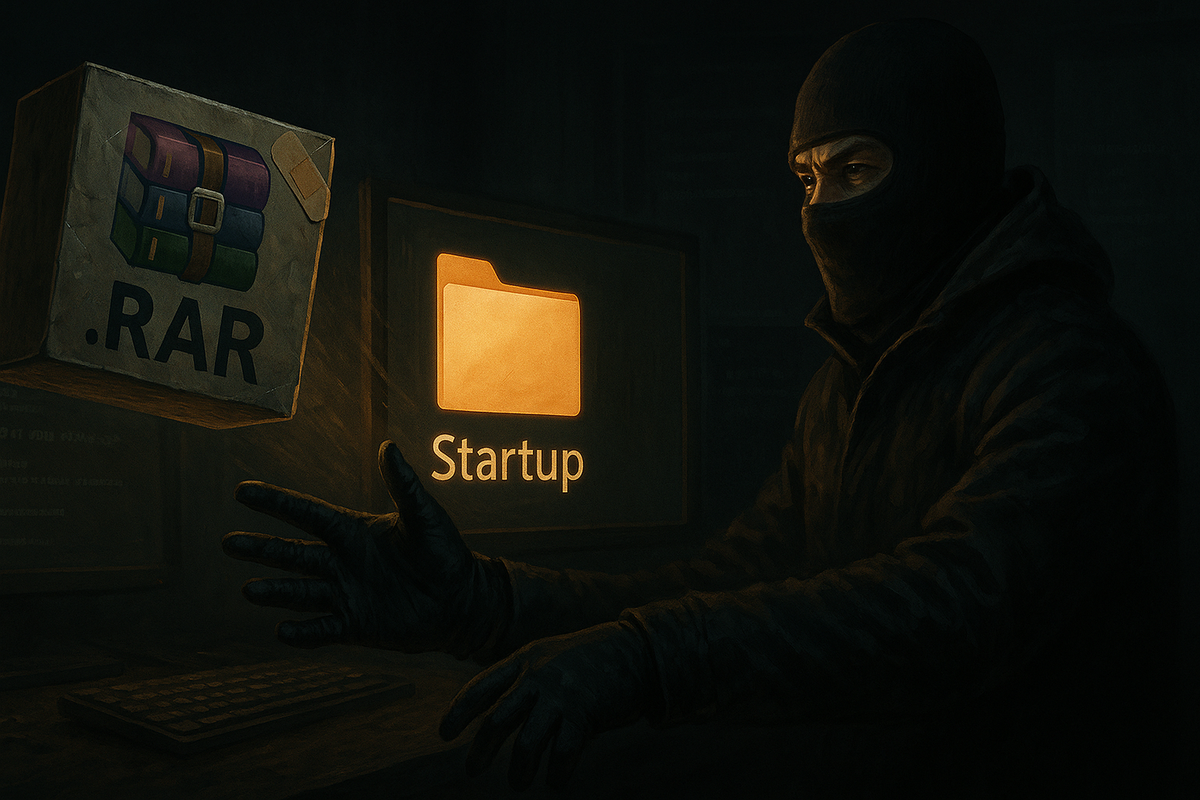
Mechanism: By exploiting the path traversal flaw, attackers craft RAR archives that, when extracted, place RomCom executables in startup locations. This causes the malware to execute automatically upon user login, maintaining persistence without requiring additional user interaction.
-
Evolution: This persistence method has been consistently observed in RomCom campaigns from 2024 through 2025, with the group refining spearphishing lures and delivery mechanisms to exploit this vulnerability effectively.
Data Exfiltration Methods (MITRE ATT&CK T1041)
-
Technique Used: RomCom employs T1041 - Exfiltration Over C2 Channel, where stolen data is encoded and sent over existing command and control channels.
-
Operational Tradecraft: After establishing persistence, RomCom backdoors communicate with C2 servers to exfiltrate sensitive data. The malware uses encrypted channels to evade detection and maintain stealth.
-
Evolution: RomCom's exfiltration techniques have evolved to include more sophisticated encoding and obfuscation methods, adapting to improved network defenses observed in 2024–2025 campaigns.
Campaign Evolution and Threat Actor Overlaps
-
RomCom has been linked to multiple aliases (Storm-0978, Tropical Scorpius, UNC2596) and is suspected to collaborate or overlap with other Russian cyberespionage groups.
-
Campaigns have targeted government and military organizations involved in Ukrainian affairs, as well as commercial sectors like telecommunications and finance.
-
The group has also been associated with ransomware operations (Industrial Spy, Underground ransomware), indicating a blend of espionage and financially motivated activities.
-
Microsoft reports that RomCom uses trojanized versions of legitimate software (e.g., Adobe products, Solarwinds) hosted on malicious domains mimicking legitimate ones to deliver malware.
Operational Tradecraft and Targeting Patterns
-
Initial Access: Spearphishing emails with malicious RAR attachments exploiting CVE-2025-8088.
-
Persistence: Exploitation of WinRAR vulnerability to place executables in startup folders (T1547.001).
-
Lateral Movement: Use of Impacket frameworks (SMBExec, WMIExec) for credential dumping and lateral movement.
-
Exfiltration: Data exfiltration over encrypted C2 channels (T1041).
-
Targeting: Primarily government, military, telecommunications, and finance sectors in Europe and North America, with a focus on entities involved in Ukrainian affairs.
-
Campaign Shifts: From purely espionage-focused to opportunistic ransomware and extortion attacks, indicating operational flexibility.
Recommendations, Actions, Suggested Pivots, Forecasts and Next Steps
(Subscribers Only)
Recommendations, Actions and Next Steps
-
Accelerate WinRAR Patch Deployment and Validate Remediation
- Immediately identify all endpoints with WinRAR installed and upgrade to version 7.13 or later to mitigate CVE-2025-8088. For systems where patching is not immediately feasible, deploy the FEATURE_BLOCK_CROSS_PROTOCOL_FILE_NAVIGATION registry key as a temporary safeguard. After patching, validate remediation through vulnerability scanning and targeted red team exercises simulating RomCom’s startup folder persistence (T1547.001) to ensure controls are effective.
- This directly addresses the primary RomCom persistence vector, as confirmed by ESET and HackRead: “WinRAR does not automatically update itself, so it is up to each individual user to take action. To protect yourself from this threat, you must manually download and install the new version of WinRAR. Users who do not update will remain vulnerable to this specific attack.” (HackRead, 2025)
- Challenges include asset discovery, user compliance, and legacy systems. Assign patching responsibility to IT operations and require executive oversight for compliance.
- Metrics: 100% of WinRAR instances upgraded or mitigated within 7 days; successful red team simulation results; zero new detections of startup folder abuse.
- MITRE ATT&CK: T1547.001
-
Deploy Targeted EDR and SIEM Detection Logic for RomCom TTPs
- Implement and tune EDR rules to detect: (a) creation of executables in Windows Startup folders and registry run keys (T1547.001), (b) execution of Impacket tools (SMBExec, WMIExec) for lateral movement, and (c) suspicious outbound encrypted traffic indicative of C2 exfiltration (T1041). Leverage Microsoft Defender for Endpoint and Sentinel hunting queries, such as “Potential Impacket Execution” and “Commands executed by WMI on new hosts,” and ensure alerts are triaged by trained analysts. Periodically validate detection efficacy with simulated attacks.
- Microsoft confirms: “Microsoft Defender for Endpoint detects this type of activity with alerts such as Export of SAM registry hive… Storm-0978 has then used the Impacket frameworks SMBExec and WMIExec functionalities for lateral movement.” (Microsoft Security Blog, 2023)
- Considerations: EDR/SIEM coverage gaps, alert fatigue, and need for staff training on new detection logic.
- Metrics: Number of RomCom-related alerts detected and contained; mean time to detect/respond (MTTD/MTTR); results of periodic detection validation exercises.
- MITRE ATT&CK: T1547.001, T1041, T1021.002
-
Enhance Email Security Controls and User Awareness with Evidence-Based Training
- Strengthen email gateway policies to block or quarantine RAR attachments, especially those exploiting CVE-2025-8088. Deploy advanced phishing detection (e.g., Microsoft Defender for Office 365 Safe Attachments/Safe Links) and conduct user training focused on RomCom’s spearphishing lures. Validate controls with simulated phishing campaigns and update training content based on real-world RomCom tactics.
- SecurityAffairs and HackRead both highlight the spearphishing vector: “ESET has observed spearphishing emails with attachments containing RAR files… These archives exploited the CVE-2025-8088 to deliver RomCom backdoors.” (SecurityAffairs, 2025)
- Challenges: Balancing false positives with user productivity, and ensuring high-risk users (e.g., executives, finance) are prioritized for training.
- Metrics: Reduction in click-through rates on simulated phishing; increased user reporting of suspicious emails; decrease in malicious RAR attachments reaching inboxes.
- MITRE ATT&CK: T1566.001
Suggested Pivots
-
What specific telemetry sources (e.g., EDR logs, sandbox detonation data, registry monitoring) and threat intelligence feeds are most effective for detecting emerging RomCom persistence techniques, including new anti-sandbox and obfuscation methods observed in the SnipBot variant?
-
How can network defenders develop and refine detection indicators for RomCom's encrypted C2 exfiltration channels, considering the latest variants like SnipBot that use sophisticated multi-stage payloads and covert communication methods?
-
What are the documented collaboration patterns and tool-sharing behaviors between RomCom and other Russian-aligned APT groups in 2024–2025, and how do these relationships influence their targeting strategies and operational tradecraft?
Forecast
Short-Term Forecast (3-6 months)
RomCom will continue exploiting the WinRAR CVE-2025-8088 vulnerability to achieve persistence by placing malicious executables in Windows Startup folders (MITRE T1547.001). Spearphishing campaigns using malicious RAR attachments will remain the primary initial access vector, targeting government, military, telecommunications, and finance sectors in Europe and North America. The group will further refine spearphishing lures and delivery mechanisms, including trojanized legitimate software mimicking popular applications, to increase infection rates and evade detection. Data exfiltration over encrypted command and control (C2) channels (MITRE T1041) will persist, with enhanced encoding and obfuscation techniques to bypass network defenses. Lateral movement using Impacket tools (SMBExec, WMIExec) for credential dumping and network propagation will remain common. Defenders should prioritize rapid deployment of WinRAR version 7.13 or later, implement registry mitigations where patching is delayed, enhance email security controls to block or quarantine RAR attachments, and deploy targeted EDR detection rules for startup folder modifications and lateral movement activities.
Examples
- ESET and SecurityAffairs confirm active exploitation of CVE-2025-8088 by RomCom via spearphishing with malicious RAR attachments.
- Microsoft documents RomCom’s use of Impacket frameworks for lateral movement and credential dumping.
- Microsoft reports trojanized legitimate software delivery methods used by RomCom to evade detection.
- HackRead highlights the criticality of manual WinRAR patching due to lack of automatic updates.
What to watch out for
- Increased volume of spearphishing emails with malicious RAR attachments exploiting CVE-2025-8088.
- Detection of new RomCom variants using startup folder persistence or novel delivery methods.
- Alerts from EDR/SIEM for creation of executables in startup folders and execution of Impacket tools.
- Network traffic patterns indicative of encrypted data exfiltration over C2 channels.
- Adoption rates of WinRAR patching and registry mitigations across targeted organizations.
Long-Term Forecast (12-24 months)
RomCom is likely to evolve its persistence and exfiltration techniques beyond reliance on WinRAR CVE-2025-8088 as patch adoption increases. The group may develop or adopt new zero-day vulnerabilities or alternative persistence mechanisms, though this remains a possibility rather than a certainty. Operational flexibility suggests continued blending of espionage and financially motivated ransomware/extortion activities, with potential expansion of targeting to additional critical infrastructure sectors. Collaboration or tool-sharing with other Russian-aligned APT groups may occur, as observed in the broader Russian threat landscape, but direct evidence specific to RomCom is limited; this should be considered a plausible scenario rather than a confirmed trend. The emergence of advanced multi-stage payloads like the SnipBot variant demonstrates ongoing sophistication in evasion and modularity. Defenders will need to institutionalize patch management, advanced telemetry for encrypted C2 detection, behavioral analytics for lateral movement, and continuous user training to keep pace with evolving RomCom tactics.
Examples
- Palo Alto Networks’ Unit 42 analysis of SnipBot, a sophisticated RomCom variant employing anti-sandbox and obfuscation techniques.
- ESET’s report on Russian APT groups intensifying cyberattacks with zero-day exploits and destructive malware, illustrating the evolving threat environment.
- Historical patterns of Russian APT groups adapting tactics post-patch adoption, such as Sandworm’s shift to destructive wipers.
- Documented collaboration among Russian APT groups sharing tools and operational tradecraft, though specific RomCom collaboration is not confirmed.
What to watch out for
- Discovery and exploitation of new zero-day vulnerabilities or alternative persistence techniques by RomCom.
- Increased deployment of multi-stage, modular malware variants with advanced evasion capabilities.
- Indicators of collaboration or tool-sharing between RomCom and other Russian APT groups.
- Expansion of targeting to new sectors or geographic regions.
- Evolution of spearphishing tactics beyond RAR attachments, including new social engineering methods.
- Effectiveness and adoption of advanced detection technologies and user training programs.
MITRE ATT&CK IDs
T1547.001, T1041, T1566.001, T1021.002
Appendix
References
- (2025-08-09) - Phishing attacks exploit WinRAR flaw CVE-2025-8088 to install RomCom
- (2025-08-01) - WinRAR Zero-Day CVE-2025-8088 Exploited to Spread RomCom Malware
- (2023-07-11) - Storm-0978 attacks reveal financial and espionage motives
- (2024-09-23) - Inside SnipBot: The Latest RomCom Malware Variant
- (2025-05-19) - ESET Research APT Report: Russian cyberattacks in Ukraine intensify; Sandworm unleashes new destructive wiper
- (2025-03-25) - APT and financial attacks on industrial organizations in Q4 2024
AlphaHunt
(Have feedback? Did something resonate with you? Did something annoy you? Just hit reply! :))
Tired of explaining what "our RomCom risk" is? ChatGPT not helping you with the peer review?
What are the specific persistence (e.g., MITRE ATT&CK T1547) and data exfiltration (e.g., T1041) techniques employed by RomCom malware variants exploiting WinRAR CVE-2025-8088, and how do these techniques evolve across different campaigns? write a report targeting strategic stakeholders
Does it take a chunks out of your day? Would you like help with the research?
This baseline report was thoughtfully researched and took 15 minutes.. It's meant to be a rough draft for you to enhance with the unique insights that make you an invaluable analyst.
We just did the initial grunt work.. and the peer review.
Are you ready to level up your skillset? Get Started Here!
Did this help you? Forward it to a friend!
(c) 2025 CSIRT Gadgets, LLC
MITRE ATT&CK
Techniques
-
T1547.001 - Boot or Logon Autostart Execution: Registry Run Keys / Startup Folder
- RomCom exploits WinRAR CVE-2025-8088 to place malicious executables in Windows Startup folders, ensuring malware persistence at user logon. This is confirmed by ESET and Microsoft and is the primary persistence vector observed in recent campaigns.
- ESET: RomCom APT exploits WinRAR zero-day
- Microsoft: Storm-0978 attacks reveal financial and espionage motives
-
T1041 - Exfiltration Over C2 Channel
- RomCom exfiltrates stolen data over encrypted command and control channels, using this technique to evade detection and maintain stealth during data theft operations. Documented in Microsoft and ESET reporting.
- Microsoft: Storm-0978 attacks reveal financial and espionage motives
-
T1566.001 - Phishing: Spearphishing Attachment
- Initial access is achieved via spearphishing emails with malicious RAR attachments exploiting WinRAR CVE-2025-8088. ESET and Microsoft both confirm this vector.
- ESET: RomCom APT exploits WinRAR zero-day
- Microsoft: Storm-0978 attacks reveal financial and espionage motives
-
T1021.002 - Remote Services: SMB/Windows Admin Shares
- RomCom uses Impacket tools (SMBExec, WMIExec) for lateral movement and credential dumping, leveraging SMB/Windows Admin Shares for remote execution. Confirmed by Microsoft and MITRE.
- Impacket, Software S0357 (MITRE)
- Microsoft: Storm-0978 attacks reveal financial and espionage motives
Tactics
-
- The use of startup folder persistence (T1547.001) is a core tactic for RomCom, ensuring continued access after initial compromise. Confirmed by ESET and Microsoft.
-
- Exfiltration of sensitive data over C2 channels (T1041) is a key objective in RomCom campaigns, as documented by Microsoft.
-
- Spearphishing with malicious attachments (T1566.001) is the primary initial access vector for RomCom, confirmed by ESET and Microsoft.
-
- Use of Impacket tools for lateral movement (T1021.002) is a documented RomCom tradecraft, confirmed by Microsoft and MITRE.
Procedures
-
T1547.001 - Placing Executables in Startup Folders via WinRAR Exploit
- RomCom leverages WinRAR CVE-2025-8088 to drop executables in Windows Startup folders, ensuring execution at user logon. ESET and Microsoft both document this method in 2024–2025 campaigns.
- ESET: RomCom APT exploits WinRAR zero-day
- Microsoft: Storm-0978 attacks reveal financial and espionage motives
-
T1566.001 - Spearphishing with Malicious RAR Attachments
- RomCom sends spearphishing emails with RAR files exploiting CVE-2025-8088 to deliver malware. ESET and Microsoft confirm this as the initial access vector.
- ESET: RomCom APT exploits WinRAR zero-day
- Microsoft: Storm-0978 attacks reveal financial and espionage motives
-
T1021.002 - Lateral Movement via Impacket SMBExec/WMIExec
- RomCom uses Impacket’s SMBExec and WMIExec modules for lateral movement and credential access, as documented by Microsoft and MITRE.
- Impacket, Software S0357 (MITRE)
- Microsoft: Storm-0978 attacks reveal financial and espionage motives
Software
-
- RomCom uses Impacket for lateral movement, credential dumping, and remote command execution via SMBExec and WMIExec. Confirmed by MITRE and Microsoft.
- Impacket, Software S0357 (MITRE)
- Microsoft: Storm-0978 attacks reveal financial and espionage motives
-
RomCom Backdoor (no MITRE ID, but confirmed by ESET and Microsoft)
- The RomCom malware family, including recent variants, is the primary backdoor used in these campaigns, supporting persistence, C2, and exfiltration.
- ESET: RomCom APT exploits WinRAR zero-day
- Microsoft: Storm-0978 attacks reveal financial and espionage motives
Mitigations
-
- Regularly audit startup folders and registry run keys, and monitor for unauthorized modifications to detect persistence mechanisms like T1547.001. Recommended by Microsoft and MITRE.
- Microsoft: Storm-0978 attacks reveal financial and espionage motives
-
M1031 - Network Intrusion Prevention
- Deploy network intrusion prevention systems to detect and block exfiltration over C2 channels (T1041). Recommended by MITRE and Microsoft.
- Microsoft: Storm-0978 attacks reveal financial and espionage motives
-
M1027 - Patch Operating System and Applications
- Apply WinRAR version 7.13 or later to mitigate CVE-2025-8088 and prevent exploitation for persistence. Confirmed by ESET and Microsoft.
- ESET: RomCom APT exploits WinRAR zero-day
-
- Conduct user training to recognize spearphishing attempts and malicious attachments (T1566.001). Recommended by ESET and Microsoft.
- ESET: RomCom APT exploits WinRAR zero-day