
CryptoChameleon: Multi-Channel Phishing Kit Driving Advanced Credential Theft in Financial and Crypto Sectors
CryptoChameleon is an advanced phishing kit distributed via phishing-as-a-service platforms, enabling rapid, scalable attacks against cryptocurrency users, financial institutions, and related sectors...

(Have feedback? Did something resonate with you? Did something annoy you? Just hit reply! :))
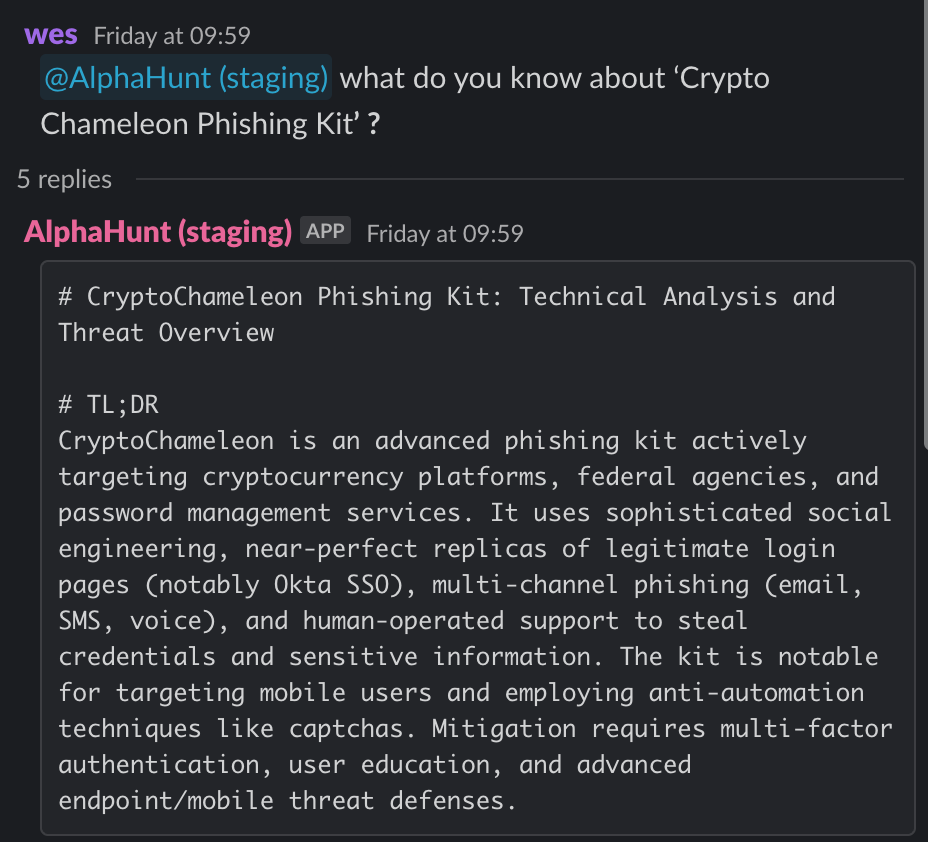
Get questions from your boss, like this:
- what do you know about ‘Crypto Chameleon Phishing Kit’ ?
Are you ready to level up your skillset? Get Started Here!
TL;DR
Key Points
-
- CryptoChameleon is a sophisticated phishing kit enabling multi-channel attacks (email, SMS, vishing) with advanced MFA bypass (TOTP theft), primarily targeting cryptocurrency users and financial institutions.
- Security teams must monitor for domains registered on NiceNIC, Cloudflare Turnstile anti-bot evasion, and spearphishing campaigns leveraging CRM/bulk email provider compromise.
-
- The kit is part of The Comm cybercrime ecosystem, sharing infrastructure and TTPs with groups like Scattered Spider and campaigns such as PoisonSeed.
- Attribution can be refined by analyzing domain registration patterns, WHOIS metadata, and hosting provider usage.
-
- Recent campaigns exploit supply chain vectors, leveraging compromised CRM and bulk email accounts to distribute phishing at scale.
- Organizations should collaborate with CRM vendors and threat intelligence communities for rapid IoC sharing and takedown coordination.
-
- Defenders are advised to deploy phishing-resistant MFA (hardware tokens), enhance anti-phishing detection (including anti-bot evasion), and conduct targeted user awareness training on multi-channel threats.
- KPIs include reducing phishing domain detection time, increasing detection rates, and lowering user click-through rates on phishing links.
-
- The threat landscape is evolving toward modular phishing platforms, AI-driven social engineering, and increased targeting of emerging digital economies and payment platforms.
- Ongoing monitoring of infrastructure, user behavior, and regulatory trends is critical for proactive defense.
Executive Summary
CryptoChameleon is an advanced phishing kit distributed via phishing-as-a-service platforms, enabling rapid, scalable attacks against cryptocurrency users, financial institutions, and related sectors. It features multi-channel delivery (email, SMS, vishing), sophisticated MFA bypass via TOTP theft, and anti-detection mechanisms such as Cloudflare Turnstile evasion. The kit is linked to The Comm cybercrime community, including groups like Scattered Spider, and shares infrastructure and TTPs with campaigns like PoisonSeed.
Recent campaigns have shifted toward supply chain phishing, exploiting compromised CRM and bulk email providers to distribute phishing at scale, complicating detection and mitigation. The kit’s infrastructure is characterized by domains registered on NiceNIC, hosting on Cloudflare, Njalla, and DigitalOcean, and distinctive WHOIS metadata.
MITRE ATT&CK mapping highlights spearphishing (T1566), MFA bypass (T1556), credential access (T1078), and infrastructure compromise (T1586) as core techniques. No direct links to other malware families were found, but operational similarities exist with kits delivering RATs and info-stealers.
Actionable recommendations include advanced domain and infrastructure monitoring, rapid takedown of phishing domains, deployment of phishing-resistant MFA, user training on multi-channel threats, and collaboration with threat intelligence communities. The forecast anticipates further evolution toward modular, AI-driven phishing platforms, expanded targeting of digital economies, and increased regulatory pressure for supply chain and authentication security.
Security practitioners should prioritize detection of multi-channel phishing, MFA bypass attempts, and supply chain compromise, while tracking infrastructure patterns and collaborating across the ecosystem to disrupt CryptoChameleon and related campaigns.
Research
Origin
The CryptoChameleon Phishing Kit is a sophisticated toolkit primarily targeting cryptocurrency users and financial institutions. It is part of a broader cybercrime ecosystem known as The Comm, which includes threat actor groups such as CryptoChameleon and Scattered Spider. The kit provides ready-made phishing page templates, multi-channel attack capabilities (email, SMS, vishing), and advanced features like multi-factor authentication bypass through TOTP theft. It is often distributed via phishing-as-a-service platforms, enabling rapid deployment and scaling of campaigns.
Motivation
The primary motivation behind CryptoChameleon is financial gain through credential theft, particularly targeting cryptocurrency wallets and financial accounts. The kit facilitates large-scale credential harvesting, enabling attackers to hijack accounts, transfer funds, and monetize stolen credentials via fraudulent transactions and mobile wallet abuse.
Historical Context
CryptoChameleon operates within a cybercrime community known as The Comm, which has been active since at least 2022. The kit and associated threat actors have evolved to include multi-channel phishing, anti-detection mechanisms such as Cloudflare Turnstile bot detection evasion, and sophisticated credential harvesting workflows. The kit is linked to campaigns targeting high-value cryptocurrency brands like Coinbase and Ledger, as well as bulk email and CRM providers, indicating a supply chain phishing approach.
Timeline
- 2022: Initial use of domains linked to CryptoChameleon in phishing campaigns.
- 2023-2024: Expansion of phishing kits and campaigns targeting cryptocurrency and financial sectors.
- 2024-2025: Use of Cloudflare Turnstile anti-bot technology and multi-channel phishing vectors.
- Early 2025: Observed campaigns involving supply chain spam operations targeting CRM and bulk email providers.
- 2025: Arrests related to tap-to-pay fraud schemes leveraging credentials harvested via phishing kits.
Countries Targeted
- United States – Major target due to large financial and crypto user base.
- Canada – Targeted for financial institutions and payment card fraud.
- Australia – Targeted in phishing campaigns against financial institutions.
- Latin America – Increasingly targeted in mobile phishing campaigns.
- Asia-Pacific – Broad targeting including banks and payment services.
Sectors Targeted
- Financial Institutions – Banks, credit unions, and payment processors targeted for credential theft and fraud.
- Cryptocurrency Users – Targeted for wallet seed phrases and account credentials.
- Telecommunications – Targeted for SMS and mobile messaging phishing.
- Retail – Targeted via payment card fraud and mobile wallet abuse.
- Public Sector – Some campaigns spoof government and intelligence agency websites for information gathering.
Links to Other Malware
No direct links to other malware families were found specifically for CryptoChameleon, but it shares operational similarities with other phishing kits that deliver remote access trojans (RATs) and information stealers such as BitRAT and Lumma Stealer.
Similar Malware
CryptoChameleon shares characteristics with other multi-channel phishing kits used in campaigns like PoisonSeed and those operated by groups such as the Smishing Triad. These kits also employ multi-factor authentication bypass techniques, use bot detection evasion, and target financial and cryptocurrency sectors.
Threat Actors
CryptoChameleon is part of The Comm, a cybercrime community that includes groups like Scattered Spider. While PoisonSeed is a distinct campaign, it shares infrastructure and targeting overlaps with CryptoChameleon, particularly in targeting cryptocurrency brands and bulk email providers. Attribution to specific actors is supported by infrastructure patterns such as domain registration on NiceNIC, use of obscene language in WHOIS fields, and hosting on Cloudflare and other providers. The Comm actors are known for using phishing-as-a-service platforms and sophisticated social engineering tactics.
Breaches Involving This Malware
No specific public breach disclosures directly naming CryptoChameleon were found. However, the kit is implicated in ongoing phishing campaigns that have led to credential theft and financial fraud, including tap-to-pay fraud arrests in the United States.
Recommendations, Actions, Suggested Pivots, Forecasts and Next Steps..
(Subscribers Only)
Recommendations
-
Immediately implement advanced domain and infrastructure monitoring to detect phishing domains registered on NiceNIC and hosted on Cloudflare, Njalla, Virtuo, and DigitalOcean. Establish KPIs such as reducing phishing domain detection time by 50% within three months and decreasing successful phishing incidents by 30% within six months through proactive blocking and takedown efforts.
-
Prioritize enhancement of email and multi-channel phishing detection capabilities by integrating anti-bot evasion detection (e.g., Cloudflare Turnstile challenge recognition) and spearphishing link/attachment identification. Set measurable goals to increase phishing email detection rates by 40% within four months using threat intelligence feeds like IOFATM from Silent Push.
-
Within the next six months, strengthen multi-factor authentication (MFA) by deploying phishing-resistant methods such as hardware security tokens (e.g., FIDO2 keys) across critical user groups. Track adoption rates and aim to reduce MFA bypass incidents related to TOTP theft by at least 60% within the first year.
-
Launch comprehensive user awareness and training programs within one month, focusing on multi-channel phishing risks (email, SMS, vishing) and social engineering tactics used by The Comm actors. Measure effectiveness by conducting phishing simulation exercises quarterly and target a 25% reduction in user click-through rates on phishing links within six months.
-
Establish ongoing collaboration with threat intelligence sharing communities and CRM/bulk email providers to share IoCs and coordinate rapid takedown of phishing infrastructure. Set a target to reduce supply chain spam incidents by 40% within six months through joint remediation efforts and information sharing.
Suggested Pivots
-
What specific telemetry and detection artifacts (e.g., HTTP request patterns, JavaScript fingerprinting, Cloudflare Turnstile challenge responses) can be collected and analyzed to improve identification of phishing campaigns using advanced anti-bot technologies, and how can these be integrated into existing security monitoring platforms to reduce detection time and false negatives?
-
How can detailed infrastructure and behavioral data (such as domain registration patterns, WHOIS metadata with obscene language markers, hosting provider usage, and phishing kit code fingerprints) be systematically compared across CryptoChameleon, Scattered Spider, and PoisonSeed to refine attribution models and distinguish overlapping threat actor activities?
-
What indicators of compromise (IoCs) and attack flow data from CRM and bulk email provider breaches can be leveraged to map the supply chain phishing attack lifecycle used in cryptocurrency seed phrase poisoning, and what collaborative frameworks with CRM vendors and threat intelligence communities can be established to share these insights and coordinate rapid response?
-
Which user interaction metrics (e.g., click-through rates on multi-channel phishing vectors, frequency of MFA bypass attempts, and success rates of TOTP theft) should be tracked to evaluate the effectiveness of user awareness programs and phishing-resistant MFA deployments in financial and cryptocurrency sectors, and what KPIs can be set to measure improvements over time?
-
How can monitoring of dynamic DNS and publicly rentable subdomains be enhanced through real-time DNS telemetry, domain lifecycle analysis, and anomaly detection to preemptively identify Scattered Spider’s evolving infrastructure, and what partnerships with DNS providers and security communities can facilitate timely sharing of these threat signals?
Forecast
Short-Term Forecast (3-6 months)
-
Rapid Expansion of Multi-Channel Phishing Campaigns Targeting Cryptocurrency and Financial Sectors
CryptoChameleon’s evolution into a multi-channel phishing toolkit—leveraging email, SMS, and vishing—will drive a significant increase in credential theft campaigns focused on cryptocurrency wallets and financial institutions. The kit’s advanced MFA bypass via TOTP theft and Cloudflare Turnstile anti-bot evasion will enable attackers to circumvent traditional defenses, increasing campaign success rates. This trend is supported by recent observations of supply chain spam operations targeting CRM and bulk email providers, as detailed in the PoisonSeed campaigns (Silent Push, 2025-04-03).
What to watch for: Security teams should monitor for phishing domains using Cloudflare Turnstile challenges, spearphishing emails with links to newly registered NiceNIC domains, and unusual MFA bypass attempts. Early detection of multi-channel phishing indicators will be critical.
Examples:- Arrests linked to tap-to-pay fraud schemes leveraging credentials harvested via CryptoChameleon (Allure Security, 2024-10-29).
- PoisonSeed’s use of CRM accounts for seed phrase poisoning attacks (Cyber News Group, 2025-04-08).
-
Heightened Focus on Supply Chain Phishing via CRM and Bulk Email Provider Compromise
Ongoing supply chain phishing campaigns exploit compromised CRM and bulk email provider accounts to distribute phishing kits at scale. This vector will become a primary enabler for rapid, trusted phishing link delivery, increasing the difficulty of detection and mitigation. The PoisonSeed campaign’s recent targeting of CRM accounts exemplifies this trend (Silent Push, 2025-04-03).
What to watch for: Organizations should monitor for anomalous CRM account activity, unusual bulk email sending patterns, and rapid domain registration spikes associated with phishing infrastructure. Collaboration with CRM vendors for threat intelligence sharing is essential.
Examples:- Bulk email provider breaches facilitating large-scale phishing distribution.
- Supply chain spam operations increasing phishing reach.
-
Increased Use of Anti-Detection and Evasion Techniques in Phishing Infrastructure
Attackers will refine the use of Cloudflare Turnstile anti-bot technology, domain registration on NiceNIC, and hosting on providers like Njalla and DigitalOcean to evade detection and prolong phishing infrastructure lifetimes. Code obfuscation and PowerShell-based post-exploitation scripts will further complicate endpoint detection efforts. These tactics are consistent with observed CryptoChameleon campaigns (Allure Security, 2024-10-29).
What to watch for: Security teams should enhance detection capabilities for obfuscated scripts, monitor for PowerShell execution patterns linked to phishing, and track domain registration metadata for suspicious patterns such as obscene WHOIS entries.
Examples:- Use of subdirectory-based brand impersonation to bypass domain filters.
- PowerShell scripts used in post-exploitation phases.
-
Accelerated Adoption of Phishing-Resistant MFA and User Awareness Programs by Defenders
In response to MFA bypass via TOTP theft, organizations—especially in financial and cryptocurrency sectors—will accelerate deployment of phishing-resistant MFA methods such as hardware security tokens (FIDO2). Concurrently, user awareness programs focusing on multi-channel phishing vectors will be expanded, with quarterly phishing simulations to measure effectiveness. This aligns with recommendations from Silent Push and Allure Security reports.
What to watch for: Adoption metrics of hardware MFA tokens, reduction in successful MFA bypass incidents, and user click-through rates on phishing simulations.
Examples:- Financial institutions leading hardware token rollouts.
- User training programs addressing SMS and vishing phishing.
-
Increased Collaboration and Intelligence Sharing to Combat Phishing-as-a-Service Ecosystem
Threat intelligence communities, CRM providers, and bulk email services will intensify collaboration to share IoCs, coordinate takedowns, and disrupt phishing infrastructure. Integration of IOFATM feeds from providers like Silent Push will enhance rapid detection and mitigation of CryptoChameleon-related campaigns.
What to watch for: Joint takedown announcements, shared IoC repositories, and coordinated incident response efforts.
Examples:- Reduction in phishing domain lifetimes through collaborative takedowns.
- Increased sharing of phishing infrastructure indicators.
Long-Term Forecast (12-24 months)
-
Evolution of Phishing Kits into Modular, Multi-Vector Platforms with Integrated Fraud Monetization
CryptoChameleon and similar kits will evolve into modular platforms combining phishing, MFA bypass, and direct fraud monetization tools such as tap-to-pay fraud modules. This integration will enable threat actors to conduct end-to-end attacks with minimal external dependencies, increasing operational efficiency and impact. This forecast is grounded in recent arrests linked to tap-to-pay fraud schemes leveraging phishing-harvested credentials (Allure Security, 2024-10-29).
What to watch for: Emergence of phishing kits bundling fraud modules, increased reports of contactless payment fraud linked to credential theft, and new malware variants integrating these capabilities.
Examples:- Kits combining credential harvesting with real-time transaction manipulation.
- Expansion into mobile wallet abuse.
-
Expansion of Targeting Beyond Traditional Financial and Crypto Sectors into Emerging Digital Economies
As cryptocurrency adoption grows in Asia-Pacific and Latin America, phishing campaigns will increasingly target emerging digital financial services, DeFi platforms, and mobile payment ecosystems. This diversification will complicate defense due to varied regulatory environments and security postures. The intelligence product notes broad targeting in these regions, including banks and payment services (Silent Push, 2025-04-08).
What to watch for: Phishing campaigns spoofing regional payment services, government digital ID portals, and localized CRM providers.
Examples:- Supply chain attacks targeting regional CRM and bulk email providers.
- Phishing campaigns tailored to local languages and payment platforms.
-
Increased Use of AI and Automation in Phishing-as-a-Service Platforms to Enhance Social Engineering and Evasion
Phishing kits will incorporate AI-driven content generation for personalized social engineering, dynamic evasion of detection systems, and automated adaptation to defender countermeasures. While not explicitly observed in CryptoChameleon yet, this trend is emerging in the broader phishing ecosystem and aligns with the sophistication trajectory of The Comm community (Krebs on Security, 2025-01-21).
What to watch for: AI-generated spearphishing messages, automated domain rotation, and adaptive phishing infrastructure.
Examples:- Use of AI chatbots to engage victims in vishing campaigns.
- Automated phishing page customization based on victim profile.
-
Regulatory and Industry Pressure Driving Adoption of Phishing-Resistant Authentication and Supply Chain Security Standards
Rising impact of phishing-enabled fraud will prompt governments and industry bodies to impose stricter regulations on MFA standards and supply chain security for CRM and bulk email providers. This will drive widespread adoption of hardware MFA and enhanced vendor security assessments, as recommended in the intelligence product.
What to watch for: New regulatory mandates, certification programs for CRM providers, and compliance reporting requirements.
Examples:- Mandates for hardware token MFA in financial sectors.
- Industry standards for supply chain phishing resilience.
-
Fragmentation and Specialization within The Comm Cybercrime Ecosystem Leading to Distinct Sub-Groups with Focused TTPs
The Comm community, including CryptoChameleon and Scattered Spider, will likely fragment into specialized sub-groups focusing on distinct attack vectors such as supply chain phishing, mobile wallet fraud, and voice phishing. This specialization will increase operational efficiency but also create identifiable patterns for defenders to exploit, as seen in the distinct PoisonSeed and Scattered Spider campaigns (Silent Push, 2025-04-08).
What to watch for: Emergence of sub-groups with unique infrastructure, TTPs, and targeting profiles.
Examples:- Dedicated voice phishing crews operating alongside phishing kit distributors.
- Sub-groups focusing exclusively on mobile payment fraud.
Appendix
References
- (2024-10-29) – Phishing Kits Targeting Regional and Community Banks and Credit Unions – https://alluresecurity.com/phishing-kits-targeting-regional-banks-and-credit-unions/
- (2025-04-08) – PoisonSeed uses CRM Accounts for Cryptocurrency 'Seed Phrase' Poisoning Attacks – https://www.cybernewsgroup.co.uk/2025/04/08/poisonseed-uses-crm-accounts-for-cryptocurrency-seed-phrase-poisoning-attacks/
- (2025-04-03) – PoisonSeed Campaign Targets CRM and Bulk Email Providers in Supply Chain Spam Operation – https://www.silentpush.com/blog/poisonseed/
- (2025-04-08) – Scattered Spider: Still Hunting for Victims in 2025 – https://www.silentpush.com/blog/scattered-spider-2025/
- (2025-01-21) – A Day in the Life of a Prolific Voice Phishing Crew – https://krebsonsecurity.com/2025/01/a-day-in-the-life-of-a-prolific-voice-phishing-crew/
AlphaHunt
(Have feedback? Did something resonate with you? Did something annoy you? Just hit reply! :))
Get questions like this:
- what do you know about ‘Crypto Chameleon Phishing Kit’ ?
Does it take a chunks out of your day? Would you like help with the research?
This baseline report was thoughtfully researched and took 10 minutes.. It's meant to be a rough draft for you to enhance with the unique insights that make you an invaluable analyst.
We just did the initial grunt work..
Are you ready to level up your skillset? Get Started Here!
Did this help you? Forward it to a friend!
(c) 2025 CSIRT Gadgets, LLC
![[DEEP RESEARCH] Who Owns the Cold Chain When the Controller Goes Online?](https://storage.ghost.io/c/06/e5/06e5730b-7d78-4713-9cec-6cba31d297f5/content/images/size/w600/2026/10/alphahunt-deep-research-who-owns-the-cold-chain-when-the-controller-goes-online-hero-2026-10-19.png)
![[SIGNALS WEEKLY] Edge Brokers, Ephemeral Supply Chains, and Control-Plane Pivots](https://storage.ghost.io/c/06/e5/06e5730b-7d78-4713-9cec-6cba31d297f5/content/images/size/w600/2026/10/alphahunt-signals-weekly-edge-brokers-ephemeral-supply-chains-and-control-plane-pivots-hero-2026-10-20.png)
![[DEEP RESEARCH] Silent Lynx and the Intelligence Value of Water](https://storage.ghost.io/c/06/e5/06e5730b-7d78-4713-9cec-6cba31d297f5/content/images/size/w600/2026/10/alphahunt-deep-research-silent-lynx-and-the-intelligence-value-of-water-hero-2026-10-16.png)
![[GAME THEORY] The Contractor Is Becoming the Intrusion Supply Chain](https://storage.ghost.io/c/06/e5/06e5730b-7d78-4713-9cec-6cba31d297f5/content/images/size/w600/2026/10/alphahunt-game-theory-the-contractor-is-becoming-the-intrusion-supply-chain-hero-2026-10-12.png)