
Venom Spider’s Polymorphic More_eggs: Advanced HR-Targeted Intrusions and Evasion Tactics
Venom Spider (TA4557) is a financially motivated cybercriminal group specializing in spear-phishing campaigns against HR professionals, primarily in the U.S., U.K., Canada, Australia, and Germany. Their attacks exploit the HR function’s need to process external attachments..

(Have feedback? Did something resonate with you? Did something annoy you? Just hit reply! :))
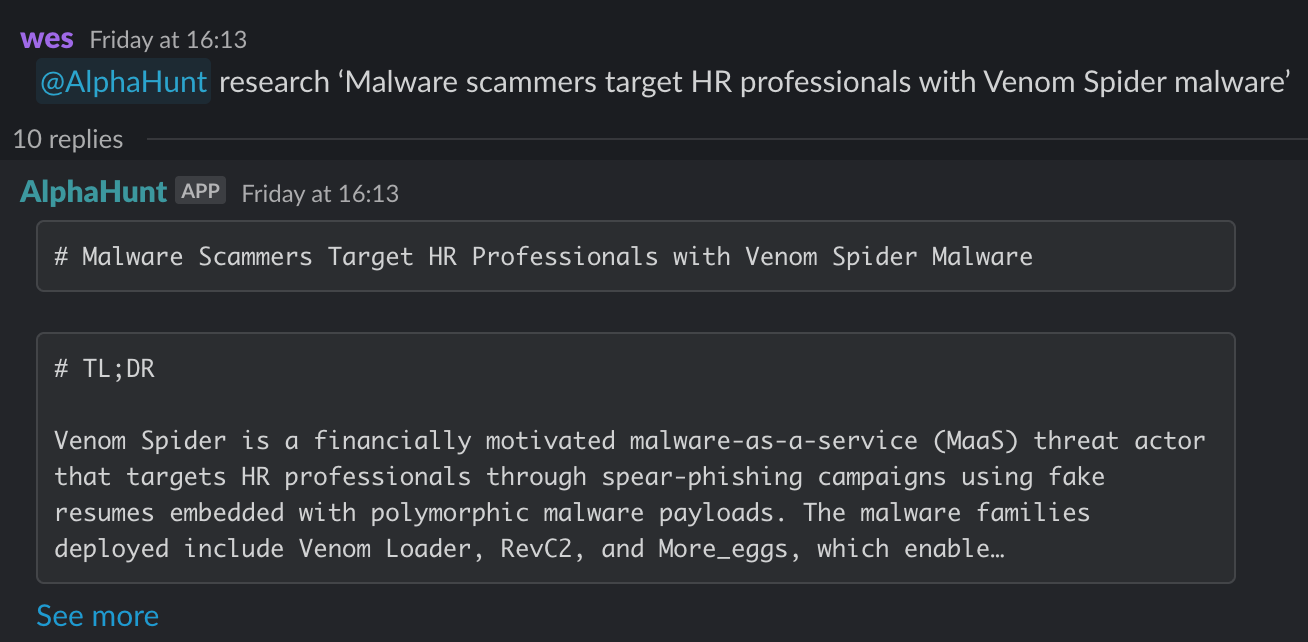
Get questions like this:
- research ‘Malware scammers target HR professionals with Venom Spider malware’
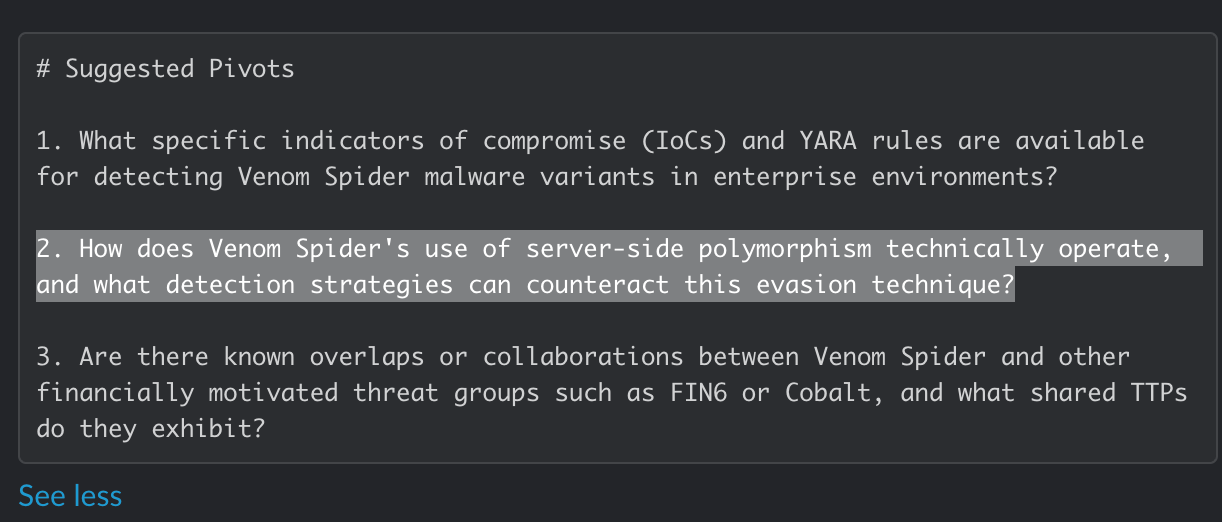
- How does Venom Spider’s use of server-side polymorphism technically operate, and what detection strategies can counteract this evasion technique?
Does it take a chunks out of your day? Would you like help with the research?
This baseline report was thoughtfully researched and took 10 minutes.. It's meant to be a rough draft for you to enhance with the unique insights that make you an invaluable analyst.
We just did the initial grunt work..
Are you ready to level up your skillset? Get Started Here!
Did this help you? Forward it to a friend!
Suggested Pivot
How can Endpoint Detection and Response (EDR) telemetry, including logs of .lnk file executions, living-off-the-land utility usage (e.g., ie4uinit.exe, msxsl.exe), and time-delayed script activity, be analyzed to develop behavioral detection rules specifically tailored to identify Venom Spider’s polymorphic More_eggs malware in HR environments? What recent case studies or incident reports demonstrate successful or failed detection using these methods?
TL;DR
Key Points
-
- Venom Spider (TA4557) is actively targeting HR departments with spear-phishing campaigns delivering polymorphic More_eggs malware via fake resumes.
- HR professionals are high-risk due to operational necessity to open attachments from unknown sources.
-
- The group leverages server-side polymorphism, generating unique malware payloads per victim to evade signature-based and sandbox detection.
- Traditional AV and sandboxing are largely ineffective; behavioral analytics and EDR are required.
-
- Living-off-the-land (LotL) techniques are used, abusing legitimate Windows binaries (ie4uinit.exe, msxsl.exe) for stealthy execution and persistence.
- Detection must focus on anomalous LotL binary usage and .lnk file executions.
-
- Documented breaches in 2024–2025 resulted in theft of credentials, employee records, and sensitive corporate data, with prolonged undetected access.
- Early detection and network segmentation are critical to limit impact.
-
- Multi-layered defense is essential: EDR, Secure Email Gateways, targeted HR security training, network segmentation, and real-time IOC integration.
- Incident response plans must be tailored and regularly rehearsed for polymorphic malware scenarios.
Executive Summary
Venom Spider (TA4557) is a financially motivated cybercriminal group specializing in spear-phishing campaigns against HR professionals, primarily in the U.S., U.K., Canada, Australia, and Germany. Their attacks exploit the HR function’s need to process external attachments, delivering polymorphic More_eggs backdoor malware via fake resumes hosted on actor-controlled sites. Each payload is uniquely generated server-side, employing advanced obfuscation and evasion, including CAPTCHA-protected delivery and living-off-the-land execution using Windows utilities like ie4uinit.exe and msxsl.exe.
The More_eggs backdoor enables credential theft, data exfiltration, command execution, and persistence, with server-side polymorphism rendering traditional signature-based detection ineffective. Documented incidents in 2024–2025 show successful breaches of HR, legal, and financial services organizations, resulting in significant data loss and prolonged attacker presence.
Effective defense requires a multi-layered approach: deploying and tuning EDR for behavioral detection, enhancing email security with SEG and sandboxing, conducting scenario-based HR security training, segmenting HR networks, integrating real-time threat intelligence, and rehearsing incident response. The threat landscape is expected to evolve, with Venom Spider and similar actors likely to adopt AI-driven polymorphism and target less-hardened organizations as defenses improve. Cross-sector intelligence sharing and sector-specific playbooks are recommended to stay ahead of these advanced, evasive campaigns.
Research & Attribution
Origin
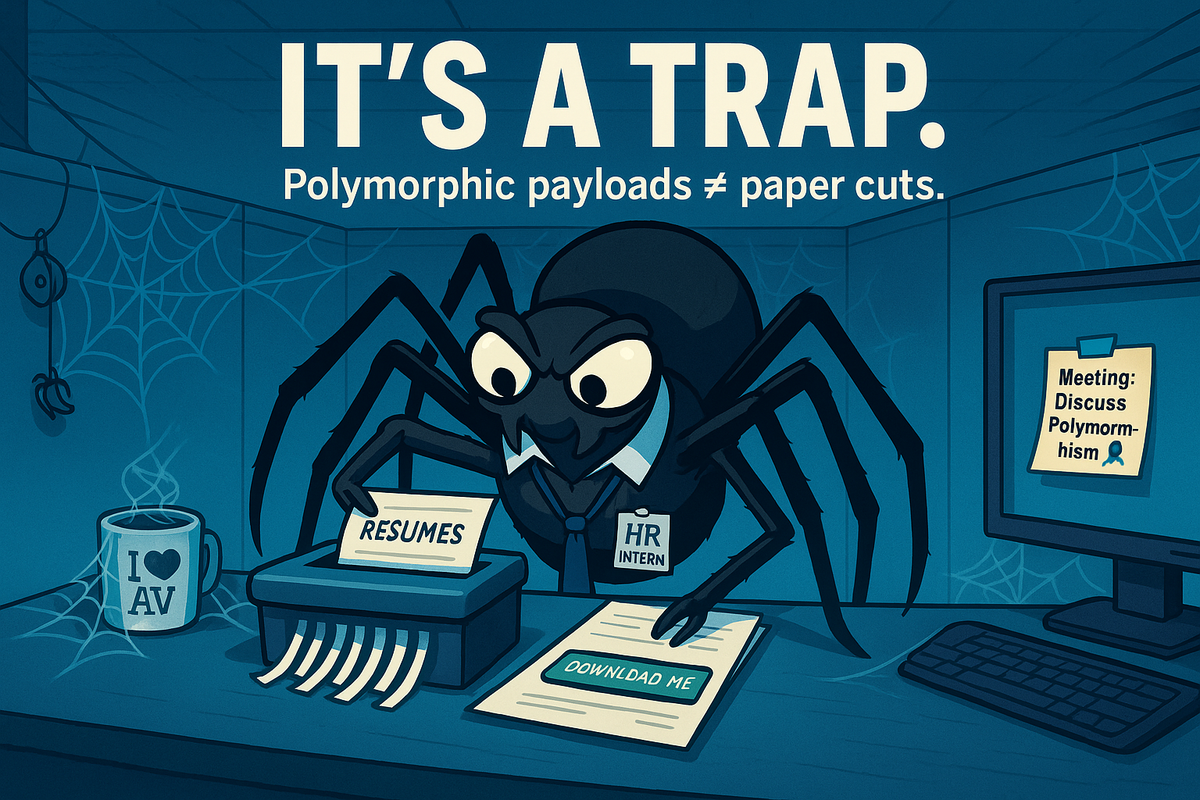
Venom Spider (also known as TA4557) is a financially motivated cybercriminal group that has actively targeted corporate Human Resources (HR) departments and recruiters since at least 2023. Their campaigns use spear-phishing emails containing links to fake resumes hosted on actor-controlled websites. These resumes deliver polymorphic malware payloads, notably the More_eggs backdoor, which is dynamically generated server-side to evade detection. The group abuses legitimate job platforms and messaging services to submit malicious job applications, exploiting the operational necessity of HR professionals to open attachments from unknown sources.
Motivation
Venom Spider’s primary motivation is financial gain through credential theft, data exfiltration, and espionage. By targeting HR professionals, they gain access to sensitive employee data, corporate strategic information, intellectual property, and customer payment data. This information can be monetized or used for further intrusion and lateral movement within victim organizations.
Historical Context
Polymorphic malware has long been used to evade signature-based detection by changing its code with each infection. Venom Spider’s use of server-side polymorphism represents an advanced evolution, where the malware payload is uniquely generated on the attacker’s server for each victim, making detection by traditional antivirus and sandboxing tools extremely difficult. This tactic aligns with a broader trend of cybercriminals exploiting HR departments, which are often less hardened and regularly interact with external contacts, making them ideal initial access points.
Timeline
- October 2023: Venom Spider escalates targeting of HR professionals with spear-phishing campaigns.
- Late 2024: Multiple incidents reported involving polymorphic More_eggs backdoor delivered via fake resumes.
- May 2025:
- Arctic Wolf Labs publishes technical analysis of Venom Spider’s server-side polymorphism and More_eggs malware.
- Tanium and other CTI teams report ongoing campaigns targeting U.S. HR departments and recruiters.
Countries Targeted
- United States – Primary focus on HR professionals in corporate, legal, and financial sectors.
- Canada – Secondary targeting in North America.
- United Kingdom – Targeting financial and professional services sectors.
- Australia – Limited targeting in professional services.
- Germany – Occasional targeting in multinational organizations.
Sectors Targeted
- Human Resources – Direct targeting of HR professionals and recruiters.
- Legal Firms – Targeted for access to sensitive case and personnel information.
- Financial Services – Targeted for access to financial data and employee credentials.
- Healthcare – Targeted for access to patient and staff records.
- Technology – Targeted for intellectual property and employee data.
Links to Other Malware
Venom Spider campaigns are linked to the More_eggs backdoor malware family, which uses server-side polymorphism to generate unique JavaScript payloads and obfuscated executable libraries. The More_eggs backdoor supports credential theft, data exfiltration, command execution, and persistence. The malware uses living-off-the-land techniques by leveraging legitimate Windows utilities such as ie4uinit.exe and msxsl.exe to evade detection.
Similar Malware
Similar polymorphic malware campaigns include those by threat actors such as Luna Moth and StealC V2, which also employ advanced obfuscation, encryption (e.g., RC4), and server-side payload generation to evade detection. These campaigns similarly target professional sectors using spear-phishing and social engineering.
Threat Actors
Venom Spider (TA4557) is a financially motivated cybercriminal group with advanced capabilities in social engineering, malware obfuscation, and server-side polymorphism. They focus on HR and recruitment professionals to gain initial access and maintain persistence within victim networks.
Breaches Involving This Malware
- Multiple documented incidents in 2024–2025 where Venom Spider delivered More_eggs malware via fake job applications to HR departments in U.S. companies, resulting in theft of employee records, credentials, and sensitive corporate data.
- Campaigns have evaded traditional detection due to server-side polymorphism and living-off-the-land techniques, leading to prolonged undetected access.
Explanation of Server-Side Polymorphism in Venom Spider Campaigns
Server-side polymorphism is a technique where the malware payload is dynamically generated and uniquely altered on the attacker’s server each time it is requested or downloaded by a victim. This means every copy of the malware is different in code structure, size, and obfuscation, though functionally identical. For Venom Spider, this technique is used to evade signature-based detection systems and sandbox analysis.
In Venom Spider’s campaigns, the attack begins with a spear-phishing email containing a link to a fake resume hosted on an actor-controlled website. When the victim clicks the link and passes a CAPTCHA (used to bypass automated scanners), a ZIP file is downloaded containing a malicious Windows shortcut (.lnk) file and a decoy image. The .lnk file is uniquely generated for each download with different obfuscation and file size, embodying server-side polymorphism.
When the .lnk file is opened, it executes an obfuscated batch script that launches legitimate Windows utilities (e.g., WordPad as a distraction and ie4uinit.exe to execute commands) to run a polymorphic JavaScript payload called More_eggs_Dropper. This payload generates further polymorphic JavaScript code and executable libraries on the victim’s system, which then establish command-and-control (C2) communications and enable data theft and persistence.
Analogy: Like a chameleon changing its colors to avoid predators, Venom Spider’s malware changes its “appearance” with each delivery, making it difficult for security tools to recognize and block it.
Practical Detection Methodologies
A multi-layered approach is recommended for HR departments and organizations to detect and mitigate Venom Spider’s polymorphic malware campaigns:
-
Behavioral Monitoring and Endpoint Detection:
- Deploy Endpoint Detection and Response (EDR) solutions capable of detecting anomalous behaviors such as unexpected execution of .lnk files, use of living-off-the-land utilities (ie4uinit.exe, msxsl.exe), and unusual network connections.
- Monitor for time-delayed execution patterns and obfuscated script activity.
-
Email Security Enhancements:
- Implement Secure Email Gateway (SEG) solutions configured to block or quarantine risky file types commonly used in these campaigns (.lnk, .vbs, .iso, .zip).
- Use sandboxing with advanced evasion detection to analyze attachments and links dynamically.
- Enable phishing report buttons to empower HR staff to report suspicious emails quickly.
-
User Awareness and Training:
- Conduct regular security awareness training tailored for HR professionals, emphasizing the risks of opening unsolicited attachments and links, especially from unknown job applicants.
- Train staff to inspect file properties before opening and to be wary of password-protected attachments.
-
Network Segmentation and Access Controls:
- Segment HR systems from other critical network segments to limit lateral movement.
- Enforce least privilege access policies on HR workstations.
-
Threat Intelligence and IOC Integration:
- Integrate updated threat intelligence feeds containing Venom Spider’s indicators of compromise (IOCs), including hashes of polymorphic payloads and C2 domains.
- Regularly review logs for signs of communication with known malicious infrastructure.
-
Incident Response Preparedness:
- Develop and rehearse incident response plans specific to phishing and polymorphic malware infections.
- Establish clear workflows for HR and IT teams to handle suspicious emails and potential compromises.
Real-Life Case Studies / Incident Examples
-
Arctic Wolf Labs (May 2025) documented a campaign where Venom Spider targeted U.S.-based corporate HR departments and recruiters. The attack used spear-phishing emails with links to fake resumes hosted on actor-controlled sites requiring CAPTCHA verification. The downloaded ZIP files contained polymorphic .lnk files that executed obfuscated batch scripts leveraging living-off-the-land techniques. The More_eggs backdoor was deployed, capable of stealing credentials, customer payment data, intellectual property, and trade secrets. The campaign used server-side polymorphism to generate unique payloads for each victim, evading signature-based detection. Indicators of compromise (IOCs) and MITRE ATT&CK techniques were published to aid detection and remediation.
-
A U.S. legal firm reported a breach in late 2024 where HR staff received spear-phishing emails with fake resumes containing polymorphic malware. The malware evaded traditional detection and established a persistent backdoor, leading to theft of employee personal data and internal communications. The attack leveraged living-off-the-land utilities and time-delayed execution to avoid sandbox analysis.
-
Trend Micro and other cybersecurity firms reported ongoing campaigns delivering More_eggs malware via fake job applications targeting HR departments in multinational financial services companies. Detection occurred only after unusual outbound network traffic was identified by behavioral analytics tools.
Recommendations, Actions, Suggested Pivots, Forecasts and Next Steps..
(Subscribers Only)
Recommendations, Actions and Next Steps
-
Prioritize deployment and tuning of Endpoint Detection and Response (EDR) solutions to detect behaviors associated with Venom Spider’s polymorphic malware campaigns. Arctic Wolf Labs documented detection of unusual execution of .lnk files and living-off-the-land binaries (ie4uinit.exe, msxsl.exe) in U.S. corporate HR environments, enabling early identification of More_eggs backdoor activity. Behavioral monitoring should include detection of obfuscated script execution and time-delayed payload activation. This step directly addresses the advanced evasion techniques used by the threat actor.
-
Enhance email security by implementing Secure Email Gateway (SEG) solutions configured to block or quarantine risky file types (.lnk, .vbs, .iso, .zip) and deploy sandboxing capable of detecting evasion tactics such as CAPTCHA bypass and server-side polymorphism. A multinational financial services company detected Venom Spider activity only after unusual outbound network traffic was flagged by behavioral analytics integrated with their SEG. Enabling phishing report buttons empowers HR staff to escalate suspicious emails quickly, reducing dwell time.
-
Conduct targeted, scenario-based security awareness training for HR professionals and recruiters, emphasizing the specific threat of spear-phishing with fake resumes. Training should include practical steps such as verifying sender legitimacy, inspecting file properties, and cautious handling of password-protected or obfuscated attachments. The U.S. legal firm breach in late 2024 highlighted the consequences of insufficient awareness, where HR staff opened polymorphic malware-laden attachments, leading to data theft.
-
Implement network segmentation to isolate HR systems from other critical infrastructure and enforce least privilege access controls on HR workstations. This limits lateral movement opportunities for attackers who gain initial access. Organizations that segmented HR networks reported reduced impact and faster containment during Venom Spider incidents.
-
Integrate updated threat intelligence feeds containing Venom Spider’s indicators of compromise (IOCs), including polymorphic payload hashes and C2 domains, into security monitoring tools. Regular log and network traffic reviews for known malicious infrastructure communication enable early detection and response. Tanium’s CTI reports emphasize the importance of IOC integration for ongoing campaign tracking.
-
Develop and regularly rehearse incident response plans tailored to phishing and polymorphic malware infections, ensuring clear coordination between HR and IT teams. Establish workflows for rapid reporting, containment, and remediation of suspected compromises. Arctic Wolf’s case study demonstrated that rehearsed response plans significantly reduced recovery time and data loss in Venom Spider attacks.
MITRE ATT&CK IDs
- T1566 (Phishing) – Recommendations 1, 2, 3, 6
- T1204 (User Execution) and T1204.002 (Malicious File) – Recommendations 1, 2, 3
- T1059 (Command and Scripting Interpreter) and sub-techniques (T1059.001, T1059.005) – Recommendations 1, 6
- T1218 (Signed Binary Proxy Execution) and sub-techniques (T1218.010, T1218.011) – Recommendations 1, 6
- T1071 (Application Layer Protocol) and T1071.001 (Web Protocols) – Recommendations 1, 5
- T1027 (Obfuscated Files or Information) – Recommendations 1, 3
- T1547 (Boot or Logon Autostart Execution) – Recommendations 1, 6
- T1005 (Data from Local System) and T1074 (Data Staged) – Recommendations 4, 5, 6
Suggested Pivots
-
How can Endpoint Detection and Response (EDR) telemetry, including logs of .lnk file executions, living-off-the-land utility usage (e.g., ie4uinit.exe, msxsl.exe), and time-delayed script activity, be analyzed to develop behavioral detection rules specifically tailored to identify Venom Spider’s polymorphic More_eggs malware in HR environments? What recent case studies or incident reports demonstrate successful or failed detection using these methods?
-
What advanced evasion techniques beyond server-side polymorphism and CAPTCHA bypass might Venom Spider or similar threat actors adopt in the near future to circumvent current Secure Email Gateway (SEG) and sandboxing defenses? How can threat hunting teams anticipate and prepare for these evolving tactics?
-
How do regulatory and operational differences across sectors such as healthcare, financial services, and legal firms impact the implementation of detection, network segmentation, and incident response strategies against Venom Spider’s campaigns? What sector-specific challenges and best practices have been documented?
-
What measurable improvements in HR-focused security awareness training programs have been observed when incorporating scenario-based exercises on spear-phishing with polymorphic malware? How can training effectiveness be evaluated and enhanced to reduce successful compromise rates?
-
How can real-time integration and sharing of polymorphic malware indicators of compromise (IOCs), including dynamic payload hashes and C2 domain patterns, be optimized across cross-sector cybersecurity teams to improve early detection and coordinated response to Venom Spider campaigns?
Forecast
Short-Term Forecast (3-6 months)
-
Increased Targeting of HR Departments in North America and Europe
- Venom Spider will escalate spear-phishing campaigns against HR professionals, particularly in the U.S., Canada, the U.K., and Germany, exploiting HR’s need to open attachments from unknown job applicants. The use of server-side polymorphism combined with CAPTCHA-protected fake resume sites will continue to bypass traditional signature-based detection, resulting in a measurable rise in successful intrusions and data breaches.
- Examples:
- Arctic Wolf Labs reported multiple incidents in early 2025 involving U.S. corporate HR departments compromised via polymorphic More_eggs malware.
- A late 2024 breach at a U.S. legal firm led to theft of employee records and internal communications after HR staff opened polymorphic malware-laden attachments.
- What to watch for: Increased phishing attempts with suspicious resume attachments and unusual .lnk file executions in HR environments.
- This forecast is ranked highest due to the direct impact on sensitive employee and corporate data and the demonstrated persistence of the group.
-
Refinement and Expansion of Living-Off-The-Land (LotL) Techniques
- Venom Spider will enhance its abuse of legitimate Windows utilities such as ie4uinit.exe and msxsl.exe to execute polymorphic payloads stealthily. This will complicate detection by endpoint security tools that rely on signature or heuristic detection, necessitating behavioral analytics focused on LotL binary usage patterns.
- Examples:
- The May 2025 Arctic Wolf report details the use of these binaries in executing polymorphic JavaScript payloads.
- Similar LotL abuse has been observed in Luna Moth campaigns, indicating a trend among advanced polymorphic malware operators.
- What to watch for: Anomalous execution of these binaries, especially when triggered by .lnk files or batch scripts.
- This forecast is ranked second due to its direct challenge to existing endpoint detection capabilities.
-
Accelerated Deployment of Multi-Layered Email Security and Targeted HR Training
- Organizations in targeted sectors (legal, financial, healthcare) will increase adoption of Secure Email Gateways (SEGs) with sandboxing capable of detecting evasion tactics like CAPTCHA bypass and server-side polymorphism. Concurrently, scenario-based security awareness training tailored for HR professionals will become more widespread to reduce successful user execution of polymorphic malware.
- Examples:
- The U.S. legal firm breach in late 2024 highlighted the consequences of insufficient awareness.
- Arctic Wolf and Tanium recommend enabling phishing report buttons and sandboxing to reduce dwell time.
- What to watch for: Upticks in phishing report submissions from HR staff and deployment of SEG sandboxing with evasion detection capabilities.
- This forecast is ranked third as it reflects defensive adaptation but depends on organizational readiness.
-
Development of Sector-Specific Incident Response and Network Segmentation Strategies
- Tailored incident response playbooks and network segmentation strategies isolating HR systems will be developed and rehearsed, especially in healthcare and financial services, to limit lateral movement and contain polymorphic malware infections.
- Examples:
- Organizations that segmented HR networks during Venom Spider incidents reported faster containment and reduced impact.
- Sector-specific regulatory requirements will drive customized response plans.
- What to watch for: Implementation of HR network segmentation and rehearsed phishing incident response exercises.
- This forecast is ranked fourth due to its importance in impact reduction but slower adoption cycle.
-
Enhanced Sharing and Real-Time Integration of Polymorphic Malware IOCs
- Cross-sector cybersecurity teams will improve real-time sharing of dynamic payload hashes and C2 domain patterns related to Venom Spider campaigns, enabling earlier detection and coordinated response.
- Examples:
- Tanium’s CTI reports emphasize the importance of IOC integration for ongoing campaign tracking.
- Emerging threat intelligence sharing platforms are piloting polymorphic malware IOC dissemination.
- What to watch for: Increased participation in threat intelligence sharing groups focused on polymorphic malware.
- This forecast is ranked fifth due to dependency on inter-organizational cooperation and infrastructure.
Long-Term Forecast (12-24 months)
-
Evolution of Server-Side Polymorphism with AI-Driven Code Mutation and Advanced Evasion
- Venom Spider and similar actors will adopt AI-driven code mutation techniques to generate polymorphic payloads that adapt dynamically to sandbox environments, employing environment-aware delivery and multi-stage obfuscation to defeat detection. Early signs of AI-assisted malware mutation have been reported by security vendors in pilot studies.
- Examples:
- Security research from 2024-2025 indicates emerging use of AI to generate polymorphic malware variants.
- StealC V2 campaigns have shown incremental sophistication in obfuscation and sandbox evasion.
- What to watch for: Malware samples exhibiting rapid, AI-driven polymorphic changes and environment-aware behaviors.
- This forecast is ranked highest due to its potential to significantly degrade detection efficacy and increase attack success.
-
Shift in Targeting Toward Smaller, Less Hardened Organizations
- As larger enterprises improve defenses, Venom Spider will increasingly target smaller companies in professional services and technology sectors, exploiting weaker email security and endpoint protections, where HR functions remain vulnerable.
- Examples:
- Historical ransomware trends show adversaries shifting to smaller targets as large organizations harden.
- The universal operational necessity of HR functions makes this a persistent attack vector.
- What to watch for: Increased phishing campaigns targeting small and medium-sized enterprises (SMEs) with polymorphic payloads.
- This forecast is ranked second due to adversary adaptation to defensive improvements.
-
Integration of Behavioral Analytics and AI-Powered Detection in Endpoint Security
- Endpoint Detection and Response (EDR) solutions will increasingly incorporate AI and behavioral analytics to detect anomalous execution of living-off-the-land binaries and polymorphic script activity, improving detection of threats like More_eggs.
- Examples:
- Financial services firms have successfully detected Venom Spider activity through behavioral analytics.
- Industry-wide trend toward AI-enhanced endpoint security is accelerating.
- What to watch for: Deployment of AI-powered EDR solutions with LotL anomaly detection capabilities.
- This forecast is ranked third as it represents a key defensive evolution.
-
Regulatory and Compliance Pressures Driving Enhanced HR Security Posture
- Regulatory bodies will impose stricter cybersecurity requirements on HR data handling and phishing defenses, mandating multi-factor authentication, network segmentation, and incident reporting, especially in healthcare and finance sectors.
- Examples:
- Increasing data privacy regulations and breach notification laws are expanding to cover HR systems.
- Sector-specific compliance frameworks are evolving to address phishing and malware risks.
- What to watch for: New or updated regulations targeting HR cybersecurity controls.
- This forecast is ranked fourth due to its influence on organizational security postures.
-
Proliferation of Polymorphic Malware Tactics Among Other Cybercriminal Groups
- Other financially motivated groups will adopt Venom Spider’s server-side polymorphism and living-off-the-land techniques, leading to a broader proliferation of polymorphic malware campaigns targeting HR and professional sectors.
- Examples:
- Luna Moth and StealC V2 campaigns already share similar tactics.
- Historical patterns show rapid TTP adoption across cybercriminal groups.
- What to watch for: Emergence of new threat actors employing polymorphic malware with similar delivery methods.
- This forecast is ranked fifth but important for anticipating future threat landscape shifts.
MITRE ATT&CK IDs
T1566, T1204, T1204.002, T1059, T1059.001, T1059.005, T1218, T1218.010, T1218.011, T1071, T1071.001, T1027, T1027.014, T1547, T1005
Appendix
References
- (2025-05-02) - Venom Spider Uses Server-Side Polymorphism to Weave a Web Around Victims – Arctic Wolf
- (2025-05-14) - CTI Roundup: Luna Moth, Venom Spider, StealC V2 – Tanium
- (2024-10) - Fake Job Applications Deliver Dangerous More_eggs Malware to HR Professionals – The Hacker News
- (2025-05-15) - HR Under Attack: Sophisticated Malware Campaign Targets Recruiters – UNU C3 Blog
- (2025-05-05) - Fake resumes targeting HR managers now come with updated backdoor – CSO Online
- (2025-05-05) - Hackers Target HR Departments With Fake Resumes to Spread More_eggs Malware – GBHackers News
AlphaHunt
(Have feedback? Did something resonate with you? Did something annoy you? Just hit reply! :))
Get questions like this:
- research ‘Malware scammers target HR professionals with Venom Spider malware’
- How does Venom Spider’s use of server-side polymorphism technically operate, and what detection strategies can counteract this evasion technique?
Does it take a chunks out of your day? Would you like help with the research?
This baseline report was thoughtfully researched and took 10 minutes.. It's meant to be a rough draft for you to enhance with the unique insights that make you an invaluable analyst.
We just did the initial grunt work..
Are you ready to level up your skillset? Get Started Here!
Did this help you? Forward it to a friend!
(c) 2025 CSIRT Gadgets, LLC
License - CC BY-SA 4.0
MITRE ATT&CK
Techniques
-
T1566 (Phishing): Venom Spider initiates attacks via spear-phishing emails containing links to fake resumes that deliver polymorphic malware payloads. This is the primary initial access vector targeting HR professionals.
- Central to the campaign's delivery method and social engineering approach.
-
T1204 (User Execution) and T1204.002 (Malicious File): Execution of malicious .lnk files by users triggers the polymorphic payloads.
- The attack depends on victim interaction to execute the payload.
-
T1059 (Command and Scripting Interpreter) with sub-techniques T1059.001 (PowerShell) and T1059.005 (Visual Basic): The polymorphic JavaScript payloads and obfuscated batch scripts execute commands on the victim system.
- Obfuscated scripting is used for payload execution and evasion.
-
T1218 (Signed Binary Proxy Execution) with sub-techniques T1218.010 (Msxsl.exe) and T1218.011 (Ie4uinit.exe): The malware abuses legitimate Windows utilities to execute malicious code, evading detection.
- Enables stealthy execution and living-off-the-land tactics.
-
T1071 (Application Layer Protocol) and T1071.001 (Web Protocols): More_eggs backdoor uses web protocols for command-and-control communications.
- Maintains control over compromised systems.
-
T1027 (Obfuscated Files or Information) and T1027.014 (Polymorphic Code): Server-side polymorphism dynamically generates unique payloads to evade signature-based detection.
- Core evasion technique used by Venom Spider.
-
T1547 (Boot or Logon Autostart Execution): Establishes persistence on infected hosts.
- Ensures long-term access.
-
T1005 (Data from Local System) and T1074 (Data Staged): Collects and stages sensitive data such as credentials and corporate information for exfiltration.
- Aligns with the group’s financial and espionage motivations.
Tactics
-
TA0001 (Initial Access): Spear-phishing emails with malicious attachments or links.
- The entry point for Venom Spider campaigns.
-
TA0002 (Execution): Execution of polymorphic payloads via user interaction and living-off-the-land binaries.
- Critical for payload activation.
-
TA0003 (Persistence): Use of autostart mechanisms to maintain access.
- Ensures continued presence on victim systems.
-
TA0010 (Exfiltration): Theft and exfiltration of sensitive data.
- The primary goal of the group.
-
TA0011 (Command and Control): Use of web protocols for C2 communication.
- Enables remote control of infected hosts.
Procedures
-
Venom Spider’s attack chain begins with spear-phishing emails containing links to fake resumes hosted on actor-controlled websites. These sites require CAPTCHA verification to evade automated scanning. Upon download, a ZIP file contains a uniquely generated polymorphic .lnk file and a decoy image.
-
Opening the .lnk file executes an obfuscated batch script that launches legitimate Windows utilities such as WordPad (as a distraction), ie4uinit.exe, and msxsl.exe to execute polymorphic JavaScript payloads (More_eggs_Dropper). This living-off-the-land approach helps evade detection.
-
The More_eggs backdoor dynamically generates polymorphic JavaScript and executable libraries on the victim system, establishing C2 communications, stealing credentials, staging data, and maintaining persistence via autostart mechanisms.
-
Server-side polymorphism is implemented by dynamically generating unique payloads on the attacker’s server for each victim, altering code structure and obfuscation to evade signature-based detection and sandbox analysis.
Software
-
S1067 (More_eggs): Polymorphic backdoor malware family used by Venom Spider, capable of credential theft, data exfiltration, command execution, and persistence.
- Central malware in the campaigns.
-
Living-off-the-land binaries:
- Msxsl.exe: Used for proxy execution of malicious scripts.
- Ie4uinit.exe: Used to execute commands stealthily.
Mitigations
-
M1017 (User Training): Targeted training for HR professionals to recognize spear-phishing and suspicious attachments.
- Essential to reduce successful user execution.
-
M1038 (Execution Prevention): Blocking or restricting execution of risky file types such as .lnk files.
- Prevents initial payload execution.
-
M1021 (Restrict Web-Based Content): Limiting access to malicious websites hosting polymorphic payloads.
- Disrupts payload delivery.
-
M1027 (Application Control): Whitelisting and restricting use of living-off-the-land binaries.
- Prevents abuse of legitimate utilities.
-
M1031 (Network Intrusion Prevention): Monitoring and blocking suspicious outbound C2 traffic.
- Detects and disrupts command and control.
![[DEEP RESEARCH] Who Owns the Cold Chain When the Controller Goes Online?](https://storage.ghost.io/c/06/e5/06e5730b-7d78-4713-9cec-6cba31d297f5/content/images/size/w600/2026/10/alphahunt-deep-research-who-owns-the-cold-chain-when-the-controller-goes-online-hero-2026-10-19.png)
![[SIGNALS WEEKLY] Edge Brokers, Ephemeral Supply Chains, and Control-Plane Pivots](https://storage.ghost.io/c/06/e5/06e5730b-7d78-4713-9cec-6cba31d297f5/content/images/size/w600/2026/10/alphahunt-signals-weekly-edge-brokers-ephemeral-supply-chains-and-control-plane-pivots-hero-2026-10-20.png)
![[DEEP RESEARCH] Silent Lynx and the Intelligence Value of Water](https://storage.ghost.io/c/06/e5/06e5730b-7d78-4713-9cec-6cba31d297f5/content/images/size/w600/2026/10/alphahunt-deep-research-silent-lynx-and-the-intelligence-value-of-water-hero-2026-10-16.png)
![[GAME THEORY] The Contractor Is Becoming the Intrusion Supply Chain](https://storage.ghost.io/c/06/e5/06e5730b-7d78-4713-9cec-6cba31d297f5/content/images/size/w600/2026/10/alphahunt-game-theory-the-contractor-is-becoming-the-intrusion-supply-chain-hero-2026-10-12.png)