
TheWizards APT: IPv6 SLAAC Spoofing, Spellbinder Malware, and Advanced Lateral Movement in Asia and the Middle East
TheWizards is a China-aligned APT group, active since at least 2022, specializing in espionage and influence operations across Asia and the Middle East. Their hallmark is the use of IPv6 SLAAC spoofing to hijack legitimate software update mechanisms—most notably Tencent QQ..

(Have feedback? Did something resonate with you? Did something annoy you? Just hit reply! :))
Get questions from your boss, like this:
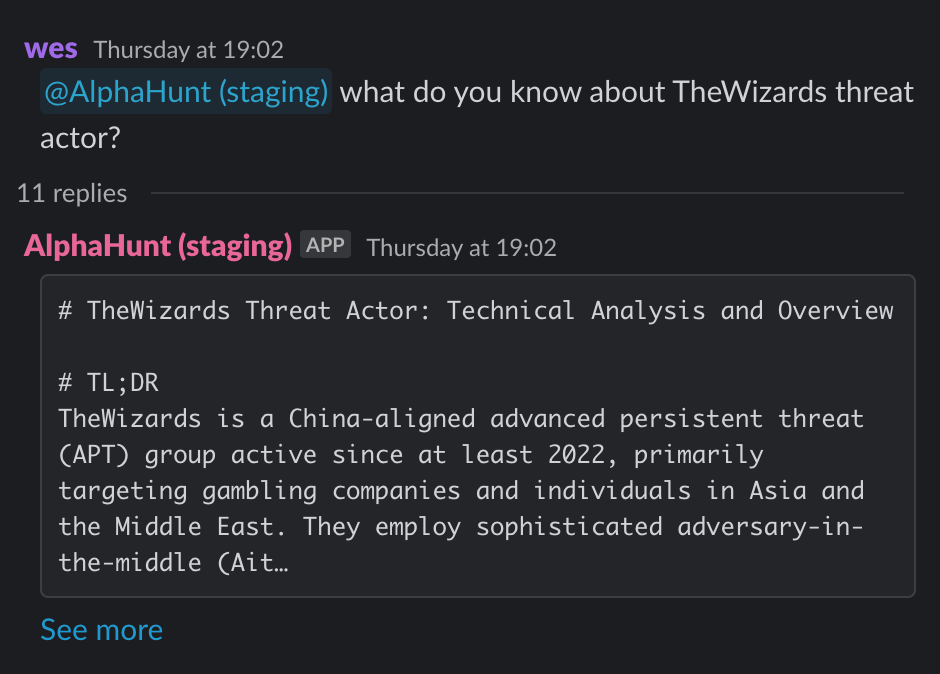
- what do you know about TheWizards threat actor?
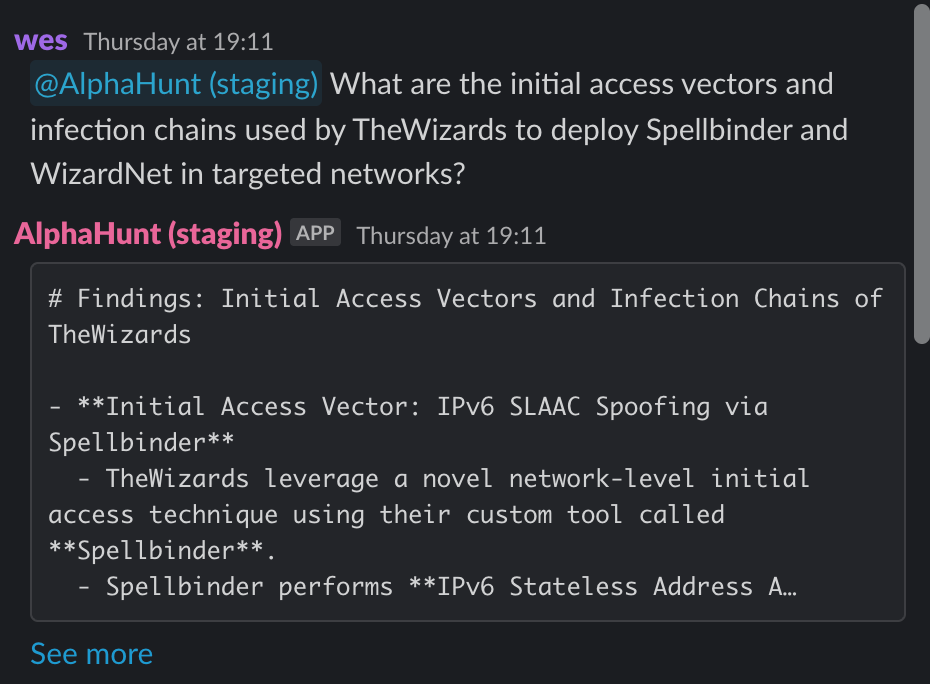
- What are the initial access vectors and infection chains used by TheWizards to deploy Spellbinder and WizardNet in targeted networks?
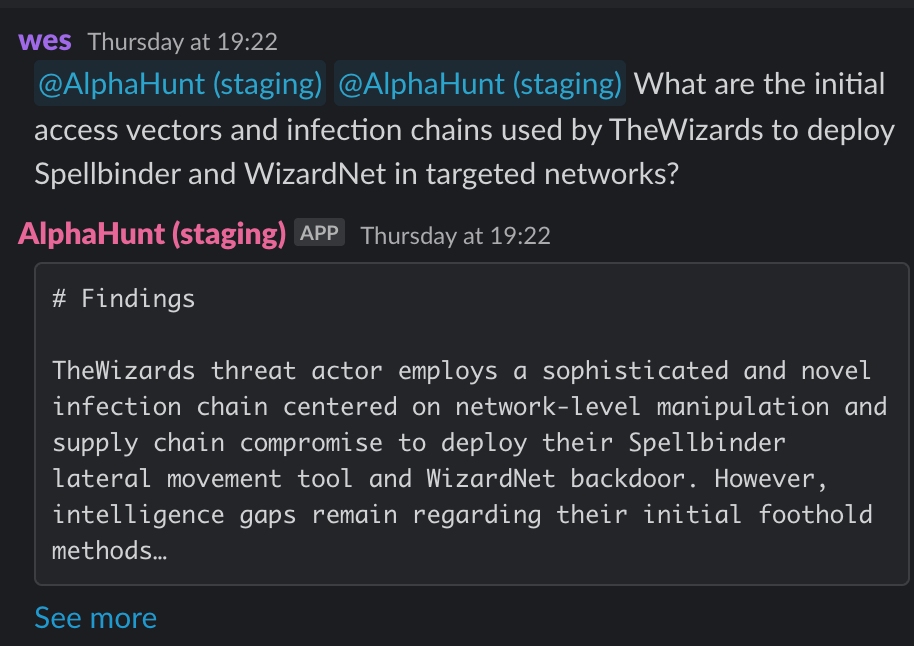
- What are the initial access vectors and infection chains used by TheWizards to deploy Spellbinder and WizardNet in targeted networks?
Are you ready to level up your skillset? Get Started Here!
Suggested Pivot
What specific supply chain attack vectors does TheWizards exploit to deploy Spellbinder, such as compromised update servers or third-party software dependencies, and what telemetry or indicators (e.g., network, endpoint, registry) are most effective for early detection and mitigation?
TL;DR
Key Points
-
- TheWizards, a China-aligned APT, leverages IPv6 SLAAC spoofing for adversary-in-the-middle (AitM) attacks, hijacking software update mechanisms (notably Tencent QQ) to deploy custom malware.
- Immediate deployment of IPv6 SLAAC spoofing detection and cryptographic validation of update channels is critical.
-
- Spellbinder and WizardNet, modular malware tools, enable persistent access, process injection, encrypted C2, and stealthy lateral movement.
- Endpoint detection, registry monitoring, and threat hunting for obfuscated .NET modules and process injection are high-priority defenses.
-
- TheWizards’ TTPs include process injection (APC), registry modification, polymorphic code, and encrypted communications, mapped to MITRE ATT&CK techniques T1659, T1055, T1112, T1027, T1105, T1573.001, T1082, T1583.001/.004, T1587.001.
- SOCs should implement Sigma rules for IPv6 SLAAC, suspicious .NET module execution, and APC-based process injection.
-
- The group’s operations target gambling, individuals, and other sectors in the Philippines, Cambodia, UAE, mainland China, and Hong Kong, with potential for global supply chain and cloud/mobile expansion.
- Supply chain and cloud security teams must anticipate future targeting and harden defenses accordingly.
-
- No major public breaches are attributed yet, but recent technical disclosures (April–May 2025) highlight the sophistication and evolving threat.
- Continuous threat intelligence integration and cross-industry sharing are essential for early warning and defense.
Executive Summary
TheWizards is a China-aligned APT group, active since at least 2022, specializing in espionage and influence operations across Asia and the Middle East. Their hallmark is the use of IPv6 SLAAC spoofing to hijack legitimate software update mechanisms—most notably Tencent QQ—enabling adversary-in-the-middle attacks that deliver custom malware (Spellbinder and WizardNet). Spellbinder exploits network packet manipulation and process injection, while WizardNet provides modular, encrypted backdoor capabilities for remote command execution, data exfiltration, and lateral movement.
The group’s TTPs include advanced evasion (polymorphic code, dynamic API resolution), process injection (APC), registry modification for persistence, and encrypted C2 channels. Their infrastructure leverages acquired domains and servers, with a focus on stealth and modularity. Technical detection is supported by Sigma rules targeting IPv6 SLAAC spoofing, suspicious .NET module execution, and process injection events.
Defensive recommendations include immediate deployment of IPv6 SLAAC spoofing detection (e.g., Suricata, Zeek), cryptographic validation of software updates, EDR tuning for process injection and obfuscated code, registry monitoring, and proactive threat hunting for lateral movement and encrypted communications. Threat intelligence teams should maintain updated feeds on TheWizards and related groups, while supply chain and cloud security teams must prepare for likely expansion into new sectors and platforms.
Short-term forecasts predict rapid adoption of IPv6-specific defenses and hardening of update mechanisms, while long-term trends suggest multi-platform malware evolution, sectoral/geographic expansion, and regulatory focus on supply chain security. TheWizards’ novel techniques are likely to be emulated by other APTs, underscoring the need for continuous monitoring, intelligence sharing, and adaptive defense strategies.
Attribution
Links and Similarity
Earth Minotaur:
- Shares some malware families (DarkNights/DarkNimbus) with TheWizards but operates with different infrastructure and targets.
- Similar malware usage and China alignment but different operational focus.
Historical Context
TheWizards is a China-aligned advanced persistent threat (APT) group first identified by ESET in 2022. The group has been active since at least that year, focusing on espionage and influence operations primarily in Asia and the Middle East. Their campaigns target individuals, gambling companies, and other entities in countries such as the Philippines, Cambodia, UAE, mainland China, and Hong Kong. TheWizards are distinguished by their use of sophisticated malware tools and novel lateral movement techniques, including IPv6 SLAAC spoofing to hijack legitimate software update mechanisms.
Timeline
- 2022: Emergence of TheWizards as a distinct APT group.
- 2022–2025: Ongoing operations targeting Asia and Middle East sectors.
- April 2025: Public disclosure and detailed technical analysis of TheWizards' malware tools Spellbinder and WizardNet by ESET and other cybersecurity researchers.
Origin
TheWizards are attributed to a China-aligned threat actor group with links to Sichuan Dianke Network Security Technology (UPSEC), a Chinese company supplying malware used in their campaigns. This connection suggests a commercial and state-aligned nexus supporting their operations.
Countries Targeted
- Philippines – Focus on individuals and gambling companies.
- Cambodia – Similar targeting as the Philippines.
- United Arab Emirates (UAE) – Middle Eastern targets.
- Mainland China – Internal espionage and control.
- Hong Kong – Regional targeting consistent with other Asian operations.
Sectors Targeted
- Gambling Companies – Primary sector targeted for espionage and financial intelligence.
- Individuals – Likely for intelligence gathering.
- Other Entities – Various sectors within targeted countries, possibly including government and private sectors.
Motivation
TheWizards are motivated by regional espionage and influence aligned with Chinese strategic interests. Their targeting suggests a blend of intelligence gathering and financial motives, with a focus on long-term access and control.
Attack Types
- Adversary-in-the-middle (AitM) attacks via IPv6 SLAAC spoofing.
- Hijacking of legitimate software update mechanisms.
- Deployment of modular backdoors and lateral movement tools.
- Use of process injection, obfuscation, and encrypted communication.
Technical Analysis
Malware: Spellbinder
Infection Chain
- Initial infection vectors are not fully disclosed but likely involve spear-phishing or supply chain compromise.
- Spellbinder is deployed as a ZIP archive containing executables, a .dat file, and a DLL.
- Upon execution, Spellbinder uses the WinPcap library to capture and manipulate network packets.
- It exploits IPv6 SLAAC spoofing to hijack Tencent QQ's software update process, redirecting update requests to attacker-controlled servers.
Persistence Mechanisms
- Spellbinder maintains persistence by hijacking legitimate software update channels, ensuring repeated execution during update cycles.
- It modifies registry keys to maintain execution and evade removal.
- The modular WizardNet backdoor is deployed via the hijacked update process, establishing long-term access.
Evasion Techniques
- Uses polymorphic code and dynamic API resolution to evade signature-based detection.
- Employs process injection, including asynchronous procedure calls, to hide malicious activity within legitimate processes.
- Obfuscates payloads and communications using encryption and non-standard protocols.
- Execution guardrails prevent detection by avoiding execution in sandbox or analysis environments.
Malware: WizardNet
Capabilities
- Modular .NET backdoor capable of executing various payloads.
- Supports remote command execution, data exfiltration, and lateral movement.
- Uses encrypted communication channels with symmetric cryptography.
- Employs process injection and registry modifications for stealth and persistence.
Deployment
- Delivered via Spellbinder's hijacked software update mechanism.
- Executes .NET modules dynamically, allowing flexible payload delivery.
Infrastructure
- Command and Control (C2) servers operate domains and servers acquired for malware deployment and control.
- Uses encrypted channels and non-application layer protocols for covert communication.
- Infrastructure supports modular malware delivery and lateral movement.
Tactics, Techniques, and Procedures (TTPs)
Prioritized MITRE ATT&CK techniques used by TheWizards include:
- T1583.001 Acquire Infrastructure: Domains
- T1583.004 Acquire Infrastructure: Servers
- T1587.001 Develop Capabilities: Malware
- T1659 Content Injection (used by Spellbinder)
- T1055 Process Injection (including asynchronous procedure calls)
- T1112 Modify Registry
- T1027 Obfuscated Files or Information (dynamic API resolution, embedded payloads, polymorphic code)
- T1082 System Information Discovery
- T1105 Ingress Tool Transfer
- T1573.001 Encrypted Channel: Symmetric Cryptography
Sigma-Format Detection Rules (Pseudocode Examples)
Rule 1: Detect IPv6 SLAAC Spoofing Activity
title: Detect IPv6 SLAAC Spoofing Attempts
id: 12345678-90ab-cdef-1234-567890abcdef
description: Detects suspicious IPv6 SLAAC traffic indicative of spoofing used by Spellbinder.
status: experimental
logsource:
  product: network
detection:
  selection:
    NetworkProtocol: ICMPv6
    ICMPv6Type: 134  # Router Advertisement
    SourceIPv6Address: suspicious or unexpected addresses
  condition: selection
fields:
  - SourceIPv6Address
level: high
Rule 2: Detect Execution of Suspicious .NET Modules
title: Detect Suspicious .NET Module Execution
id: 23456789-0abc-def1-2345-67890abcdef1
description: Detects execution of .NET modules associated with WizardNet backdoor.
status: experimental
logsource:
  product: windows
  service: sysmon
detection:
  selection:
    Image: '*\rundll32[.]exe'
    CommandLine|contains: '.dat'
  condition: selection
fields:
  - Image
  - CommandLine
level: high
Rule 3: Detect Process Injection via Asynchronous Procedure Calls
title: Detect Process Injection via APC
id: 34567890-abcd-ef12-3456-7890abcdef12
description: Detects process injection using asynchronous procedure calls, a technique used by TheWizards.
status: experimental
logsource:
  product: windows
  service: sysmon
detection:
  selection:
    EventID: 8  # CreateRemoteThread or similar
    Details|contains: 'APC'
  condition: selection
fields:
  - EventID
  - Details
level: high
Recommendations, Actions, Suggested Pivots, Forecasts and Next Steps..
(Subscribers Only)
Recommendations, Actions and Next Steps
Recommendations
-
Network Security Team: Immediately deploy IPv6 SLAAC spoofing detection using network monitoring tools such as Suricata or Zeek. Implement the provided Sigma detection rule for ICMPv6 Router Advertisement anomalies to identify TheWizards' adversary-in-the-middle (AitM) attacks. This action is critical for early detection and mitigation of lateral movement attempts (MITRE ATT&CK T1659).
-
Software Development and Patch Management Teams: Enforce cryptographic validation of all software update mechanisms, especially for high-risk applications like Tencent QQ. Implement code signing verification and integrity checks on update packages to prevent hijacking by malware such as Spellbinder. This reduces the attack surface exploited by TheWizards (MITRE ATT&CK T1105).
-
Endpoint Security and SOC Teams: Deploy and fine-tune endpoint detection and response (EDR) solutions such as Microsoft Defender for Endpoint or CrowdStrike Falcon to detect advanced evasion techniques, including process injection (especially asynchronous procedure calls), polymorphic code, and suspicious .NET module execution. Use Sysmon for detailed endpoint logging and implement detection rules similar to the provided Sigma rules for process injection and suspicious rundll32[.]exe executions. This is a high-priority, ongoing action to improve detection capabilities (MITRE ATT&CK T1055, T1027).
-
SOC and Incident Response Teams: Establish continuous monitoring and alerting for registry modifications associated with persistence mechanisms, focusing on keys commonly targeted by TheWizards malware. Use tools like Sysmon and Windows Event Forwarding to capture and analyze registry changes. This supports early detection of persistence attempts (MITRE ATT&CK T1112).
-
Threat Hunting and Intelligence Teams: Conduct proactive threat hunting focused on lateral movement behaviors, encrypted communication channels using symmetric cryptography, and non-standard protocol usage. Leverage network traffic analysis tools and decrypt traffic where possible to identify WizardNet backdoor activity. This enhances visibility into stealthy attacker behaviors (MITRE ATT&CK T1573[.]001, T1082).
-
Threat Intelligence and Security Leadership: Maintain and integrate updated threat intelligence feeds on TheWizards and related China-aligned APT groups. Use platforms like MISP or commercial threat intelligence services to stay informed of evolving TTPs, infrastructure changes, and emerging malware variants. This supports informed defense planning.
-
Supply Chain and Cloud Security Teams: Prepare for potential expansion of TheWizards' targeting beyond Asia and the Middle East by reviewing supply chain security and cloud/mobile platform defenses. Implement enhanced vendor risk management and cloud security posture management tools. This anticipates future operational shifts by the threat actor.
MITRE ATT&CK IDs and Mapping to Recommendations
- T1659 (Content Injection): Recommendation 1
- T1105 (Ingress Tool Transfer): Recommendation 2
- T1055 (Process Injection): Recommendation 3
- T1027 (Obfuscated Files or Information): Recommendation 3
- T1112 (Modify Registry): Recommendation 4
- T1573.001 (Encrypted Channel: Symmetric Cryptography): Recommendation 5
- T1082 (System Information Discovery): Recommendation 5
- T1583.001, T1583.004 (Acquire Infrastructure: Domains, Servers): Recommendation 6
- T1587.001 (Develop Capabilities: Malware): Recommendation 6
Followup Research
Suggested Pivots
-
What specific supply chain attack vectors does TheWizards exploit to deploy Spellbinder, such as compromised update servers or third-party software dependencies, and what telemetry or indicators (e.g., network, endpoint, registry) are most effective for early detection and mitigation?
Rationale: Understanding precise infection vectors and detection signals enables technical teams to prioritize defenses and reduce initial compromise risk. -
How can network defense strategies be enhanced to detect and mitigate TheWizards' novel IPv6 SLAAC spoofing adversary-in-the-middle attacks, and what are the best practices for monitoring and alerting on anomalous ICMPv6 Router Advertisement traffic?
Rationale: Given the sophistication and stealth of this lateral movement technique, immediate operational focus on network monitoring can prevent attacker persistence and spread. -
What are the security implications and preparedness gaps for organizations in supply chain, cloud, and mobile environments in light of TheWizards' potential expansion into these sectors, and how should risk management and incident response frameworks evolve accordingly?
Rationale: Anticipating future targeting trends allows proactive hardening of emerging attack surfaces before exploitation occurs. -
How can endpoint detection and response (EDR) tools be optimized to identify and disrupt the modular, dynamic execution of WizardNet backdoor payloads, especially considering their use of encrypted communication, process injection (including asynchronous procedure calls), and obfuscation techniques?
Rationale: Enhancing detection of stealthy malware behaviors is critical for timely incident response and containment. -
What operational and infrastructural overlaps exist between TheWizards and related China-aligned APT groups like Earth Minotaur, and how can these insights improve attribution accuracy and collaborative threat intelligence sharing?
Rationale: Clarifying relationships between threat actors supports more precise targeting of defensive resources and strategic intelligence efforts.
Forecast
Short-Term Forecast (3-6 months)
-
Expansion and Operationalization of IPv6 SLAAC Spoofing Detection
- Network security teams will rapidly adopt detection mechanisms for IPv6 SLAAC spoofing, focusing on anomalies in ICMPv6 Router Advertisement traffic. This will include deploying Sigma rules and leveraging network monitoring tools such as Suricata and Zeek to identify TheWizards’ adversary-in-the-middle (AitM) lateral movement attempts.
- What to watch for: Increased alerts on unusual IPv6 Router Advertisement packets, unexpected source IPv6 addresses, and suspicious SLAAC traffic patterns.
- Example: Organizations in Asia and the Middle East, particularly in gambling and software sectors, will prioritize monitoring IPv6 traffic to detect early signs of TheWizards’ activity, reducing attacker dwell time.
-
Immediate Hardening of Software Update Mechanisms
- Software development and patch management teams will enforce cryptographic validation and code signing of software updates, especially for high-risk applications like Tencent QQ, to prevent hijacking by malware such as Spellbinder.
- What to watch for: Implementation of strict code signing policies, integrity verification of update packages, and audits of third-party update servers.
- Example: Lessons from SolarWinds and other supply chain attacks will drive organizations to scrutinize update channels, reducing the risk of TheWizards’ hijacked update exploits.
-
Enhanced Endpoint Detection and Response (EDR) Focused on Process Injection and Obfuscation
- Endpoint security teams will deploy and fine-tune EDR solutions to detect TheWizards’ advanced evasion techniques, including asynchronous procedure call (APC) process injection, polymorphic code, and obfuscated .NET module execution.
- What to watch for: Telemetry from Sysmon logs capturing suspicious rundll32.exe executions, registry modifications, and process injection events flagged by custom detection rules.
- Example: Targeted threat hunting campaigns will focus on identifying encrypted C2 communications and lateral movement behaviors consistent with WizardNet backdoor activity.
-
Proactive Threat Hunting for Lateral Movement and Encrypted Communications
- SOC teams will intensify threat hunting to detect lateral movement and encrypted communication channels used by WizardNet, leveraging network traffic analysis and decryption where possible.
- What to watch for: Non-standard protocol usage, symmetric cryptography patterns, and unusual registry changes indicative of persistence.
- Example: Early identification of lateral movement will enable containment before widespread compromise.
-
Integration and Sharing of TheWizards TTPs in Threat Intelligence Platforms
- Threat intelligence teams will integrate updated TTPs and IOCs related to TheWizards into organizational defenses and share findings with industry peers to enhance collective defense.
- What to watch for: Updates in MISP feeds, commercial threat intelligence platforms, and regional CERT advisories.
- Example: Collaborative intelligence sharing will improve detection accuracy and reduce false positives.
Long-Term Forecast (12-24 months)
-
Geographic and Sectoral Expansion Including Supply Chain, Cloud, and Mobile Platforms
- TheWizards are expected to expand targeting beyond Asia and the Middle East into global supply chain vendors, cloud service providers, and mobile platforms, leveraging their sophisticated lateral movement and persistence techniques.
- What to watch for: Increased targeting of cloud-native environments, container orchestration platforms, and mobile OSes.
- Example: Similar to APT41’s evolution, TheWizards may exploit cloud misconfigurations and mobile app update mechanisms to deploy modular malware.
-
Evolution of Malware to Support Multi-Platform and Cloud-Native Environments
- TheWizards will likely develop or adapt malware tools like Spellbinder and WizardNet to operate across multiple platforms, including Linux, mobile OSes, and cloud-native infrastructures, incorporating advanced evasion techniques such as AI-driven polymorphism and multi-hop encrypted C2 channels.
- What to watch for: Emergence of container-aware backdoors, serverless function exploitation, and encrypted multi-stage payloads.
- Example: This mirrors trends seen in recent cloud-targeted APT campaigns, requiring enhanced cloud security posture management.
-
Adoption of IPv6 SLAAC Spoofing and Hijacked Update Mechanisms by Other APT Groups
- Other sophisticated threat actors, including China-aligned groups like Earth Minotaur, are likely to adopt TheWizards’ novel IPv6 SLAAC spoofing and software update hijacking techniques, increasing the complexity of detection and attribution.
- What to watch for: Similar lateral movement TTPs appearing in unrelated campaigns, requiring updated detection frameworks.
- Example: This trend will drive the development of IPv6-specific security standards and network defense best practices.
-
Regulatory and Industry Mandates on Software Supply Chain Security
- Governments and industry bodies will impose stricter regulations mandating cryptographic validation, transparency, and auditability of software update mechanisms to mitigate supply chain risks highlighted by TheWizards’ attacks.
- What to watch for: New compliance requirements, certification programs, and vendor risk management frameworks.
- Example: Organizations will need to invest in supply chain risk management tools and continuous monitoring to meet evolving standards.
-
Strengthened Collaboration Between Cybersecurity Vendors, Intelligence Agencies, and International Partners
- Enhanced collaboration will improve attribution, threat intelligence sharing, and coordinated disruption of TheWizards’ infrastructure, including takedown operations targeting C2 servers and malware distribution channels.
- What to watch for: Joint advisories, coordinated incident response exercises, and shared infrastructure blacklists.
- Example: Insights into overlaps with groups like Earth Minotaur will refine defensive postures and reduce false positives.
Appendix
References
- (2025-04-30) – ESET Research analyzes tools from the China-aligned TheWizards group
- (2025-05-01) – Chinese APT's Adversary-in-the-Middle Tool Dissected – SecurityWeek
- (2025-04-30) – TheWizards Deploy 'Spellbinder' for Global Adversary-in-the-Middle Attacks – GBHackers
AlphaHunt
(Have feedback? Did something resonate with you? Did something annoy you? Just hit reply! :))
Get questions like this:
- what do you know about TheWizards threat actor?
- What are the initial access vectors and infection chains used by TheWizards to deploy Spellbinder and WizardNet in targeted networks?
- What are the initial access vectors and infection chains used by TheWizards to deploy Spellbinder and WizardNet in targeted networks?
Does it take a chunks out of your day? Would you like help with the research?
This baseline report was thoughtfully researched and took 10 minutes.. It's meant to be a rough draft for you to enhance with the unique insights that make you an invaluable analyst.
We just did the initial grunt work..
Are you ready to level up your skillset? Get Started Here!
Did this help you? Forward it to a friend!
(c) 2025 CSIRT Gadgets, LLC
License - CC BY-SA 4.0
![[GAME THEORY] The Contractor Is Becoming the Intrusion Supply Chain](https://storage.ghost.io/c/06/e5/06e5730b-7d78-4713-9cec-6cba31d297f5/content/images/size/w600/2026/10/alphahunt-game-theory-the-contractor-is-becoming-the-intrusion-supply-chain-hero-2026-10-12.png)
![[SIGNALS WEEKLY] Edge Compromise, Real-Time Phishing, and Evidence Gaps](https://storage.ghost.io/c/06/e5/06e5730b-7d78-4713-9cec-6cba31d297f5/content/images/size/w600/2026/10/alphahunt-signals-weekly-edge-compromise-real-time-phishing-and-evidence-gaps-hero-2026-10-13.png)
![[GAME THEORY] The exploit is only one part of the business](https://storage.ghost.io/c/06/e5/06e5730b-7d78-4713-9cec-6cba31d297f5/content/images/size/w600/2026/10/alphahunt-game-theory-the-exploit-is-only-one-part-of-the-business-hero-2026-10-13.png)
![[GAME THEORY] The OAuth Prompt Is Becoming the New Diplomatic Pouch](https://storage.ghost.io/c/06/e5/06e5730b-7d78-4713-9cec-6cba31d297f5/content/images/size/w600/2026/10/alphahunt-game-theory-the-oauth-prompt-is-becoming-the-new-diplomatic-pouch-hero-2026-10-08.png)