The 90-Day Disruption Dividend: How Intel-Led Hunting Reduces Dwell Time Without a Massive SOC
Your SOC isn’t understaffed. It’s late. ⏱️😈 Attackers aren’t scaling with malware—they’re scaling with OAuth + tokens + “normal” API exports. Big tech wins by yanking kill-switches fast. Can you revoke an OAuth grant in <30 min?

TL;DR
- Major cloud and SaaS postmortems show impact reduction comes from shrinking attacker time-to-operate, not perfect prevention.
- The highest-leverage surface is identity + authorization — sessions, OAuth grants, tokens, admin changes.
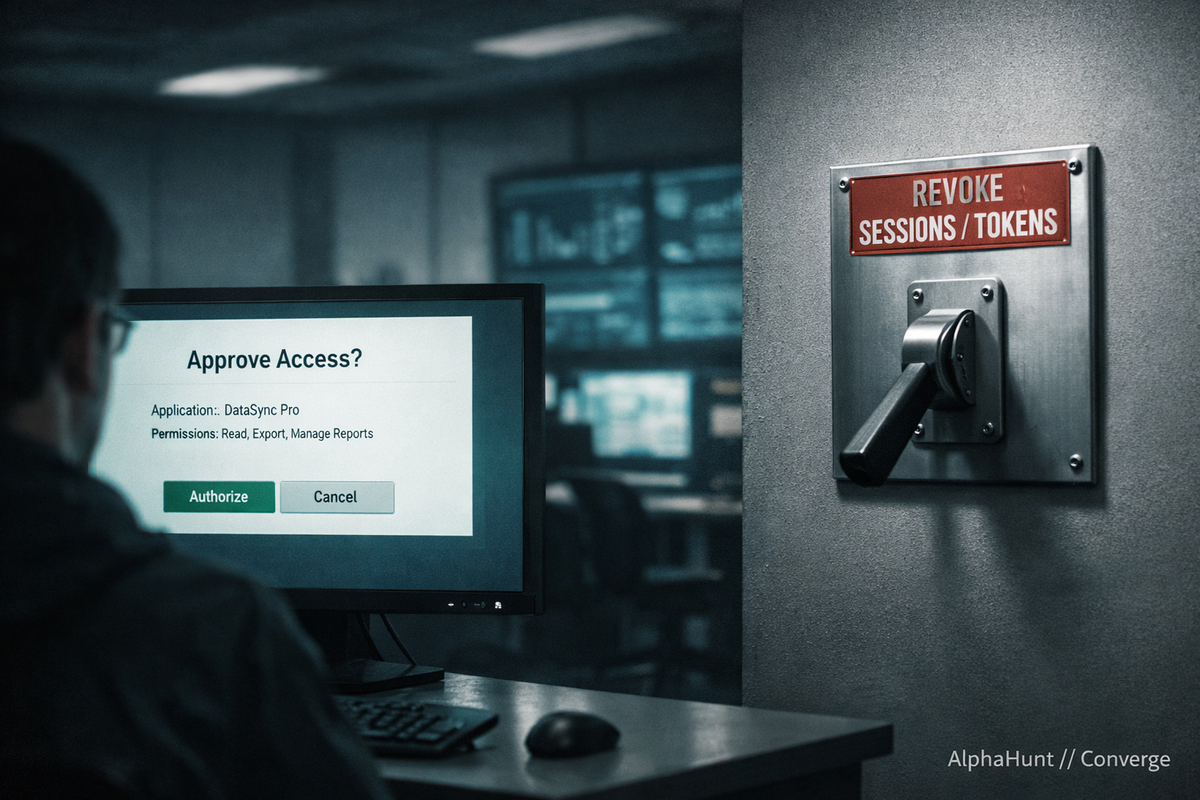
- Big tech reduces customer impact by pairing durable telemetry with pre-authorized kill-switches.
- You don’t need a massive SOC. You need 3 kill-switches, 4 hunts, and a repeatable loop.
- If you don’t have an intel team, this is your edge.
AlphaHunt
Stop doomscrolling, start decisioning. We chewed through the muck so your team doesn’t have to. → Subscribe!
Like this? Forward this to a friend!
(Have feedback? Did something resonate with you? Did something annoy you? Just hit reply! :))
This Week’s Pattern
In the last 24 months, many high-profile cloud/SaaS postmortems have told the same story.
The compromise didn’t scale because of malware sophistication.
It scaled because identity changes weren’t disrupted fast enough.
Helpdesk impersonation.
OAuth abuse.
Session replay.
Bulk API export.
Not zero-days.
Identity.
What Big Tech Learned (The Hard Way)
Across Microsoft’s Exchange Online intrusion review, Secure Future Initiative reporting, Google disruption campaigns, and large-scale takedowns, three repeatable levers stand out.
1️⃣ Platform-Native Disruption
Providers do not wait for customers to detect compromise. They:
- Disable abusive accounts and projects
- Revoke tokens
- Remove malicious connected apps
- Sinkhole domains
- Reduce attacker infrastructure capacity
Google has described enforcement actions that reduced abusive device pools “by millions” through ecosystem enforcement and in-product protections.
That is systemic risk reduction — without waiting for every victim to respond.
2️⃣ Identity Hardening at the Primitive Layer
The CSRB’s review of the 2023 Exchange Online intrusion made something clear: when identity primitives fail, blast radius can be global.
Microsoft’s Secure Future Initiative emphasized:
- Hardened token signing
- Reduced key validity
- Standardized token validation libraries
- Expanded audit retention and centralized logging
These changes reduced investigative ambiguity and shortened containment timelines.
3️⃣ SecOps Operability at Scale
Inventory + durable telemetry + validated detections determine whether you answer “what happened?” in hours or weeks.
SFI reporting cites near-total asset inventory coverage, centralized logging, multi-year retention, and hundreds of validated detections.
That is not more alerts.
It is decision-grade visibility.
The Pattern Across Incidents
Across Okta, Cloudflare, vishing-led SaaS data theft, Scattered Spider tradecraft, and cloud data-platform abuse, initial access increasingly looks like:
- MFA resets via helpdesk impersonation
- Malicious OAuth/connected app authorization
- Session/token replay
- Legitimate API bulk export
Not malware.
The failure mode is delayed containment of authorization abuse.
The Problem Most Organizations Avoid
Most SOCs are optimized for volume, not adversary behavior.
They are built to process alerts.
They are not optimized to hunt irreversible identity changes or pre-authorize disruption pathways.
Intel-led hunting shifts the question from:
“How many alerts did we close?”
to:
“How fast can we confirm and disrupt identity abuse?”
That question translates directly into executive metrics:
- Reduced hours of uncontrolled data access
- Reduced investigation uncertainty
- Reduced regulatory exposure
- Improved audit defensibility
The Disruption Dividend (In Business Terms)
Executives do not fund “more alerts.”
They fund speed and certainty.
Illustrative contrast (hypothetical):
Before:
14 hours of uncontrolled export activity before session revocation.
After:
Token revoked in 22 minutes.
OAuth grant removed.
Tier-0 account stepped up.
Same intrusion.
Very different board conversation.
Avoided incident-hours
= baseline uncontrolled access − post-program containment time.
Avoided cost scales accordingly across IR, legal, communications, and remediation.
This is the disruption dividend.
AlphaHunt Converge - Plug in your Flight Crew
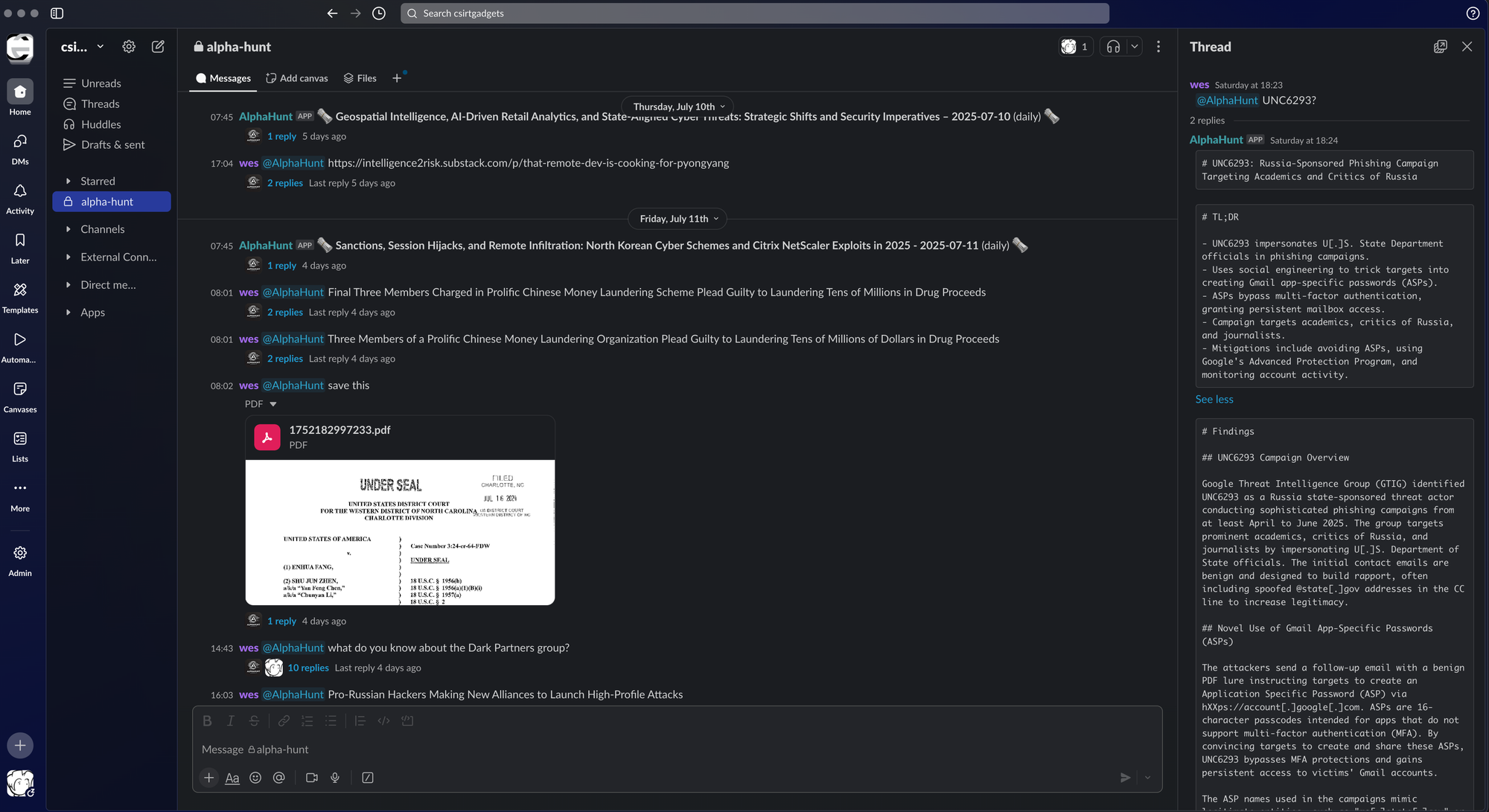
Get intelligence where it counts. No dashboards. No detours. AlphaHunt Converge teases out your intent, reviews the results and delivers actionable intel right inside Slack. We turn noise into signal and analysts into force multipliers.
Anticipate, Don’t Chase.
![[FORECASTS] From Password Sprays to Tenant Sabotage: The 8-Week Iran Cyber Risk for U.S. and Israeli Orgs - UPDATED: 2026-03-26](/content/images/size/w600/2026/03/z-6.png)
![[SIGNALS WEEKLY] Ransomware’s New Priority Targets—Hypervisors, Recovery Paths, and Control Planes](/content/images/size/w600/2026/03/z-5.png)
![[FORECAST] Will RedNovember be publicly reported to exploit at least one zero-day vulnerability in 2026? Updated 2026-03-24](/content/images/size/w600/2026/03/z-4.png)
![[DEEP RESEARCH] How Malware Uses Solana and EVM Chains to Rotate C2 Without Burning Infrastructure](/content/images/size/w600/2026/03/z-3.png)