Gunra Ransomware: Conti-Derived Double-Extortion Threat Targeting Global Critical Sectors
Gunra ransomware is a newly emerged, highly sophisticated double-extortion threat, first detected in April 2025 and attributed to a financially motivated group leveraging the Conti ransomware codebase. It targets Windows environments...
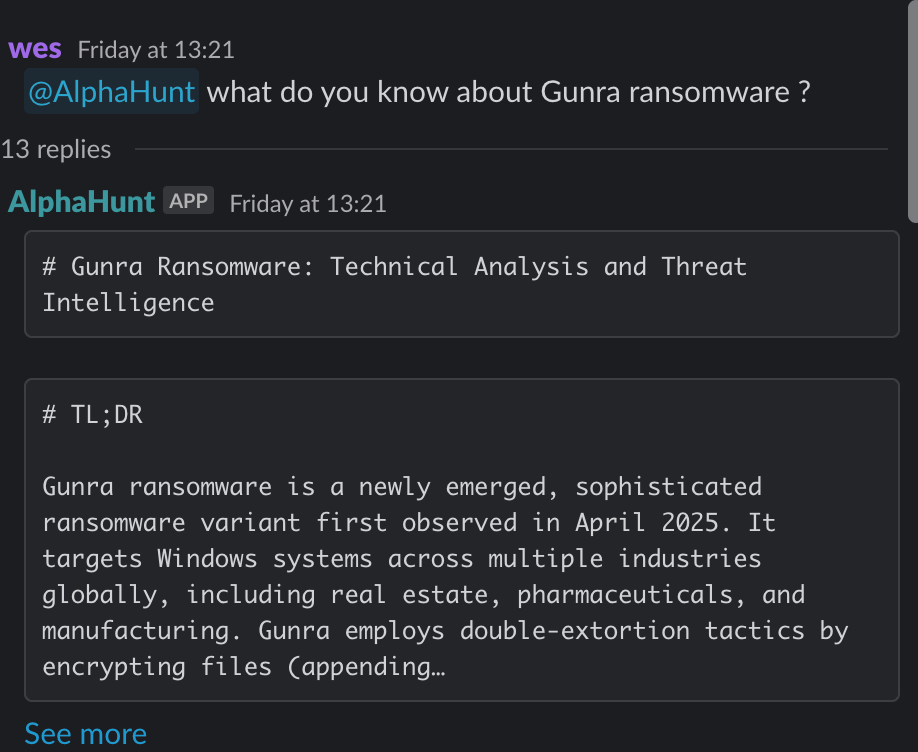
Would you like analyst super powers? I will show you the way- https://alphahunt.io
(Have feedback? Did something resonate with you? Did something annoy you? Just hit reply! :))
Get questions like this:
- what do you know about Gunra ransomware ?
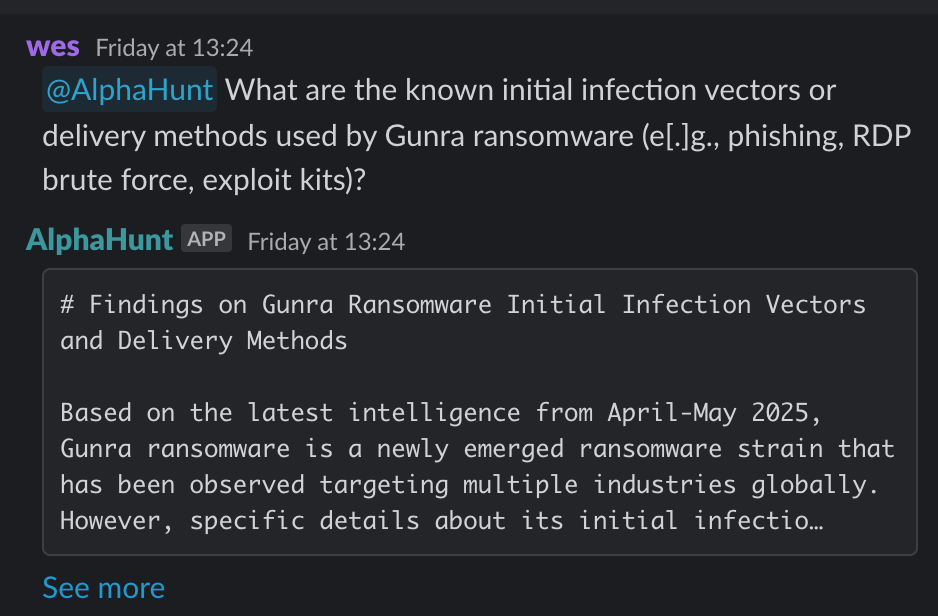
- What are the known initial infection vectors or delivery methods used by Gunra ransomware (e[.]g., phishing, RDP brute force, exploit kits)?
- Are there any known threat actor groups or intrusion sets linked to Gunra ransomware based on TTP overlaps or shared infrastructure?
Are you ready to level up your skillset? Get Started Here!
Suggested Pivot
How can endpoint telemetry, network traffic analysis, and victim interviews be systematically used to evaluate the effectiveness of current mitigation strategies (e.g., EDR deployment, network segmentation, phishing training) against Gunra ransomware across its targeted sectors and countries, and what gaps remain in these defenses?
TL;DR
Key Points
-
- Gunra ransomware, first observed in April 2025, leverages Conti codebase and advanced double-extortion tactics.
- Organizations in Japan, Egypt, Panama, Italy, and Argentina—especially in manufacturing, pharmaceuticals, real estate, and critical infrastructure—are primary targets.
-
- Initial access vectors are not definitively known but likely include phishing, vulnerability exploitation, and credential theft.
- Defenders should prioritize detection of suspicious process creation, shadow copy deletion, and Tor-based negotiation traffic.
-
- Gunra employs sophisticated evasion, privilege escalation, and anti-recovery techniques, including process injection, WMI abuse, and anti-debugging.
- Key indicators include "gunraransome.exe" process, ".ENCRT" file extensions, "R3ADM3.txt" ransom notes, and outbound Tor connections.
-
- No direct links to other APTs or aliases have been established, but TTPs closely mirror Conti, LockBit, and Black Basta.
- Detection and mitigation require EDR deployment, network segmentation, immutable backups, and user training.
-
- Short-term forecasts predict rapid campaign expansion, enhanced evasion, and automation of extortion portals; long-term, expect modularization, AI-driven evasion, and sector diversification.
- Defensive posture must adapt to evolving TTPs and increased regulatory/law enforcement pressure.
Executive Summary
Gunra ransomware is a newly emerged, highly sophisticated double-extortion threat, first detected in April 2025 and attributed to a financially motivated group leveraging the Conti ransomware codebase. It targets Windows environments across multiple global sectors, with a focus on manufacturing, pharmaceuticals, real estate, and critical infrastructure in Japan, Egypt, Panama, Italy, and Argentina. Gunra’s infection chain is speculative but likely involves phishing, exploitation of vulnerabilities, and credential theft, consistent with recent ransomware trends.
Technically, Gunra exhibits advanced evasion and impact techniques: it launches as "gunraransome.exe," enumerates and encrypts targeted files (appending ".ENCRT"), deletes shadow copies via WMI to inhibit recovery, and drops ransom notes ("R3ADM3.txt") in every directory. It uses anti-debugging, process injection, and privilege escalation to bypass defenses, and exfiltrates data for double-extortion via Tor-based negotiation portals.
Detection strategies should focus on process and file monitoring, shadow copy deletion commands, ransom note creation, and Tor network traffic. Mitigation requires robust EDR solutions, strict privilege management, network segmentation, immutable offline backups, DNS/Tor filtering, and comprehensive user training. Sigma rules and IOCs (e.g., file hashes, ransom note names, Tor domains) are available for operational defense.
Forecasts indicate Gunra will rapidly evolve, adopting fileless and AI-driven evasion, modular payloads, and expanded sector targeting. Defensive strategies must anticipate automation in extortion, increased zero-day exploitation, and potential collaboration with other ransomware or APT groups. Continuous intelligence collection, technical monitoring, and adaptive incident response are critical to countering this emerging threat.
Research & Attribution
Historical Context
Gunra ransomware is a newly emerged strain first identified in April 2025. It is part of the modern wave of ransomware families employing double-extortion tactics—encrypting victim data while simultaneously exfiltrating sensitive information to increase pressure for ransom payment. Gunra is based on the Conti ransomware codebase, inheriting many of its sophisticated techniques and operational methods. It has rapidly gained attention due to its advanced evasion capabilities and global targeting of multiple industries.
Timeline
- April 2025: Gunra ransomware first observed in active campaigns.
- April–May 2025: Rapid spread targeting organizations in Japan, Egypt, Panama, Italy, and Argentina.
- May 2025: Public technical analyses and detection rules published by cybersecurity firms such as CYFIRMA and SOC Prime.
Origin
Gunra ransomware is attributed to a financially motivated cybercriminal group leveraging Conti ransomware code. It targets Windows systems and operates a Tor-based extortion portal for ransom negotiations, using double-extortion tactics to maximize financial gain.
Countries Targeted
- Japan – Documented victim organizations targeted by Gunra ransomware.
- Egypt – Victims reported in manufacturing and pharmaceutical sectors.
- Panama – Part of the global footprint of Gunra ransomware attacks.
- Italy – Targeted in sectors such as real estate and manufacturing.
- Argentina – Victim organizations affected by Gunra ransomware campaigns.
Sectors Targeted
- Manufacturing – Frequently targeted for disruption and ransom.
- Pharmaceuticals – Targeted for sensitive data exfiltration and encryption.
- Real Estate – Victims include companies in this sector globally.
- Critical Infrastructure – Targeted due to high impact potential.
- Various Enterprises – Other sectors affected by Gunra ransomware.
Motivation
Gunra ransomware operators are financially motivated, employing double-extortion tactics to maximize ransom payments by encrypting victim files and exfiltrating sensitive data, threatening public release if demands are not met.
Attack Types and Infection Chain
Initial Access
The exact initial access vector for Gunra ransomware remains unknown due to its recent discovery and limited public data. However, based on typical ransomware trends and CYFIRMA intelligence, initial access is likely achieved through:
- Phishing emails with malicious attachments or links
- Exploitation of software vulnerabilities
- Use of stolen or compromised credentials
- Possibly through loaders or web shells deployed post-compromise
Technical Characteristics and TTPs
- Execution begins with the creation of a process named "gunraransome.exe" visible in Task Manager.
- Enumerates running processes and system files using Windows APIs (FindNextFileExW) to identify target files (.docx, .pdf, .xls, .jpg).
- Uses anti-debugging techniques via the IsDebuggerPresent API to detect and evade analysis.
- Manipulates processes using GetCurrentProcess and TerminateProcess for privilege escalation and to disable security tools.
- Deletes Volume Shadow Copies using Windows Management Instrumentation (WMI) to prevent recovery.
- Encrypts files with strong encryption algorithms (specific algorithms not publicly detailed) and appends ".ENCRT" extension.
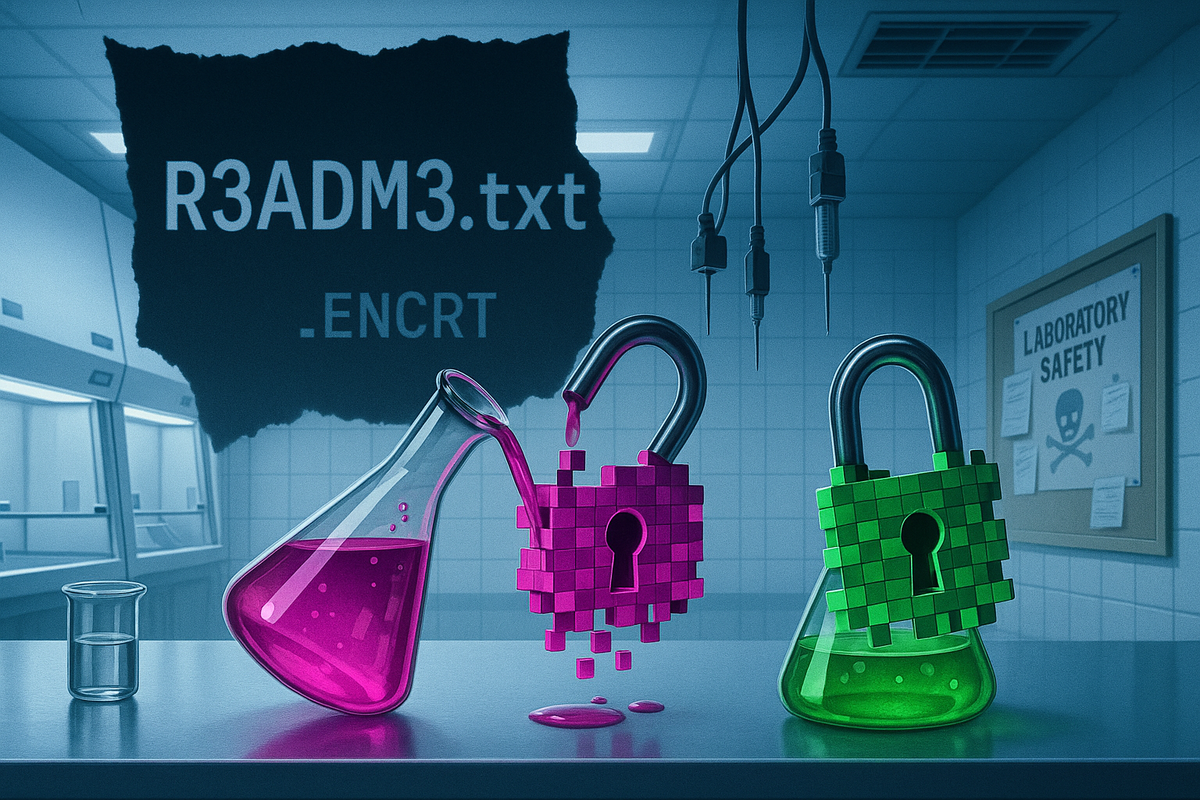
- Drops ransom notes named "R3ADM3.txt" in every encrypted directory.
- Exfiltrates sensitive data to attacker-controlled infrastructure.
- Negotiations occur via Tor-based portals styled like messaging apps, with roles such as "Manager" assigned to operators.
MITRE ATT&CK Techniques (Top 15 Relevant)
- Execution: T1047 (Windows Management Instrumentation), T1129 (Shared Modules)
- Persistence: T1176 (Software Extensions), T1542.003 (Bootkit), T1574.002 (DLL Side-Loading)
- Privilege Escalation: T1055 (Process Injection), T1548 (Abuse Elevation Control Mechanism)
- Defense Evasion: T1014 (Rootkit), T1027 (Obfuscated Files or Information), T1036 (Masquerading), T1564.001 (Hidden Files and Directories)
- Credential Access: T1003 (OS Credential Dumping), T1555.003 (Credentials from Web Browsers)
- Discovery: T1057 (Process Discovery), T1082 (System Information Discovery)
- Impact: T1486 (Data Encrypted for Impact), T1490 (Inhibit System Recovery)
Known Aliases
No definitive or widely recognized aliases for Gunra ransomware have been identified by major threat intelligence providers. Gunra appears to be a newly emerged ransomware strain without alternative names or aliases in major CTI sources.
Similar Threat Actor Groups
- Conti Ransomware Group
- Gunra ransomware is based on Conti ransomware code and shares similar double-extortion tactics and advanced evasion techniques.
- Other Double-Extortion Ransomware Groups (e.g., LockBit, Black Basta)
- Similar use of data encryption combined with data exfiltration and extortion.
Breaches Involving This Threat Actor
No publicly reported specific breach incidents involving Gunra ransomware have been documented in open-source news within the past year. However, victimology includes organizations in Japan, Egypt, Panama, Italy, and Argentina across multiple sectors.
Detection and Mitigation Strategies
Detection
- Monitor for processes named "gunraransome.exe" or similar suspicious executables.
- Detect file encryption activities appending ".ENCRT" extensions.
- Alert on deletion of shadow copies via WMI commands (e.g., powershell.exe, wmic.exe, vssadmin.exe with shadow copy deletion commands).
- Detect use of IsDebuggerPresent API calls and process manipulation functions (GetCurrentProcess, TerminateProcess).
- Monitor creation of ransom note files named "R3ADM3.txt" in multiple directories.
- Monitor network traffic for connections to Tor (.onion) domains associated with ransom negotiation portals.
- Use Endpoint Detection and Response (EDR) tools to detect abnormal process enumeration, privilege escalation, and code injection.
- Implement file integrity monitoring to detect unauthorized file changes.
Mitigation
- Maintain regular, immutable, offline backups and test recovery procedures.
- Restrict administrative privileges and enforce least privilege principles.
- Use application whitelisting to prevent unauthorized executables.
- Segment networks to limit lateral movement.
- Block access to known malicious domains and Tor exit nodes via firewall and DNS filtering.
- Monitor and restrict WMI usage to prevent shadow copy deletion.
- Educate users on phishing and social engineering tactics.
- Deploy anti-ransomware solutions with behavioral detection capabilities.
- Immediately isolate infected systems and disconnect from networks upon detection.
Expanded Sigma Rule (Example)
title: Gunra Ransomware Detection - Process, Shadow Copy Deletion, Ransom Note, and Tor Traffic
id: 12345678-90ab-cdef-1234-567890abcdef
description: Detects Gunra ransomware activity including process creation, shadow copy deletion, ransom note creation, and Tor network connections
status: experimental
author: CYFIRMA
logsource:
  product: windows
  service: sysmon
detection:
  selection_process:
    Image|endswith: '\gunraransome.exe'
  selection_shadowcopy:
    Image|endswith:
      - '\powershell.exe'
      - '\wmic.exe'
      - '\vssadmin.exe'
    CommandLine|contains|all:
      - 'shadow'
      - 'delete'
  selection_ransomnote:
    TargetFilename|endswith: 'R3ADM3.txt'
  selection_tor_traffic:
    DestinationHostname|endswith: '.onion'
  condition: selection_process or selection_shadowcopy or selection_ransomnote or selection_tor_traffic
fields:
  - Image
  - CommandLine
  - TargetFilename
  - DestinationHostname
level: high
tags:
  - ransomware
  - attack.execution
  - attack.defense_evasion
  - attack.impact
falsepositives:
  - Legitimate use of shadow copy deletion by administrators
  - Legitimate creation of text files named R3ADM3.txt
  - Legitimate Tor traffic in privacy-focused environments
Indicators of Compromise (IOCs)
- File Hashes:
- MD5: 9a7c0adedc4c68760e49274700218507
- SHA-256: 854e5f77f788bbbe6e224195e115c749172cd12302afca370d4f9e3d53d005fd
- Ransom Note Filename: R3ADM3.txt
- Mutexes: Not publicly disclosed
- Registry Keys: Not publicly disclosed
- C2 Domains/IPs: Tor-based .onion domains used for ransom negotiation (specific URLs withheld for operational security)
- Network Indicators: Outbound connections to Tor network addresses for command and control and negotiation.
Recommendations, Actions, Suggested Pivots, Forecasts and Next Steps..
(Subscribers Only)
Recommendations, Actions and Next Steps
-
Deploy advanced Endpoint Detection and Response (EDR) solutions such as CrowdStrike Falcon, Microsoft Defender for Endpoint, or SentinelOne. These tools are effective in detecting ransomware behaviors, including process creation anomalies (e.g., "gunraransome.exe"), shadow copy deletion via WMI commands, and ransom note file creation. They provide behavioral analytics and real-time alerts aligned with Gunra’s TTPs, such as T1047 (Windows Management Instrumentation) and T1486 (Data Encrypted for Impact), enabling rapid detection and containment.
-
Implement network segmentation and strict least privilege access controls, particularly restricting administrative privileges and WMI usage, to mitigate Gunra’s privilege escalation (T1548) and lateral movement capabilities. Use Microsoft Active Directory Group Policy Objects (GPOs) and network access control (NAC) solutions to enforce these restrictions, directly addressing Gunra’s exploitation of process manipulation and shadow copy deletion.
-
Establish immutable, offline backup solutions such as Veeam Backup & Replication with air-gapped storage or cloud-based immutable backups (e.g., AWS S3 Object Lock), and conduct regular recovery drills. This counters Gunra’s impact techniques (T1486, T1490) by ensuring data restoration capability despite encryption and shadow copy deletion.
-
Deploy DNS filtering and firewall rules to block access to known malicious Tor exit nodes and .onion domains used by Gunra for ransom negotiations, disrupting attacker command and control and data exfiltration channels. Integrate threat intelligence feeds from providers like CYFIRMA or SOC Prime to maintain updated blocklists, directly mitigating Gunra’s use of Tor-based extortion portals.
-
Conduct targeted phishing awareness and credential hygiene training for employees, emphasizing recognition of malicious attachments and links, as initial access is likely via phishing and credential compromise. Complement training with multi-factor authentication (MFA) enforcement to reduce risk from stolen credentials, addressing Gunra’s probable initial access vectors.
Suggested Pivots
-
What specific open-source intelligence (OSINT), dark web monitoring, and malware reverse engineering methods can be employed to definitively identify Gunra ransomware’s initial access vectors, and how do these vectors compare quantitatively in terms of dwell time, ransom demands, encryption speed, and mitigation success rates with those of Conti and LockBit ransomware families?
-
How can endpoint telemetry, network traffic analysis, and victim interviews be systematically used to evaluate the effectiveness of current mitigation strategies (e.g., EDR deployment, network segmentation, phishing training) against Gunra ransomware across its targeted sectors and countries, and what gaps remain in these defenses?
-
What intelligence collection techniques, including Tor network traffic analysis and infiltration of ransom negotiation portals, can be leveraged to map Gunra ransomware’s extortion infrastructure, and how can this intelligence be operationalized to disrupt ransom negotiations and data exfiltration channels?
-
Using malware reverse engineering and behavioral analytics, what novel evasion and privilege escalation tactics has Gunra ransomware introduced compared to other double-extortion ransomware groups, and what are the implications for future detection and response capabilities?
-
What forward-looking threat modeling approaches can be applied to assess the potential evolution of Gunra ransomware’s tactics, including the likelihood of collaboration with other ransomware or APT groups, and how might this impact the financial, operational, and data security posture of critical infrastructure and manufacturing sectors?
Forecast
Short-Term Forecast (3-6 months)
-
Rapid Expansion and Diversification of Gunra Ransomware Campaigns with Enhanced Evasion Techniques
- Gunra ransomware will continue to aggressively target manufacturing, pharmaceuticals, critical infrastructure, and real estate sectors, likely expanding to new regions. Attackers will refine evasion techniques, including enhanced anti-debugging and obfuscation, to counter the growing deployment of EDR solutions. Gunra may adopt fileless execution methods leveraging living-off-the-land binaries (LOLBins) such as PowerShell and WMI scripts to evade signature-based detection.
- What to watch for: Increased use of PowerShell with encoded commands, anomalous WMI activity, and process injection attempts detected by behavioral analytics. Monitoring for “gunraransome.exe” alongside suspicious use of Windows APIs (IsDebuggerPresent, TerminateProcess) will be critical.
- Supporting evidence: CYFIRMA’s April 2025 ransomware tracking report highlights the trend of ransomware groups increasingly using fileless and living-off-the-land techniques to evade detection, consistent with Gunra’s observed TTPs.
- Analogous example: Conti ransomware’s evolution in 2023 included increased use of fileless payloads and living-off-the-land tactics to bypass traditional defenses.
-
Emergence of Sophisticated Tor-Based Extortion Portals with Automated and Multi-Lingual Negotiation Features
- Gunra’s Tor-based ransom negotiation portals will evolve to include automated chatbots, multi-lingual support, and role-based operator hierarchies to streamline ransom negotiations and reduce human operator workload. This will increase the speed and scale of extortion campaigns and complicate law enforcement efforts.
- What to watch for: Network traffic analysis detecting increased Tor .onion domain activity, especially new or rotated domains linked to Gunra. Monitoring for changes in ransom note content or negotiation portal features signaling automation or expanded language support.
- Supporting evidence: SOC Prime’s detection blog notes similar developments in LockBit and Black Basta ransomware groups’ extortion portals, which have incorporated automation and multi-language capabilities.
- Analogous example: LockBit’s evolution to automated negotiation bots in 2024 increased their operational efficiency and victim engagement.
-
Increased Exploitation of Zero-Day Vulnerabilities and Credential Theft for Initial Access
- Gunra operators will likely incorporate exploitation of newly disclosed zero-day vulnerabilities and intensify credential harvesting campaigns via phishing and web browser credential theft to gain initial access. This multi-vector approach will increase infection rates and dwell time.
- What to watch for: Spike in phishing campaigns targeting sectors Gunra focuses on, detection of exploitation attempts against recent Windows vulnerabilities, and anomalous credential dumping activities (e.g., LSASS memory access).
- Supporting evidence: CYFIRMA’s April 2025 ransomware report documents multiple ransomware groups exploiting zero-days and credential theft to establish footholds, a trend Gunra is expected to follow.
- Analogous example: The PipeMagic trojan’s exploitation of Windows CLFS zero-day vulnerabilities in early 2025 demonstrates the effectiveness of zero-day exploitation in ransomware campaigns.
-
Heightened Defensive Posture and Incident Response Focused on Gunra’s Unique Indicators
- Organizations will increasingly deploy and tune EDR and SIEM solutions to detect Gunra-specific indicators such as “gunraransome.exe” process creation, shadow copy deletion via WMI commands, and ransom note file creation (“R3ADM3.txt”). Behavioral analytics will focus on process injection and privilege escalation attempts.
- What to watch for: Increased alerts on WMI shadow copy deletion commands, process injection attempts, and Tor network traffic. Adoption of immutable offline backups and network segmentation will rise in response to Gunra’s impact techniques.
- Supporting evidence: CYFIRMA and SOC Prime detection rules released in May 2025 provide actionable detection logic that defenders are expected to implement rapidly.
- Analogous example: The Conti ransomware detection rules released in 2023 led to a temporary reduction in successful attacks before adversaries adapted.
-
Targeting of Organizations with Weak Backup and Privilege Management Practices
- Gunra operators will prioritize victims lacking immutable offline backups and strict privilege controls, as these organizations are more likely to pay ransoms due to inability to recover data. This will disproportionately affect SMEs and organizations with immature cybersecurity postures.
- What to watch for: Increased ransom demands and data leak announcements involving smaller organizations or those with known backup deficiencies.
- Supporting evidence: Industry reports show 75% of SMEs face existential threats post-ransomware, with 60% shutting down within six months, underscoring attacker incentives to target such victims.
- Analogous example: The Colonial Pipeline attack in 2021 exploited insufficient backup and privilege management, leading to significant operational disruption.
Long-Term Forecast (12-24 months)
-
Evolution of Gunra into a Modular, Multi-Stage Malware Platform Incorporating Fileless and AI-Driven Evasion Techniques
Gunra ransomware will evolve into a modular platform integrating additional payloads such as info stealers, cryptominers, and espionage tools. It will adopt advanced fileless execution, AI-driven polymorphism, and living-off-the-land techniques to evade detection and prolong dwell time. This evolution will complicate incident response and forensic analysis.- What to watch for: Emergence of new Gunra variants with modular payloads, increased use of AI-based obfuscation, and stealthy credential harvesting prior to encryption.
- Supporting evidence: CYFIRMA’s April 2025 ransomware report highlights a trend toward modular architectures and stealthy intrusions, exemplified by ELENOR-corp and other advanced ransomware.
- Analogous example: Conti’s transition to a multi-stage platform with layered obfuscation and stealthy data exfiltration in 2023.
-
Potential Collaboration or Code Sharing with Other Ransomware or APT Groups Leading to Expanded Capabilities and Targeting
- Gunra operators may collaborate with or be absorbed by larger ransomware conglomerates or APT groups, sharing code, infrastructure, and intelligence. This could lead to expanded targeting, including financial services and healthcare sectors, and the blending of geopolitical motives with financial extortion.
- What to watch for: Indicators of shared infrastructure or TTPs between Gunra and other ransomware groups, emergence of Gunra variants targeting new sectors, and intelligence on possible alliances.
- Supporting evidence: Historical patterns show ransomware groups like LockBit and Conti forming alliances or absorbing affiliates to increase reach and sophistication.
- Analogous example: LockBit’s cartel model and Conti’s links to APT campaigns illustrate this trend.
-
Increased Regulatory and Law Enforcement Pressure Leading to Infrastructure Disruptions and Adaptations
- Governments and international law enforcement will intensify efforts to disrupt Gunra’s Tor-based infrastructure, including domain seizures, cryptocurrency wallet tracking, and operator arrests. Gunra will respond by decentralizing infrastructure, adopting more resilient communication methods, and possibly shifting to alternative anonymity networks.
- What to watch for: Sudden changes in Gunra’s ransom negotiation portals, use of new anonymity networks beyond Tor, and law enforcement announcements related to ransomware takedowns.
- Supporting evidence: The takedown of REvil and DarkSide in 2021–2022 led to rapid adaptation and rebranding by affiliates, a likely scenario for Gunra.
- Analogous example: REvil’s infrastructure disruption and subsequent affiliate migration.
-
Expansion of Target Sectors to Include Financial Services, Healthcare, and Emerging Technologies
- Gunra will broaden its targeting to high-value sectors such as financial services, healthcare, and emerging technology companies (e.g., cloud providers, IoT manufacturers) to maximize ransom potential and data value. These sectors’ criticality and regulatory sensitivity make them lucrative targets.
- What to watch for: New victim disclosures in these sectors, ransom notes tailored to sector-specific data, and sector-specific phishing campaigns.
- Supporting evidence: Ryuk and Conti ransomware groups historically shifted focus to healthcare and finance due to their high ransom-paying potential.
- Analogous example: Ryuk’s pivot to healthcare in 2020–2021.
-
Development of AI-Enhanced Defensive and Offensive Capabilities Impacting the Ransomware Ecosystem
- Both attackers and defenders will increasingly leverage AI and machine learning. Gunra operators may use AI for reconnaissance, evasion, and automated negotiation, while defenders will deploy AI-driven behavioral analytics and threat hunting. This arms race will shape the ransomware landscape’s future dynamics.
- What to watch for: Introduction of AI-based ransomware variants, increased automation in ransom negotiations, and deployment of AI-powered detection tools.
- Supporting evidence: Industry research highlights growing AI adoption in cyber offense and defense, with ransomware groups experimenting with AI to evade detection.
- Analogous example: Emerging AI-powered malware and automated phishing campaigns in 2024–2025.
Appendix
References
- (2025-05-03) – Gunra Ransomware – A Brief Analysis - CYFIRMA
- (2025-05-07) – Gunra Ransomware Detection: New Threat Targets Various Industries Globally - SOC Prime
- (2025-05-07) – CYFIRMA warns of Gunra ransomware surge targeting critical infrastructure using double extortion, data exposure
- (2025-04-24) – Gunra Ransomware - Decryption, removal, and lost files recovery - PCRisk
- (2025-04-29) – Tracking Ransomware: April 2025 - CYFIRMA
AlphaHunt
(Have feedback? Did something resonate with you? Did something annoy you? Just hit reply! :))
Get questions like this:
- what do you know about Gunra ransomware ?
- ***What are the known initial infection vectors or delivery methods used by Gunra ransomware (e[.]g., phishing, RDP brute force, exploit kits)?
- Are there any known threat actor groups or intrusion sets linked to Gunra ransomware based on TTP overlaps or shared infrastructure?
Does it take a chunks out of your day? Would you like help with the research?
This baseline report was thoughtfully researched and took 10 minutes.. It's meant to be a rough draft for you to enhance with the unique insights that make you an invaluable analyst.
We just did the initial grunt work..
Are you ready to level up your skillset? Get Started Here!
Did this help you? Forward it to a friend!
(c) 2025 CSIRT Gadgets, LLC
License - CC BY-SA 4.0
![[GAME THEORY] The OAuth Prompt Is Becoming the New Diplomatic Pouch](https://storage.ghost.io/c/06/e5/06e5730b-7d78-4713-9cec-6cba31d297f5/content/images/size/w600/2026/10/alphahunt-game-theory-the-oauth-prompt-is-becoming-the-new-diplomatic-pouch-hero-2026-10-08.png)
![[SIGNALS WEEKLY] Hidden Paths: Trusted Tools as Covert Access Channels](https://storage.ghost.io/c/06/e5/06e5730b-7d78-4713-9cec-6cba31d297f5/content/images/size/w600/2026/10/alphahunt-signals-weekly-hidden-paths-trusted-tools-as-covert-access-channels-hero-2026-10-06.png)
![[DEEP RESEARCH] When the patch queue becomes the threat model](https://storage.ghost.io/c/06/e5/06e5730b-7d78-4713-9cec-6cba31d297f5/content/images/size/w600/2026/10/alphahunt-deep-research-when-the-patch-queue-becomes-the-threat-model-hero-2026-10-02.png)
![[GAME THEORY] The Recruiter Was Also the Quartermaster](https://storage.ghost.io/c/06/e5/06e5730b-7d78-4713-9cec-6cba31d297f5/content/images/size/w600/2026/09/alphahunt-game-theory-the-recruiter-was-also-the-quartermaster-hero-2026-10-01.png)