
Geopatriation Is Coming: Sovereign Clouds Will Break Your Telemetry First
2026 prediction: “sovereign cloud” becomes the #1 way to accidentally create telemetry refugees 🛂☁️ Meanwhile: DPRK “IT workers” in the supply chain + OAuth consent hijacks that laugh at MFA 🔑🎭 What’s your log-clears-customs plan?

Under‑the‑Radar Geopolitics That Will Reshape Cybersecurity in 2026
TL;DR
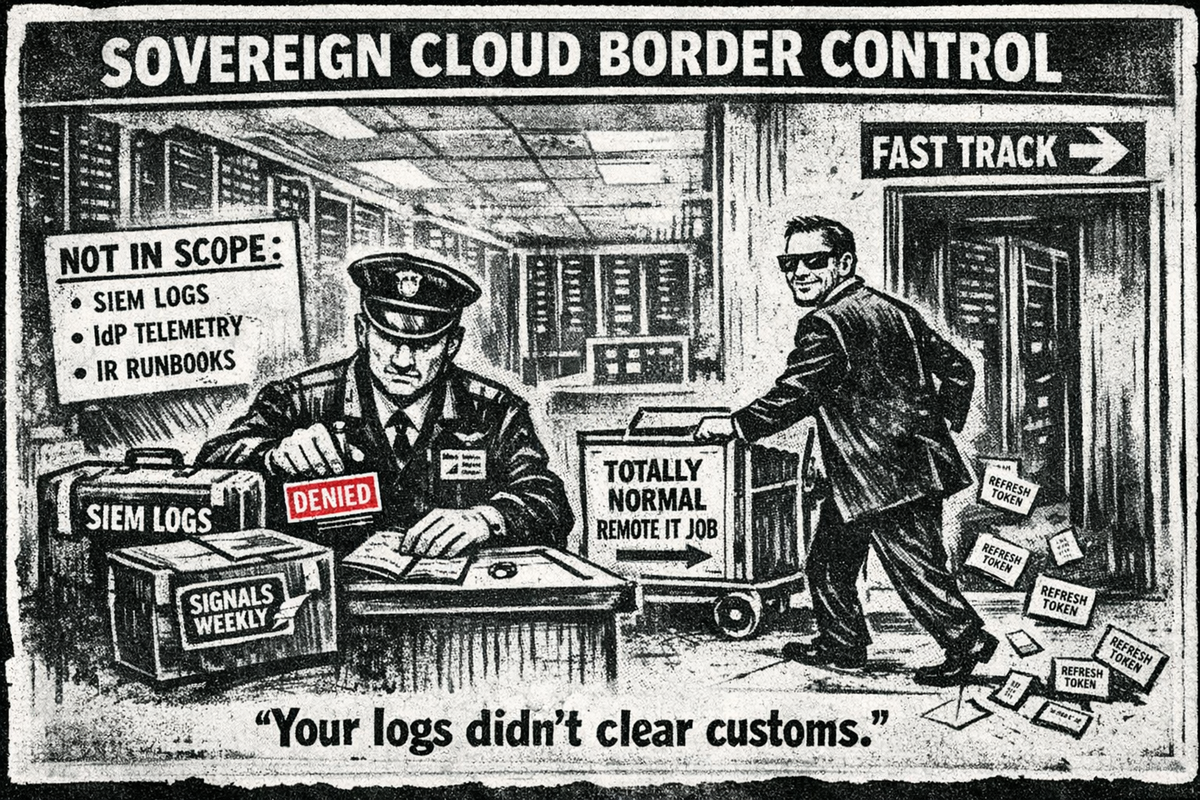
- Policy fragmentation will create identity/telemetry blind spots via sovereign clouds; probability: 80% (confidence: medium-high).
- Sanctions-evasion IT labor pipelines will penetrate software supply chains; probability: 70% (confidence: high).
- Identity-first intrusions via IdP/MSSP hijacking and OAuth/token abuse will expand; probability: 60% (confidence: medium-high).
AlphaHunt
Stop doomscrolling, start decisioning. We chewed through the muck so your team doesn’t have to. → Subscribe!
Like this? Forward this to a friend!
Want a peek at the DETECTION IDEAS based on this article at the bottom? Sign up!
(Have feedback? Did something resonate with you? Did something annoy you? Just hit reply! :))
Policy Fragmentation Triggers Identity and Telemetry Blind Spots
Short version: Divergent AI/data-localization mandates accelerate sovereign/multi-cloud migrations that outpace security engineering.
-
Signals
- 2025 AWS European Sovereign Cloud design and operations by EU-resident staff; new regional tenancy patterns.
- 2025 Microsoft EU Data Boundary scope/exclusions and Sovereign Public Cloud controls indicate differing data/telemetry baselines.
- 2026 legal trend analyses forecast expanding data localization and compliance-led re-architecture.
-
Impact/Sectors
- High: public sector, regulated industries (finance, health), multinationals in EU/ME.
- Medium: global SaaS subject to regional data rules.
-
Controls
- Unified identity with conditional access parity across sovereign and commercial clouds; phishing-resistant MFA.
- Standardize telemetry schemas/retention; ensure regional log capture for IdP, SIEM, EDR, and SaaS.
- Regional key management with HSM-backed controls; test cross-tenant incident response.
-
Key uncertainties, leading indicators, falsifiers
- Uncertainties: pace/scope of national implementations; provider feature parity.
- Indicators: rapid migrations to EU sovereign regions; service exclusions from data boundaries impacting logs.
- Falsifiers: uniform provider parity in logging/KMS; regulatory harmonization reducing re-architecture.
-
Probability: 80% (confidence: medium-high)
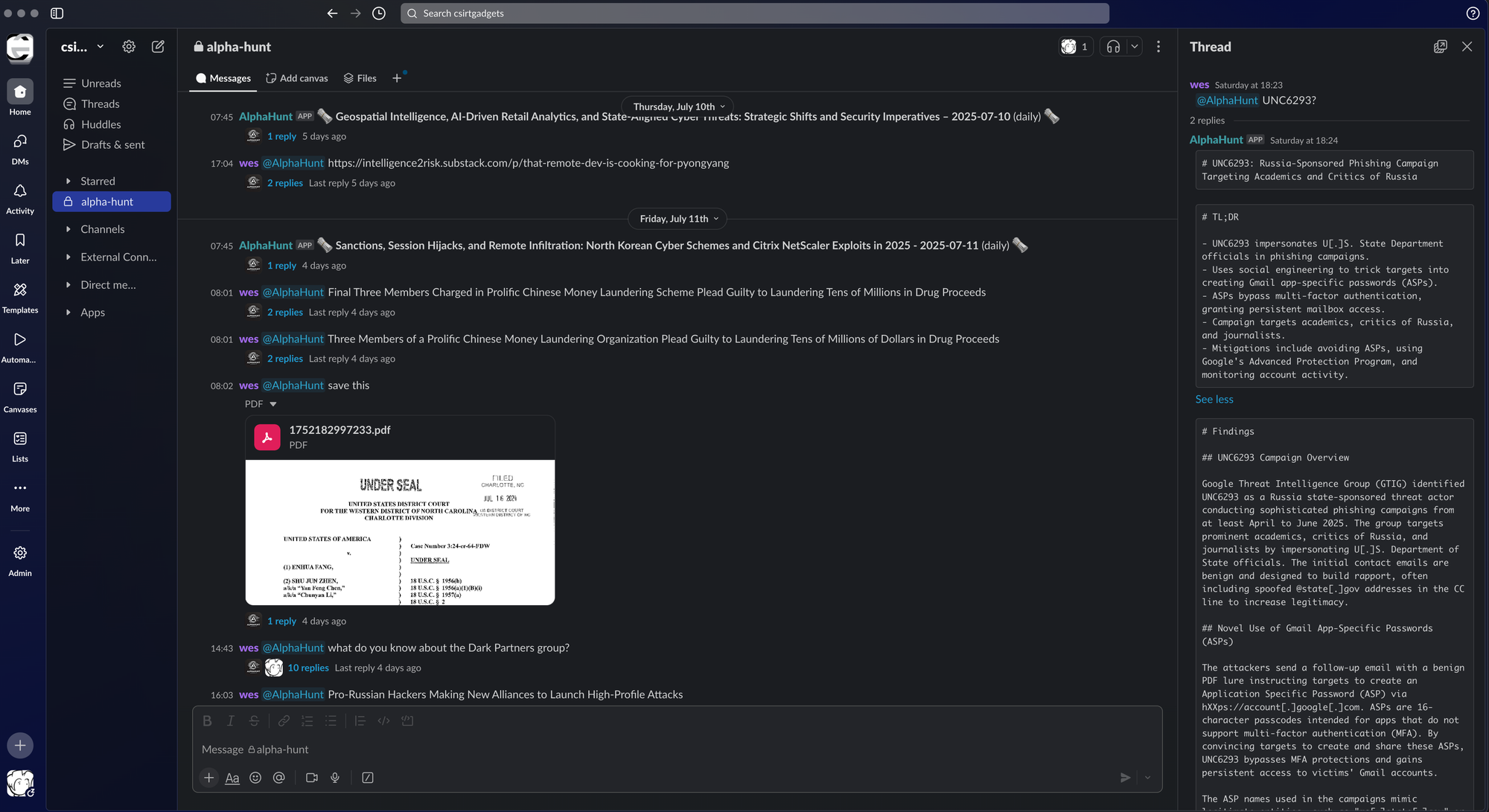
AlphaHunt Converge - Plug in your Flight Crew
Get intelligence where it counts. No dashboards. No detours. AlphaHunt Converge teases out your intent, reviews the results and delivers actionable intel right inside Slack. We turn noise into signal and analysts into force multipliers.
Anticipate, Don’t Chase.
Sanctions‑Evasion Labor Pipelines Breach the Software Supply Chain
Short version: Front-company IT staffing embeds operators in dev/DevOps, risking code-signing abuse and CI/CD persistence.
-
Signals
- 2025 U.S. DOJ takedown of DPRK remote IT worker schemes; asset seizures and company notifications.
- 2025 IC3 PSA warning U.S. businesses about DPRK IT worker threats.
- 2025 multilateral statement detailing DPRK cyber/IT worker activity and sanctions monitoring.
-
Impact/Sectors
- High: fintech/crypto, SaaS, open-source ecosystems, defense/critical tech.
- Medium: healthcare, retail with proprietary apps.
-
Controls
- Workforce provenance screening: payment rails, timezone patterns, code-review velocity anomalies.
- Enforce maintainer verification, artifact signing (Sigstore), and protected branches with mandatory reviews.
- CI/CD least privilege, short-lived credentials, and segregated code-signing HSMs.
-
Key uncertainties, leading indicators, falsifiers
- Uncertainties: scale of front companies; efficacy of 2025–2026 enforcement.
- Indicators: spikes in contractor onboarding via OTC brokers; anomalous maintainer rotation in key repos.
- Falsifiers: sustained decline in DPRK IT worker disruptions; verified reduction in suspicious contractor flows.
-
Probability: 70% (confidence: high)
Identity‑First State Tradecraft: IdP/MSSP Hijacking, OAuth/Token Abuse
Short version: Export controls and burn risk drive state/contractor ops toward low-noise identity abuse, provider/third-party hijack, and token-centric persistence.
-
Signals
- 2025 Microsoft: device-code phishing (Storm-2372), OAuth token abuse, Teams attack chains, and active exploitation reports.
- 2025 CISA: ransomware actors exploiting RMM (SimpleHelp) to access downstream customers—MSSP/RMM supply-chain risk.
- 2025 CISA/partners update on Scattered Spider shows identity-driven extortion patterns.
-
Impact/Sectors
- High: enterprises relying on MSP/MSSP, Microsoft 365/SaaS, state/local government.
- Medium: SMEs with third-party admin dependencies.
-
Controls
- Token hygiene: short lifetimes, revoke on risk, device-code flow controls, OAuth app consent governance.
- Conditional access hardening: step-up on anomalous contexts; disable legacy auth; device trust.
- Third-party access governance: least privilege, just-in-time vendor access, continuous session validation.
-
Key uncertainties, leading indicators, falsifiers
- Uncertainties: breadth of IdP compromise vs. app-level OAuth abuse; MSP segmentation maturity.
- Indicators: rise in device-code phishing, OAuth-app abuse, stale refresh tokens; MSP lateral movement cases.
- Falsifiers: measurable decline in OAuth abuse post-provider mitigations; broad MSP zero-trust adoption.
-
Probability: 60% (confidence: medium-high)
![[SIGNALS WEEKLY] Ransomware’s New Priority Targets—Hypervisors, Recovery Paths, and Control Planes](/content/images/size/w600/2026/03/z-5.png)
![[FORECAST] Will RedNovember be publicly reported to exploit at least one zero-day vulnerability in 2026? Updated 2026-03-24](/content/images/size/w600/2026/03/z-4.png)
![[DEEP RESEARCH] How Malware Uses Solana and EVM Chains to Rotate C2 Without Burning Infrastructure](/content/images/size/w600/2026/03/z-3.png)
![[SIGNALS WEEKLY] GitHub, npm, and Fake Interviews: Why Developer Supply Chain Attacks Are Converging](/content/images/size/w600/2026/03/zz-3.png)