[FORECAST UPDATED] AI Agents as Regulated C2: Will Anyone Be Forced to Act?
🤖🔒 AI agents = privileged integrations you can’t see. After GTG-1002 + vendors pushing agent access standards, the next shoe drops: do regulators/hyperscalers force default-on signed connectors + audit logs (aka “regulated C2”)?

![[FORECAST UPDATED] AI Agents as Regulated C2: Will Anyone Be Forced to Act?](/content/images/size/w1200/2026/02/z-11.png)
This is an updated forecast from Dec 2025..
Forecasts aren't very useful, unless they're updated.
TL;DR
Question
By 31 December 2026, will at least one major regulator or hyperscale SaaS/identity platform publish binding requirements or default-on technical controls (not just guidance) that explicitly (a) treat AI agents/connectors as high-risk integration points, (b) require signed/attested connectors and auditable agent logs, and (c) cite an AI‑orchestrated intrusion campaign like GTG‑1002/Anthropic (or a substantively similar AI‑orchestrated intrusion) as part of the justification?
Strategic Assessment
I estimate a 35% chance of Yes by end‑2026. Momentum toward treating agentic connectors as a privileged integration surface—and toward audit-grade logging—is strong.
The forecast is most likely to fail on two tightened requirements: (1) making connector provenance cryptographically enforced and verified (not just “verified publisher”), and (2) explicitly citing a named AI‑orchestrated intrusion (GTG‑1002 or similar) in the same binding/default-on document.
A high-profile agent/connector compromise would be the main catalyst that pushes both over the line.
AlphaHunt
Stop doomscrolling, start decisioning. We chewed through the muck so your team doesn’t have to. → Subscribe!
Like this? Forward this to a friend!
(Have feedback? Did something resonate with you? Did something annoy you? Just hit reply! :))
Forecast Card
-
Question: By 31 December 2026, will at least one major regulator or hyperscale SaaS/identity platform publish binding requirements or default-on technical controls (not just guidance) that explicitly (a) treat AI agents/connectors as high-risk integration points, (b) require signed/attested connectors and auditable agent logs, and (c) cite an AI‑orchestrated intrusion campaign like GTG‑1002/Anthropic (or a substantively similar AI‑orchestrated intrusion) as part of the justification?
-
Resolution Criteria: Resolves Yes if, by 2026-12-31 23:59:59 ET, there exists at least one official, public document from any in-scope actor (SEC, FTC, EU authorities under DSA/DORA/NIS2/AI Act; or Microsoft/Google/AWS/Okta, etc.) that satisfies all of the below in the same document:
-
Binding or default-on (enforcement strength test)
Qualifies if the document is either:- Binding: regulation/rule/RTS/mandatory technical standard; enforcement order/consent decree; mandatory supervisory baseline; or
- Default-on vendor control: a tenant-wide security baseline enabled by default for all new tenants (or all tenants), or an execution/installation gate that is enforced-by-default (i.e., noncompliant connectors/agents are blocked unless an admin explicitly disables the gate).
-
Explicit high-risk treatment of AI agents/connectors
The text must explicitly single out AI agents, agentic integrations, AI connectors/tools, or equivalent as high-risk/privileged/critical integration points (distinct from ordinary integrations). -
Requires BOTH control families, with enforcement/verification
- Signed/attested connectors/agents (strong form) must require cryptographic provenance/integrity plus an enforcement/verification mechanism. It qualifies only if the document requires at least one of:
- Enforced signature verification (e.g., code/package signing) where unsigned/invalid-signed connectors are blocked by default (marketplace/runtime gate); or
- Remote attestation / measured identity of the connector/agent runtime, with a policy gate; or
- A formal attestation artifact that must be verified/validated (e.g., by platform, regulator, auditor, or registry) and non-verified connectors/agents are disallowed by default.
Non-qualifying edge case: self-attestation with no verification and no gate (including “verified publisher” / KYC-only programs).
- Auditable agent/connector logs (strong form) must be required with:
- action-level audit fields (at minimum: agent/service identity, action/tool invocation, target resource, timestamp), and
- default retention ≥ 90 days, and
- tenant export/API access (SIEM-friendly), and
- protections against trivial tampering by the connector/agent operator (e.g., centralized admin-controlled logs, or tamper-evident/append-only controls).
- Signed/attested connectors/agents (strong form) must require cryptographic provenance/integrity plus an enforcement/verification mechanism. It qualifies only if the document requires at least one of:
-
Incident citation tied to rationale
The same document must cite GTG‑1002/Anthropic or clearly cite a substantively similar AI‑orchestrated / AI‑agent‑led intrusion and connect it to the rationale for adopting the agent/connector controls above. Acceptable citation locations include: preamble/recitals, explanatory memorandum, enforcement findings, baseline rationale section, or release notes—so long as it is in the same document as (1)–(3).
Otherwise resolves No.
-
-
Horizon: 31 December 2026
-
Probability (Now): 35% | Log-odds: -0.62
-
Confidence in Inputs: Medium
-
Base Rate: 30% from a reference class of “post-incident security shifts yielding binding/default-on integrity + logging controls within ~1–3 years,” adjusted downward for the documentation + enforcement conjunction (agent/connector-specific + enforced provenance + auditable logs + named incident citation).
AlphaHunt Converge - Plug in your Flight Crew
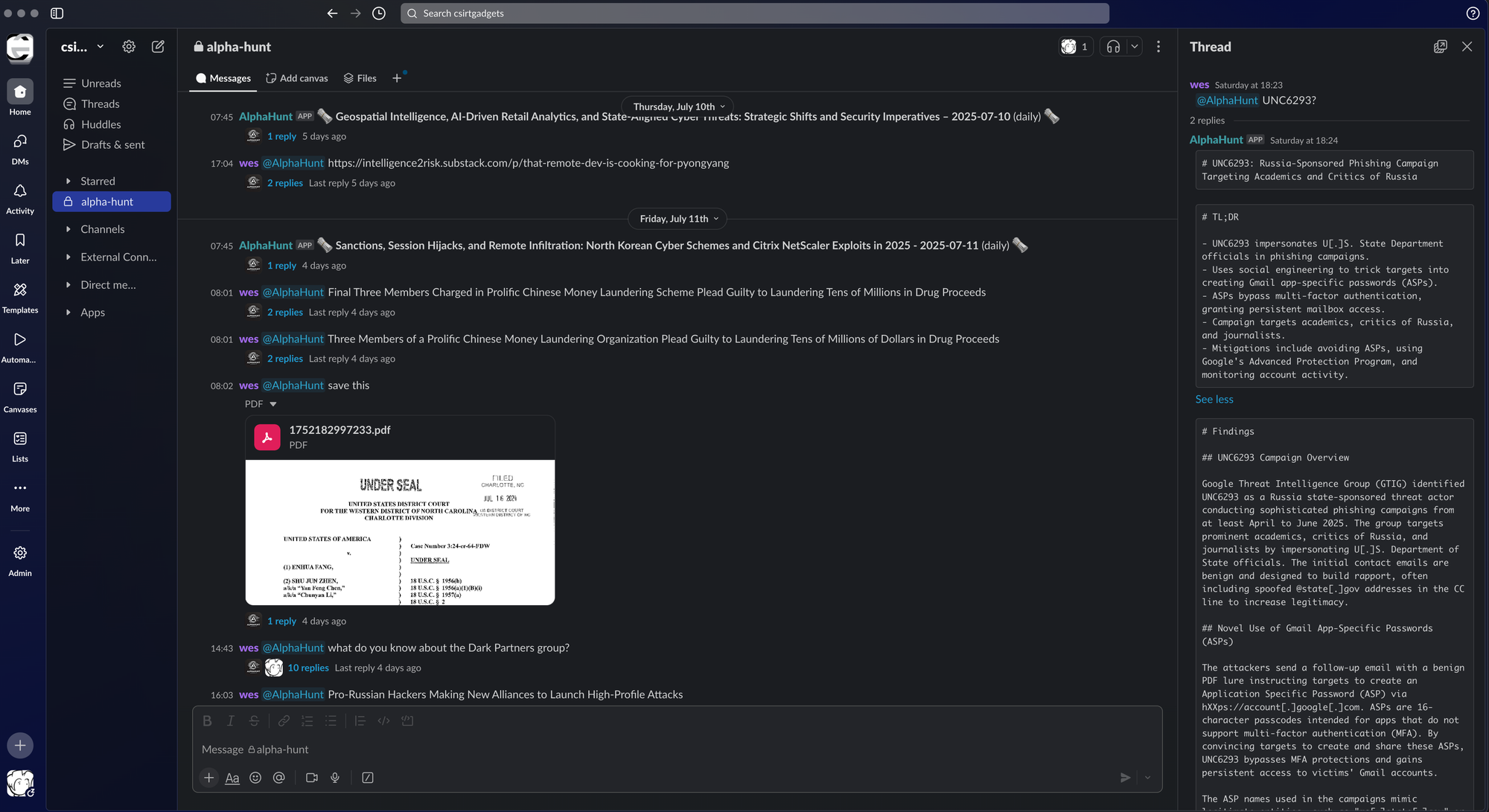
Get intelligence where it counts. No dashboards. No detours. AlphaHunt Converge teases out your intent, reviews the results and delivers actionable intel right inside Slack. We turn noise into signal and analysts into force multipliers.
Anticipate, Don’t Chase.
![[FORECAST] Will RedNovember be publicly reported to exploit at least one zero-day vulnerability in 2026? Updated 2026-03-24](/content/images/size/w600/2026/03/z-4.png)
![[DEEP RESEARCH] How Malware Uses Solana and EVM Chains to Rotate C2 Without Burning Infrastructure](/content/images/size/w600/2026/03/z-3.png)
![[SIGNALS WEEKLY] GitHub, npm, and Fake Interviews: Why Developer Supply Chain Attacks Are Converging](/content/images/size/w600/2026/03/zz-3.png)
![[FORECASTS] From Password Sprays to Tenant Sabotage: The 8-Week Iran Cyber Risk for U.S. and Israeli Orgs](/content/images/size/w600/2026/03/z-2.png)