[FORECAST] Integrator CI/CD Compromise by End-2026?
OWASP Top 10:2025 put Software Supply Chain Failures front-and-center. 🧩⚙️ Now the fun question: by end-2026, do we get public root-cause confirmation that an industrial integrator’s CI/CD/build/signing or update channel led to 2+ critical-infra intrusions? 😬
![[FORECAST] Integrator CI/CD Compromise by End-2026?](https://storage.ghost.io/c/06/e5/06e5730b-7d78-4713-9cec-6cba31d297f5/content/images/size/w1200/2026/01/z-6.png)
Question
By December 31, 2026, will there be a public confirmation that a compromise of an industrial vendor/integrator CI/CD pipeline or a signed software update channel was the root cause of intrusions at two or more qualifying critical-infrastructure operators (gas, petrochemical, nuclear-adjacent, or power)?
Executive Take
14% implies this is plausible but unlikely within 2026. The key hinge is whether investigators can publicly and explicitly confirm a single industrial vendor/integrator’s compromised build/signing/update channel as the root cause for intrusions at two or more qualifying operators. Watch for multi-victim advisories that include artifact-level evidence (signers/hashes/update domains) and clear initial-access attribution.
AlphaHunt
Stop doomscrolling, start decisioning. We chewed through the muck so your team doesn’t have to. → Subscribe!
Like this? Forward this to a friend!
(Have feedback? Did something resonate with you? Did something annoy you? Just hit reply! :))
Forecast Card
-
Question: By December 31, 2026, will there be a public confirmation that a compromise of an industrial vendor/integrator CI/CD pipeline or a signed software update channel was the root cause of intrusions at two or more qualifying critical-infrastructure operators (gas, petrochemical, nuclear-adjacent, or power)?
-
Resolution Criteria: YES if, by 2026-12-31 23:59 America/New_York, all conditions below are met:
- Supply-chain vector confirmed: A credible public source explicitly states that an industrial vendor/integrator’s (definition below) CI/CD/build pipeline or signed update channel was compromised and used to distribute or enable malicious access (e.g., trojanized installers/updates/firmware, compromised release artifacts, or compromised signing used for official distribution).
- Root cause confirmed: The same (or equally credible) public reporting explicitly identifies this compromise as the initial intrusion vector / root cause (not merely “possible,” “suspected,” or “under investigation”) for the intrusions at the victim operators.
- ≥2 distinct operators: The intrusions affected at least two distinct qualifying operators (definition below) in the specified sectors.
Operational definitions (for unambiguous resolution):
- Industrial vendor/integrator: A company whose primary products/services are used to monitor/control industrial processes or engineer/integrate/manage OT environments (e.g., DCS/SCADA/PLC/SIS vendors; historian/OT monitoring platforms; OT engineering/integration firms; OT managed service providers). Excludes general-purpose IT vendors unless the compromised product is explicitly OT/industrial-focused and used as such.
- CI/CD/build pipeline compromise: Unauthorized modification/control of source repos, build systems, artifact repositories, CI runners, or signing infrastructure used to produce release artifacts.
- Signed update channel compromise: Malicious code delivered via the vendor/integrator’s official update mechanism where updates are signed and trusted (e.g., trojanized signed updates, compromised update servers distributing signed packages, or stolen signing keys used to sign updates distributed via official channels).
- Operator (counting rules): A legal entity that owns/operates physical assets in the target sectors (e.g., pipeline operator, electric utility, refinery operator, generation/transmission operator).
- Subsidiaries/OpCos: Count as separate operators only if they are publicly identified as distinct victims and are distinct regulated operating companies (or clearly separate operating entities). Otherwise, count once at the parent/operator level.
- JVs: Count the JV as one operator if it operates the facility; do not separately count parent partners unless they are independently identified as victims of intrusions.
- Nuclear-adjacent: Operators of nuclear power plants or nuclear fuel-cycle / waste / decommissioning facilities (enrichment, conversion, fabrication, spent fuel/waste management). Excludes generic contractors unless they operate such facilities.
- Publicly confirmed: Government advisories (e.g., CISA/DOE/FBI), vendor postmortems, regulator filings, or operator statements qualify; investigative reporting qualifies if it includes explicit confirmation and is corroborated by at least one additional credible source.
-
Horizon: 2026-12-31
-
Probability (Now): 14% | Log-odds: -1.815
-
Confidence in Inputs: Med
-
Base Rate: 9% from an auditable two-step reference class:
Reference class construction (auditable):
- Window: 2020-01-01 through 2025-12-31.
- Inclusion rule: Publicly confirmed software supply-chain compromises involving (a) compromised CI/CD/build/release artifacts or (b) upstream source/release tarball compromise, documented in primary public sources.
- Counted events (denominator = 3):
- SolarWinds Orion code/build compromise (CISA emergency directive)
- xz/liblzma upstream repo + release tarballs backdoored (oss-security disclosure)
- tj-actions/changed-files GitHub Action compromise (CISA alert)
- Derived rate: 3 events / 6 years ≈ 0.5 events/year ⇒ probability of ≥1 such event in ~1 year ≈ 39% (Poisson approximation).
- Sector + attribution tightening: In the same set, 0/3 meet “industrial vendor/integrator + ≥2 qualifying operators + publicly confirmed root cause.” Using a weakly-informative prior (Jeffreys), conditional mean ≈ 12.5%; multiplying 39% × 12.5% ≈ 4.9%.
- Base-rate adjustment to 9%: Increased from 4.9% to 9% to account for (i) documented campaigns targeting energy/nuclear sectors via third parties (showing demand-side pressure toward supplier routes) and (ii) under-observability/selection bias in the small denominator (not industrial-focused).
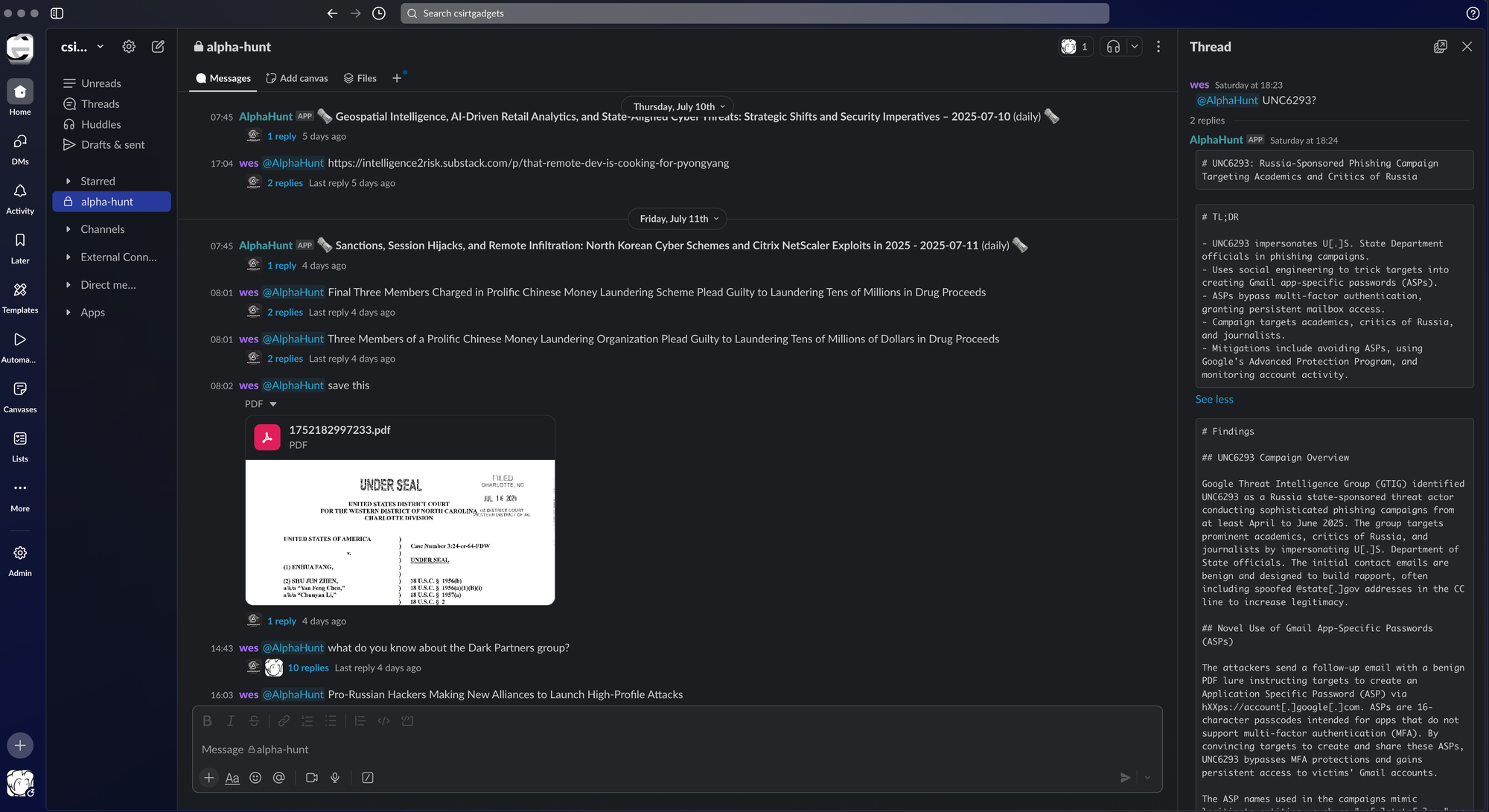
AlphaHunt Converge - Plug in your Flight Crew
Get intelligence where it counts. No dashboards. No detours. AlphaHunt Converge teases out your intent, reviews the results and delivers actionable intel right inside Slack. We turn noise into signal and analysts into force multipliers.
Anticipate, Don’t Chase.
![[DEEP RESEARCH] The registry did not see the breach. The runner did.](https://storage.ghost.io/c/06/e5/06e5730b-7d78-4713-9cec-6cba31d297f5/content/images/size/w600/2026/09/alphahunt-deep-research-the-registry-did-not-see-the-breach-the-runner-did-hero-2026-09-14.png)
![[SIGNALS WEEKLY] Control Planes Under Pressure: KEV, AI, and Identity](https://storage.ghost.io/c/06/e5/06e5730b-7d78-4713-9cec-6cba31d297f5/content/images/size/w600/2026/09/alphahunt-signals-weekly-control-planes-under-pressure-kev-ai-and-identity-hero-2026-09-15.png)
![[GAME THEORY] The Model Was Not Breached. It Was Mined.](https://storage.ghost.io/c/06/e5/06e5730b-7d78-4713-9cec-6cba31d297f5/content/images/size/w600/2026/09/alphahunt-game-theory-the-model-was-not-breached-it-was-mined-hero-2026-09-11.png)
![[GAME THEORY] The operator was not the customer. The quartermaster was.](https://storage.ghost.io/c/06/e5/06e5730b-7d78-4713-9cec-6cba31d297f5/content/images/size/w600/2026/09/alphahunt-game-theory-the-quartermaster-is-the-new-intrusion-broker-hero-2026-09-08.png)