[FORECAST] Fortune 500s: Will Prompt Injection Trick IDE Agent Mode into Running Commands—or Leaking Secrets—by 2026?
Recent agent-mode rollouts make ‘read files + run tasks’ normal. Prompt injection makes that risky. Here’s the forecast..

![[FORECAST] Fortune 500s: Will Prompt Injection Trick IDE Agent Mode into Running Commands—or Leaking Secrets—by 2026?](https://storage.ghost.io/c/06/e5/06e5730b-7d78-4713-9cec-6cba31d297f5/content/images/size/w1200/2026/02/z-10.png)
TL;DR
Question
By 2026-12-31, will there be a publicly confirmed intrusion chain at a Fortune 500 organization where prompt injection + base AI-IDE (IDE agent) features leads to (a) code execution or (b) secret exfiltration?
Strategic Forecast
24% means “plausible but not the default.” The technical path (prompt injection influencing an IDE agent with file/terminal/web tools) is well-supported in vendor docs and security research, but the forecast is throttled by whether at least one Fortune 500 incident both occurs and becomes public with enough detail to confirm prompt injection + base agent tooling as the chain. Watch for improved logging/IR language around “agent tool invocations” and for enterprise defaults that auto-approve or de-sandbox agent actions.
AlphaHunt
Stop doomscrolling, start decisioning. We chewed through the muck so your team doesn’t have to. → Subscribe!
Like this? Forward this to a friend!
(Have feedback? Did something resonate with you? Did something annoy you? Just hit reply! :))
Forecast Card
-
Question: By 2026-12-31, will there be a publicly confirmed intrusion chain at a Fortune 500 organization where prompt injection + base AI-IDE (IDE agent) features leads to (a) code execution or (b) secret exfiltration?
-
Resolution Criteria: YES if by 2026-12-31 (America/New_York) a credible public source set (vendor advisory, incident-response report, regulator filing, court filing, or well-sourced investigative reporting with technical corroboration) documents all of the following:
Victim qualification (Fortune 500):
- The victim is named or uniquely identifiable as a specific company, and
- That company appears on the Fortune 500 list published for the incident year (or, if the incident year is ambiguous, the most recently published Fortune 500 list prior to the incident date).
Operational audit step: match company name against the applicable Fortune 500 list snapshot; if subsidiary is named, treat as qualifying if it is wholly owned by the Fortune 500 parent and the parent is the materially impacted entity.
AI IDE / base features qualification:
- The compromise path involves an IDE-integrated AI assistant/agent (e.g., VS Code / Visual Studio class “agent mode” tooling; JetBrains-/other IDE equivalents), and the attacker leverages base/standard agent capabilities that are shipped with the IDE/official AI extension (not solely a bespoke internal tool).
The following qualify as “base IDE/agent features” for resolution:- Workspace file read (agent reads files in the open workspace / solution context).
- Workspace file edit / apply patch (agent writes/edits files in workspace, including config files if allowed).
- Terminal command execution via IDE-integrated terminal tool (whether or not it requires user approval).
- Built-in web/content fetch or embedded browser actions that can retrieve external content and/or make outbound requests (again, whether or not approval is required).
- Built-in VCS actions (e.g., git operations) if they are standard in the IDE flow and materially enable exfiltration (e.g., pushing secrets to a remote).
Prompt injection qualification:
- Prompt injection is a material causal step, including indirect prompt injection embedded in external content the agent ingests (issues/PRs/docs/web pages) that influences the agent’s subsequent actions.
Impact qualification (either is sufficient):
- Code execution: arbitrary command execution or equivalent execution of attacker-chosen code on a developer machine, devcontainer, build runner, or adjacent system in-scope of the IDE agent’s actions, OR
- Secret exfiltration: unauthorized transfer of credentials/tokens/keys/source code or other sensitive data outside the organization’s intended boundary.
NO if evidence is only lab PoC, rumor, or lacks enough technical detail to link prompt injection → base IDE/agent action → execution/exfil.
-
Horizon: 2026-12-31
-
Probability (Now): 24% | Log-odds: -1.15
-
Confidence in Inputs: Medium (technical feasibility is well-supported; “public confirmation with clear attribution” remains the largest uncertainty)
-
Base Rate: 20% from reference class: “Over ~2 years, probability of at least one publicly confirmed Fortune 500 incident involving a newly prominent developer-tool/agent workflow abuse that yields token/code exposure or execution.”
Caveat: this base rate is judgmental; the update below relies more heavily on observed feasibility and the disclosure/attribution bottleneck evidenced in primary vendor/security publications.
Decomposition (Auditability)
To make the 24% auditable and updateable, I model:
P(YES) ≈ P(S) × P(Pub | S) × P(Attr | S, Pub)
Where:
- S: ≥1 successful prompt-injection chain in a Fortune 500 involving base IDE/agent features that reaches execution or secret exfil (private reality, not necessarily disclosed).
- Pub|S: the incident becomes public in some form (org disclosure, regulator filing, IR write-up, vendor write-up, etc.).
- Attr|S,Pub: the public material includes enough technical attribution to meet the criteria (explicit or strongly evidenced linkage to prompt injection + base agent tools).
Current term values (calibrated to 24%):
- P(S) = 70%
- P(Pub|S) = 50%
- P(Attr|S,Pub) = 69%
Product: 0.70 × 0.50 × 0.69 ≈ 0.24
What would move each term?
P(S) — “exploit succeeds in at least one F500”
▲ Up if: more autonomy/tool scope becomes default (terminal + network + broader file scope); more evidence that tool approvals can be bypassed or habituated; widespread enablement of auto-approve patterns; more “agent mode everywhere” adoption.
▼ Down if: strong defaults (sandboxing, blocked network by default, strict file boundaries), enterprise policies disabling risky tool categories, and better guardrails around fetching/untrusted content become standard and enforced.
P(Pub|S) — “public disclosure happens”
▲ Up if: regulator regimes/contractual notification requirements push more transparency; incidents cause customer impact or IP leak that can’t be contained quietly.
▼ Down if: incidents are contained quickly, framed generically (“credential theft”), handled under NDA, or deemed immaterial for disclosure thresholds.
P(Attr|S,Pub) — “attribution meets criteria”
▲ Up if: vendors/IR firms start naming “prompt injection / agent tool misuse” as a standard root-cause category, including tool logs and agent transcripts as evidence.
▼ Down if: disclosures remain high-level, omit AI tooling details, or forensics cannot distinguish “agent acted” from “developer acted.”
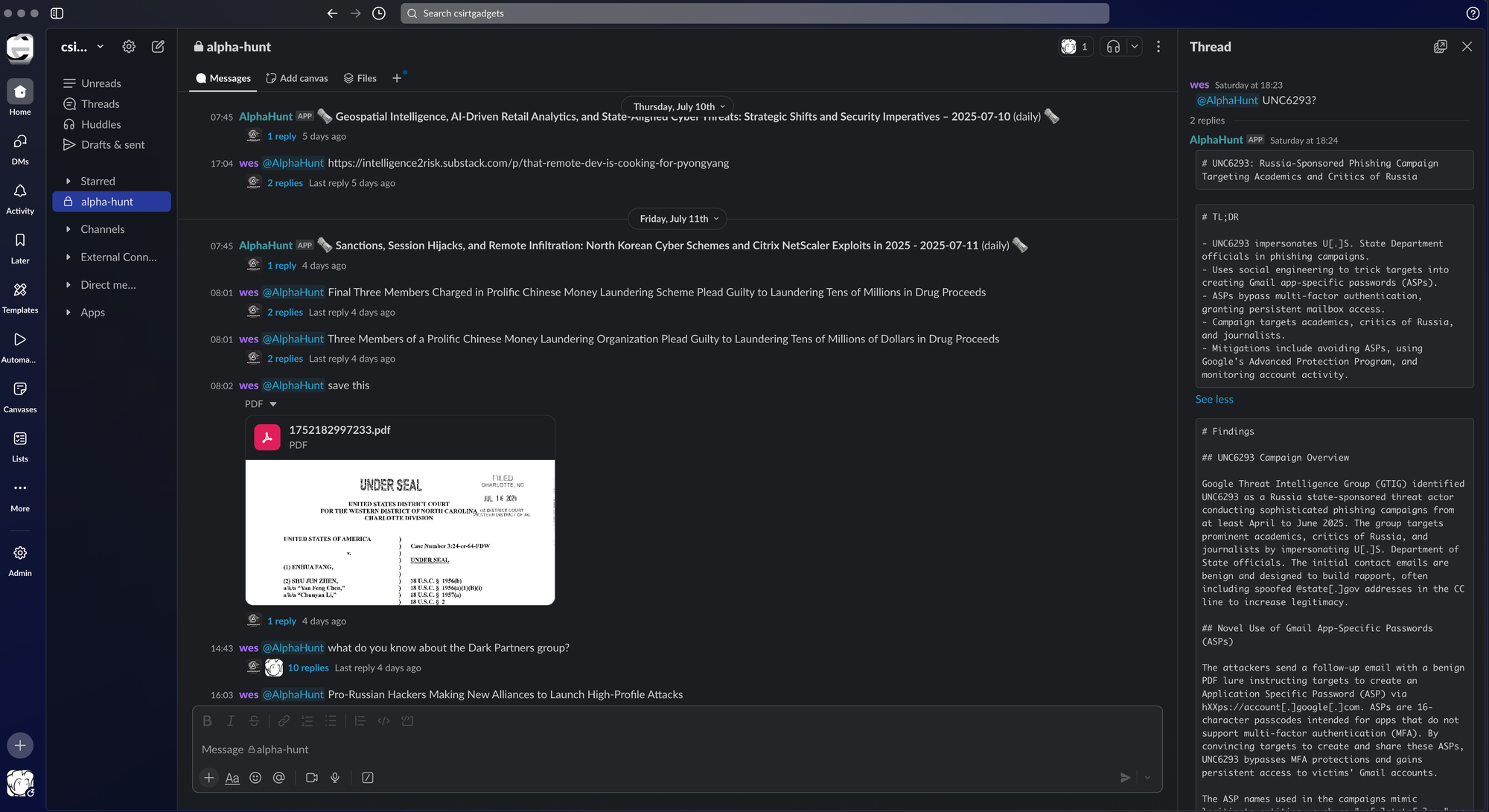
AlphaHunt Converge - Plug in your Flight Crew
Get intelligence where it counts. No dashboards. No detours. AlphaHunt Converge teases out your intent, reviews the results and delivers actionable intel right inside Slack. We turn noise into signal and analysts into force multipliers.
Anticipate, Don’t Chase.
![[FORECAST] Iran’s Cyber Window Stays Open—But the Novelty Bar Is Tougher Now (Updated: 2026-04-23)](https://storage.ghost.io/c/06/e5/06e5730b-7d78-4713-9cec-6cba31d297f5/content/images/size/w600/2026/04/z-9.png)
![[SIGNALS WEEKLY] Quiet Shifts In Tradecraft, Loud Signals In Exposure](https://storage.ghost.io/c/06/e5/06e5730b-7d78-4713-9cec-6cba31d297f5/content/images/size/w600/2026/04/z-8.png)
![[RESEARCH] CPU-Z was the lure. The real story is who buys the foothold.](https://storage.ghost.io/c/06/e5/06e5730b-7d78-4713-9cec-6cba31d297f5/content/images/size/w600/2026/04/z-7.png)
![[FORECAST] Two New App-Layer Campaigns by Year-End? Watch the Attribution Line](https://storage.ghost.io/c/06/e5/06e5730b-7d78-4713-9cec-6cba31d297f5/content/images/size/w600/2026/04/z-6.png)