Deepfake BEC & Payment Diversion: The Q1 2026 Fraud PIR You Can’t Defer
Deepfake BEC = the same old fraud… with a way better script. 🎭💸 If payroll/AP changes can happen on “sounds right,” you’re funding someone’s Q1 bonus.

TL;DR
-
PIRs keep security focused on the few threat questions that materially change decisions, reducing noise and enabling faster, defensible prioritization with limited resources.
-
PIR #1: Track ransomware/extortion pathways tied to KEV exploitation + identity compromise; fastest route to enterprise-scale disruption.
-
PIR #2: Prioritize AI-accelerated social engineering (BEC/payment diversion, deepfake-enabled impersonation); highest fraud ROI for adversaries.
-
PIR #3: Treat software/supplier concentration and supply chain compromise as a first-order risk driver (SaaS, third parties, poisoned updates).
AlphaHunt
Stop doomscrolling, start decisioning. We chewed through the muck so your team doesn’t have to. → Subscribe!
Like this? Forward this to a friend!
(Have feedback? Did something resonate with you? Did something annoy you? Just hit reply! :))
What is a PIR?
PIRs (Priority Intelligence Requirements) matter because they turn “we should pay attention to threats” into a small set of answerable questions that directly drive better security
decisions.
-
They focus limited time and budget on what changes risk most. Instead of tracking everything, you track what would materially change priorities (patching, controls, vendor decisions).
-
They improve speed and consistency in decisions. PIRs define what you need to know before acting, reducing ad hoc judgment during incidents.
-
They align security with business impact. A good PIR ties threats to outcomes (ransomware downtime, payment fraud loss, student data exposure), making prioritization
defensible. -
They make detection and response measurable. PIRs translate into concrete collection needs (logs, telemetry, vendor signals) and success criteria (time-to-detect, exposure
reduction). -
They reduce noise. PIRs help you say “no” to low-value alerts, reporting, and threat feeds that don’t affect your environment.
Ranked PIRs
| Rank | PIR | Why it matters across the 3 sectors | Probability of adoption (Q1 2026) |
|---|---|---|---|
| 1 | Ransomware + data extortion initial access (KEV + identity) | Extortion/ransomware is a dominant driver of motivated incidents; education is a known preference; KEV exploitation keeps compressing time-to-compromise. | 0.85 |
| 2 | AI-enabled social engineering and payment fraud | Cyber-enabled fraud is scaling; GenAI increases realism and throughput (phishing/vishing/deepfake), directly impacting finance and payroll/AP in all sectors. | 0.75 |
| 3 | Supply chain & shared-service systemic risk (vendors, SaaS, updates, open source) | Ecosystem interdependencies and SBOM-driven governance pressures increase; a single supplier compromise can cascade across many orgs. | 0.65 |
PIR #1 — Ransomware + data extortion initial access (KEV + identity)
-
Intelligence requirement: Identify which internet-facing assets and identity paths are most likely to be used for initial access (KEV CVEs, VPNs, hypervisors, backup
systems). -
What to collect/answer in Q1:
-
Which KEV entries map to our exposed perimeter and remote access stack, and which are being linked to ransomware activity?
-
Which identity abuse patterns (credential stuffing, password spraying, token theft) are most prevalent in our environment and vendors?
-
PIR #2 — AI-enabled social engineering and payment fraud
-
Intelligence requirement: Determine the top fraud playbooks targeting finance operations (wire diversion, invoice manipulation, payroll reroute), and which roles/workflows
are most exploitable. -
What to collect/answer in Q1:
-
Which business processes can be coerced without technical compromise (approvals, vendor onboarding, payment changes)?
-
Where are “trust signals” weakest (voice calls, SMS, helpdesk, executive impersonation)?
-
PIR #3 — Supply chain & shared-service systemic risk
-
Intelligence requirement: Maintain a current view of critical dependencies (SaaS, managed services, key libraries) and supplier compromise signals that could create
correlated failure. -
What to collect/answer in Q1:
-
Which vendors/components represent single points of failure, and what evidence exists of supply chain targeting relevant to them?
-
Where do we lack SBOM/visibility into transitive dependencies and update channels?
-
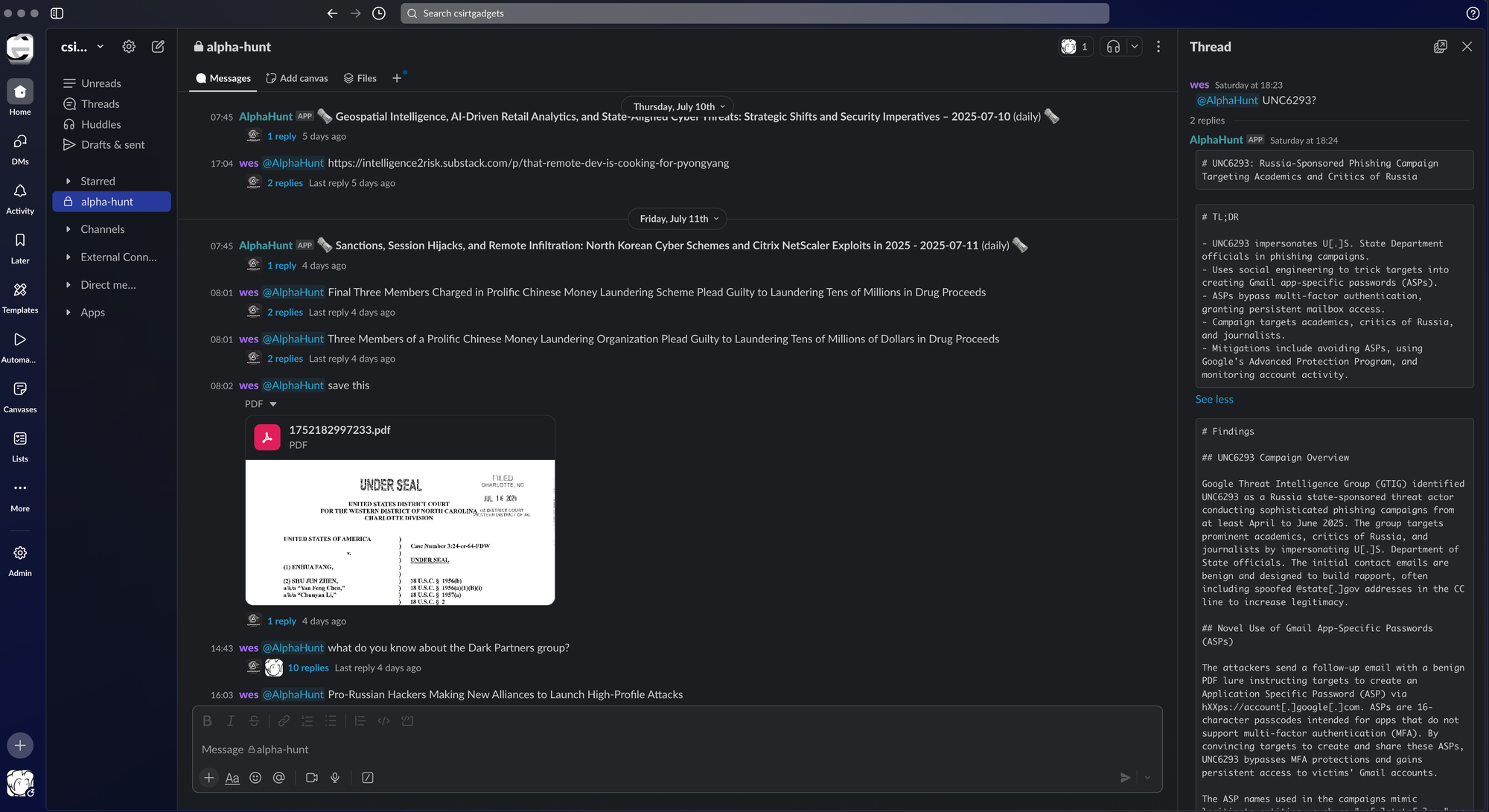
AlphaHunt Converge - Plug in your Flight Crew
Get intelligence where it counts. No dashboards. No detours. AlphaHunt Converge teases out your intent, reviews the results and delivers actionable intel right inside Slack. We turn noise into signal and analysts into force multipliers.
Anticipate, Don’t Chase.
![[GAME THEORY] The Recruiter Was Also the Quartermaster](https://storage.ghost.io/c/06/e5/06e5730b-7d78-4713-9cec-6cba31d297f5/content/images/size/w600/2026/09/alphahunt-game-theory-the-recruiter-was-also-the-quartermaster-hero-2026-10-01.png)
![[SIGNALS WEEKLY] Edge Intrusions, Cloud Identity Abuse, and Quiet OT Risk](https://storage.ghost.io/c/06/e5/06e5730b-7d78-4713-9cec-6cba31d297f5/content/images/size/w600/2026/09/alphahunt-signals-weekly-edge-intrusions-cloud-identity-abuse-and-quiet-ot-risk-hero-2026-09-29.png)
![[FORECAST] The next inbox breach will be a collection pipeline](https://storage.ghost.io/c/06/e5/06e5730b-7d78-4713-9cec-6cba31d297f5/content/images/size/w600/2026/09/alphahunt-forecast-the-next-inbox-breach-will-be-a-collection-pipeline-hero-2026-09-29.png)
![[DEEP RESEARCH] The Token Was Not a Session. It Was a Signing Dependency.](https://storage.ghost.io/c/06/e5/06e5730b-7d78-4713-9cec-6cba31d297f5/content/images/size/w600/2026/09/alphahunt-deep-research-the-token-was-not-a-session-it-was-a-signing-dependency-hero-2026-09-21.png)