
[DEEP RESEARCH] Who’s Most Likely to Abuse MCP Integrations? UNC3944, TraderTraitor, UNC6293
Three intrusion sets already excel at getting users to approve tools and auth flows. This assessment is probabilistic: it highlights who is best positioned to adapt that tradecraft to MCP-style environments next..

![[DEEP RESEARCH] Who’s Most Likely to Abuse MCP Integrations? UNC3944, TraderTraitor, UNC6293](/content/images/size/w1200/2026/03/z.png)
TL;DR
Key Points
- Prioritize MCP-related defenses for UNC3944, TraderTraitor (UNC4899 / Slow Pisces), and UNC6293 based on existing, observed tradecraft.
- Expect authorized tool/integration abuse, not exploits: “add this connector,” “run this repo,” “approve this device.”
- UNC3944: help desk and identity workflows in large, SaaS-heavy enterprises.
- TraderTraitor: developer workstations, code/package ecosystems, and cloud control planes.
- UNC6293: mailbox/document access via legitimate auth features and delegated access.
AlphaHunt
Stop doomscrolling, start decisioning. We chewed through the muck so your team doesn’t have to. → Subscribe!
Like this? Forward this to a friend!
(Have feedback? Did something resonate with you? Did something annoy you? Just hit reply! :))
The story in 60 seconds
This product ranks three intrusion sets as most likely to adopt MCP-style authorized tool/integration abuse quickly, based on current public reporting. UNC3944 leans on social engineering of help desks and users to reset credentials, change MFA, and install remote tools for fast extortion. TraderTraitor convinces developers to run trojanized tools and packages, then steals keys and cloud credentials for direct theft and downstream compromise. UNC6293 persuades high-value targets to use features like application-specific passwords and device-code flows to grant long-lived mailbox and document access.
In MCP-like workflows, these actors would use the same pattern: get a user or admin to authorize a tool or integration, then use its delegated access to pull data from mail, docs, repos, and chat via normal APIs, and potentially adjust identity or cloud control-plane settings. Early incidents will likely be labeled as “connected app abuse” or “OAuth misuse,” not as new exploit classes.
Defenders should plan as if these techniques will be reused against MCP-style environments: focus on who can approve tools/integrations, how delegated access is monitored and revoked, and how developer tooling and auth features can be turned into quiet persistence.
High Impact, Quick Wins
-
Lock down high-scope integrations as privileged objects.
Apply privileged-account-style controls to tools/integrations with broad read scopes (for example,Mail.ReadWrite.All,Files.Read.All,Sites.Read.All,Chat.Read.All): require approvals, owners, and least-privilege scopes; alert when new consents are followed by bulk SaaS exports. -
Isolate untrusted dev tooling and cut endpoint secrets.
Run recruiter-sent Git repos, coding challenges, and unfamiliar tools only in isolated VMs or non-corporate environments; aggressively reduce long-lived keys/tokens on developer machines to blunt TraderTraitor-style pivots into cloud and SaaS. -
Remove easy “legitimate” footholds in auth.
Disable or tightly restrict ASPs and risky device-code flows; limit self-service MFA changes for admins and high-risk users; enforce phishing-resistant MFA and strong help desk verification so UNC6293- and UNC3944-style access cannot be gained with a single conversation.
Why it matters
SOC
-
Alert on high-risk integration events (IdP and SaaS audit logs).
- Detect creation or first consent of OAuth apps, service principals, or integrations with broad scopes such as
Mail.ReadWrite.*,Files.Read.*,Sites.Read.All,Chat.Read.*(T1213). - Alert when a newly approved app immediately performs large
Export,List, orSyncoperations against mailboxes, file stores, repos, or chat (T1567.002). - Correlate consent events that occur shortly after password reset or MFA re-registration on the same account (T1078, T1556).
- Detect creation or first consent of OAuth apps, service principals, or integrations with broad scopes such as
-
Correlate identity changes with help desk and MSP activity.
- Use IdP admin logs, SaaS admin logs, and ITSM tickets to link password resets, MFA changes, and device registrations to specific help desk or MSP actions (T1199).
- Alert when those changes are followed by first-time sign-ins from new devices/locations and by new app or service principal creation.
-
Watch developer endpoints for pre-cloud compromise signals.
- Detect execution of new Git projects or installer scripts originating from email, chat, or LinkedIn messages on developer machines (T1204.002).
- Alert on processes reading
~/.ssh/*, cloud CLI configs (for example,~/.aws/credentials,~/.config/gcloud/*), and token stores just before new cloud logins or API keys are observed (T1552.001, T1552.004).
IR
-
Collect the full authorization trail early.
- Export IdP and SaaS audit logs for sign-ins, OAuth consents, ASP creation, device-code events, MFA changes, and service principal creation or modification (T1078, T1556).
- Pull SaaS app-level logs showing which integration accessed which mailbox, site, repo, or chat and when (T1213.003, T1213.005).
-
Hunt for delegated-access persistence.
- Enumerate active OAuth apps, service principals, refresh tokens, ASPs, and device-linked sessions associated with compromised identities.
- Flag delegated apps with broad scopes created or consented close to the suspected intrusion window and treat them as potential persistence points.
-
Contain via revocation and rotation, not just re-imaging.
- Revoke tokens, ASPs, device links, and consents; disable or delete malicious apps/service principals before rotating passwords and MFA.
- Rotate any keys and configs retrieved from developer machines or build systems where suspicious tools or repos were executed.
-
Guide red-team exercises.
- Simulate UNC3944-style flows (help desk-driven resets → integration approval) and TraderTraitor-style flows (recruiter repo → secrets theft → cloud pivot) to validate detection and containment steps.
SecOps
-
Apply privileged-approval workflows to integrations.
- Reuse existing privileged access management patterns (request, approval, owner-of-record, periodic review) for any integration that can read mail, docs, chat, tickets, or repos.
- Enforce policies that block end-user self-approval of high-scope apps; require admin approval with documented justification.
-
Standardize secure developer workflows.
- Require that recruiter coding challenges and unfamiliar Git repos run only in designated sandboxes or lab machines.
- Integrate package and dependency governance into CI/CD and internal registries to limit unvetted tools from npm, PyPI, and other ecosystems (T1195.001).
-
Harden identity control-plane operations.
- Enforce step-up verification or dual control for MFA resets and new device registrations for admins and high-risk users.
- Regularly review and prune ASPs, legacy auth, and long-lived OAuth consents; prioritize high-risk accounts and admin roles.
Strategic
- Use existing OAuth and connector controls to manage MCP-style risk.
- Govern MCP-style tools as connected apps: controlled onboarding, minimal scopes, owner accountability, periodic review, and standard revocation procedures.
- Raise expectations for partners and MSPs.
- Require strong identity verification, logging, and change records for any third party performing account, MFA, or integration changes.
- Invest in SaaS and identity observability.
- Ensure you can quickly answer: which tools/integrations exist, who approved them, what scopes they have, and what data they have accessed.
AlphaHunt Converge - Plug in your Flight Crew
Get intelligence where it counts. No dashboards. No detours. AlphaHunt Converge teases out your intent, reviews the results and delivers actionable intel right inside Slack. We turn noise into signal and analysts into force multipliers.
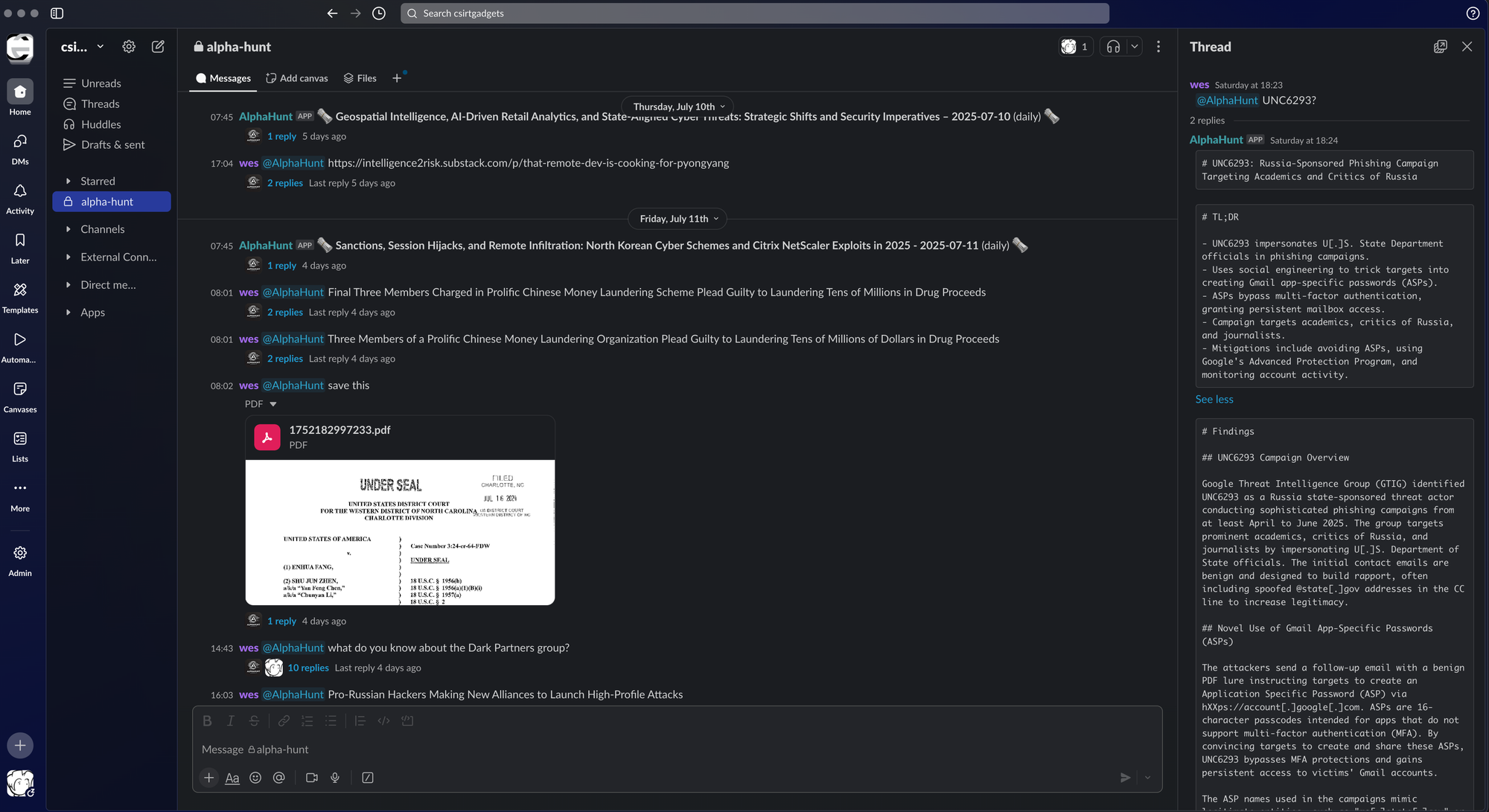
Anticipate, Don’t Chase.
See it in your telemetry
Network
-
Inspect outbound SaaS and cloud-storage traffic.
- Monitor for new or rarely seen app IDs or user agents generating large volumes of API calls or exports to collaboration and storage platforms (T1567, T1567.002).
- Baseline normal API traffic for mail, files, repos, and chat, and alert when a new client deviates sharply from those baselines.
-
Correlate help desk and MSP ranges with critical changes.
- Tag IP ranges used by help desks and MSPs and correlate them with IdP and SaaS admin actions (resets, MFA changes, app creation, consent grants) and subsequent increases in data access (T1199).
-
Monitor developer egress patterns.
- Track first-time connections from developer subnets to code and package sites such as GitHub, GitLab, npm, and PyPI followed by bulk pulls or new cloud API calls using previously unseen credentials.
Endpoint
-
Detect untrusted tool and repo execution.
- Alert when users run Git projects, installers, or scripts sourced from email or chat, especially on developer endpoints (T1204.002).
- Use EDR telemetry to detect Python or Node-based tools that start reading typical config and credential paths (for example,
.ssh,.aws,.config/gcloud,.kube) (T1059.006, T1552.001).
-
Watch for secrets and config harvesting.
- Monitor processes that open SSH private keys, cloud provider credentials, and CI/CD config files outside of approved developer or automation tools (T1552.004).
- Detect creation of files that resemble aggregated key or credential dumps and tie them to the originating process.
-
Control remote support tooling.
- Enforce allowlists for remote access and tunneling tools; alert on new installations or first use of remote support software, especially when it coincides with identity or integration changes linked to help desk activity.
DEEP RESEARCH: The top 3 intrusion sets / threat-actors most likely to leverage MCP-style “tool poisoning” (based on proven tradecraft)
(Save time mitigating these actors by signing up for a paid subscription!)
TL;DR
- UNC3944 (Scattered Spider / Octo Tempest) is the...
![[SIGNALS WEEKLY] Ransomware’s New Priority Targets—Hypervisors, Recovery Paths, and Control Planes](/content/images/size/w600/2026/03/z-5.png)
![[FORECAST] Will RedNovember be publicly reported to exploit at least one zero-day vulnerability in 2026? Updated 2026-03-24](/content/images/size/w600/2026/03/z-4.png)
![[DEEP RESEARCH] How Malware Uses Solana and EVM Chains to Rotate C2 Without Burning Infrastructure](/content/images/size/w600/2026/03/z-3.png)
![[SIGNALS WEEKLY] GitHub, npm, and Fake Interviews: Why Developer Supply Chain Attacks Are Converging](/content/images/size/w600/2026/03/zz-3.png)