[DEEP RESEARCH] Token Factory: The 5 Costliest US Breaches of 2025
2025’s costliest US breaches: identity, outage math, outcomes Identity-led intrusions at distributors, govtech, healthcare, and an appliance vendor drove nine-figure losses. Outage duration and revocation speed determined the spread between disruption and recovery.

![[DEEP RESEARCH] Token Factory: The 5 Costliest US Breaches of 2025](/content/images/size/w1200/2026/01/z.png)
Editors Note: This is PART 2 in this series. In part 1, we skim the surface, in part two, we dive deep. Get your helmet!
TL;DR
Key Points
- Prioritize control planes and identity providers (IdPs) as tier‑0 to shrink blast radius
- Stand up a revocation factory to revoke tokens/credentials and rollback OAuth consents using continuous access evaluation (CAE)
- Enforce just‑in‑time (JIT) privileged access management (PAM) with security‑key–protected admin access on marketplaces, license portals, and research enclaves
- Institutionalize manual continuity for order‑to‑cash and clinical operations to cap losses
The story in 60 seconds
Five incidents dominated 2025 US economic impact: Ingram Micro (global order‑to‑cash outage; 4‑day core operations restore), Conduent (govtech disruption; 10.5M notified), Kettering Health (system‑wide ransomware; ~21‑day restoration), F5 (BIG‑IP source and undisclosed vulnerabilities exfiltrated; 7–16‑day federal directive windows), and Sensata (manufacturing disruption). Confirmations came via 8‑Ks, status pages, and advisories.
Common TTPs: T1078 Valid Accounts and T1098 Account Manipulation for persistence, T1556 Modify Authentication Process and T1041 Exfiltration Over C2 for data theft, T1486 Data Encrypted for Impact for ransomware, and T1213.003 Code Repositories for source theft. Two metrics correlated with losses: time‑to‑revoke (TTR) across users/service principals (SPNs)/tokens, and time‑to‑restore core operations (TTRc).
What changed outcomes: tier‑0 isolation of control planes and research networks, an enterprise revocation factory with CAE/Universal Logout coverage, and drilled manual continuity standard operating procedures (SOPs) for order‑to‑cash and clinical care.
AlphaHunt
Stop doomscrolling, start decisioning. We chewed through the muck so your team doesn’t have to. → Subscribe!
Like this? Forward this to a friend!
(Have feedback? Did something resonate with you? Did something annoy you? Just hit reply! :))
High Impact, Quick Wins
- Automate org‑wide token/credential revocation and consent rollback; target TTR in minutes and ≥90% app coverage
- Gate tier‑0 systems behind JIT/PAM with security‑key–protected admin access; cap privileged API requests per second (RPS)
- Drill manual continuity for top revenue/safety processes; target TTRc to first sustained throughput ≥70% baseline
Why it matters
SOC
- Monitor marketplace/license API error spikes >20% and privilege API bursts; throttle and page app owner (T1499 Endpoint/Service DoS)
- Monitor repo/knowledge base (KB) egress >3x baseline from research subnets; isolate host and review T1213.003 Code Repositories and T1041 Exfiltration Over C2
- Monitor sudden SPN consent grants or long‑lived refresh token reuse; revoke and pivot on T1078 Valid Accounts and T1098 Account Manipulation
IR
- Execute enterprise revoke and consent rollback for users and SPNs; drive TTR from hours to minutes
- Preserve IdP/OAuth/SPN logs, repo access records, and EDR timelines; scope T1213.003 Code Repositories and T1041 Exfiltration Over C2
- Run parallel tracks for revocation, continuity, and enclave rebuild; measure TTRc to first sustained throughput
SecOps
- Enforce phishing‑resistant MFA for admins/vendors; rotate SPN keys ≤30 days and apply JIT elevation
- Enable CAE/Universal Logout and integrate revoke/rotate runbooks into SOAR
- Allow‑list egress from research enclaves and require signed, provenance‑verified pipeline artifacts
Strategic
- Add revocation SLAs, consent rollback, and vendor off‑ramps to contracts; plan against 7–16‑day directive windows
- Fund quarterly downtime drills to hit 4‑day distributor TTRc and <14‑day hospital TTRc
- Pre‑stage disclosure and customer/partner communications to limit churn and spillovers
See it in your telemetry
Network
- alert on research subnet egress >3x 7‑day median to code/object stores; quarantine host and block exfil path (T1213.003 Code Repositories, T1041 Exfiltration Over C2)
- alert on privileged marketplace/license API bursts >2x normal RPS or >20% error rate; throttle and page service owner (T1499 Endpoint/Service DoS)
- alert on VPN/Citrix logins from new geo/device followed by SMB/RDP; force reauth and disable tokens (T1133 External Remote Services, T1021 Remote Services)
Endpoint
- SOC: detect new scheduled tasks/services on admins; block and collect for triage (T1053.005 Scheduled Task, T1543 Create or Modify System Process)
- IR: hunt LSASS access and token theft; isolate host and rotate affected identities (T1078 Valid Accounts)
- SecOps: detect rapid file rename bursts and shadow copy deletions; isolate asset and trigger continuity SOPs (T1486 Data Encrypted for Impact)
AlphaHunt Converge - Plug in your Flight Crew
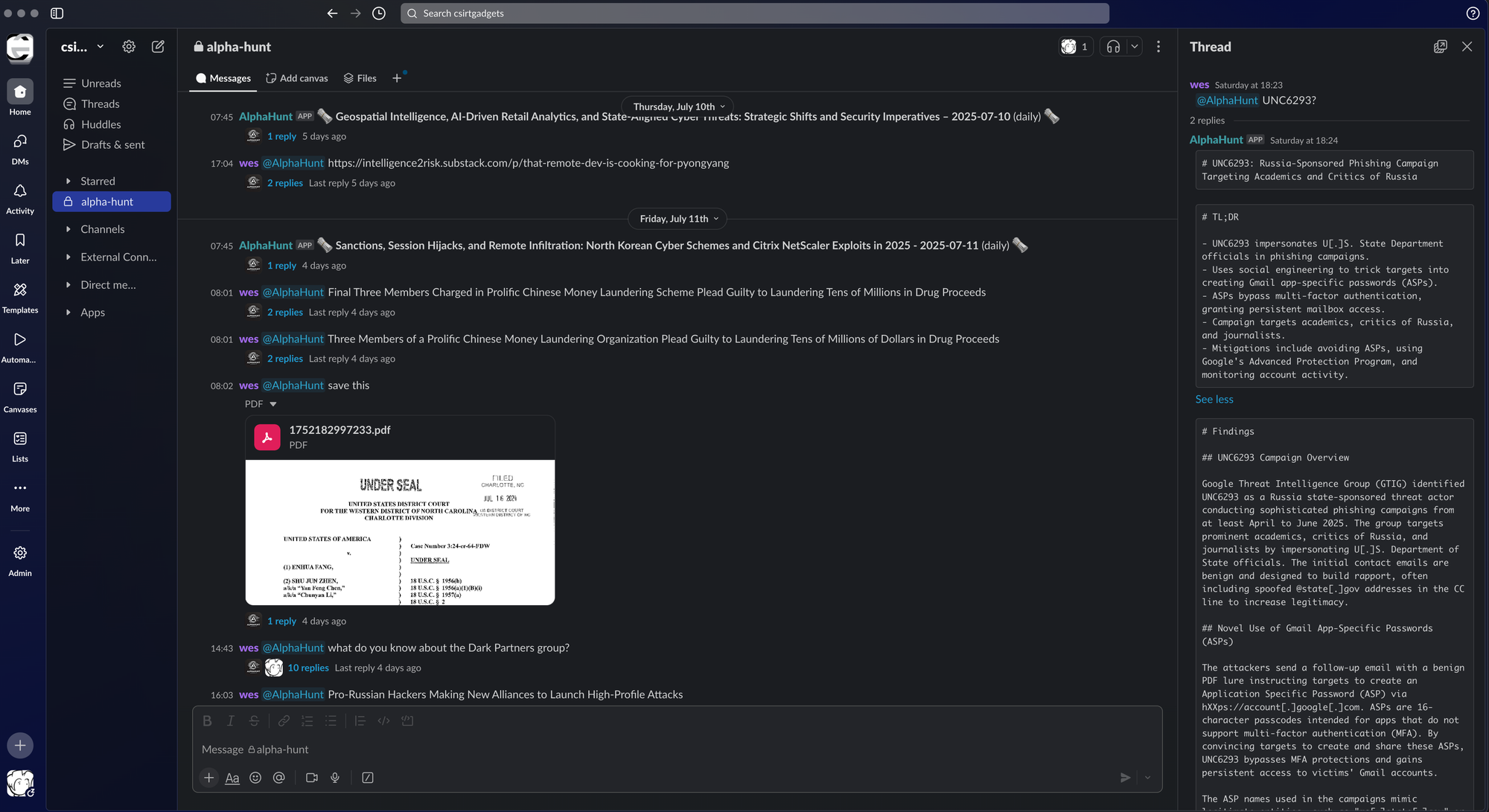
Get intelligence where it counts. No dashboards. No detours. AlphaHunt Converge teases out your intent, reviews the results and delivers actionable intel right inside Slack. We turn noise into signal and analysts into force multipliers.
Anticipate, Don’t Chase.
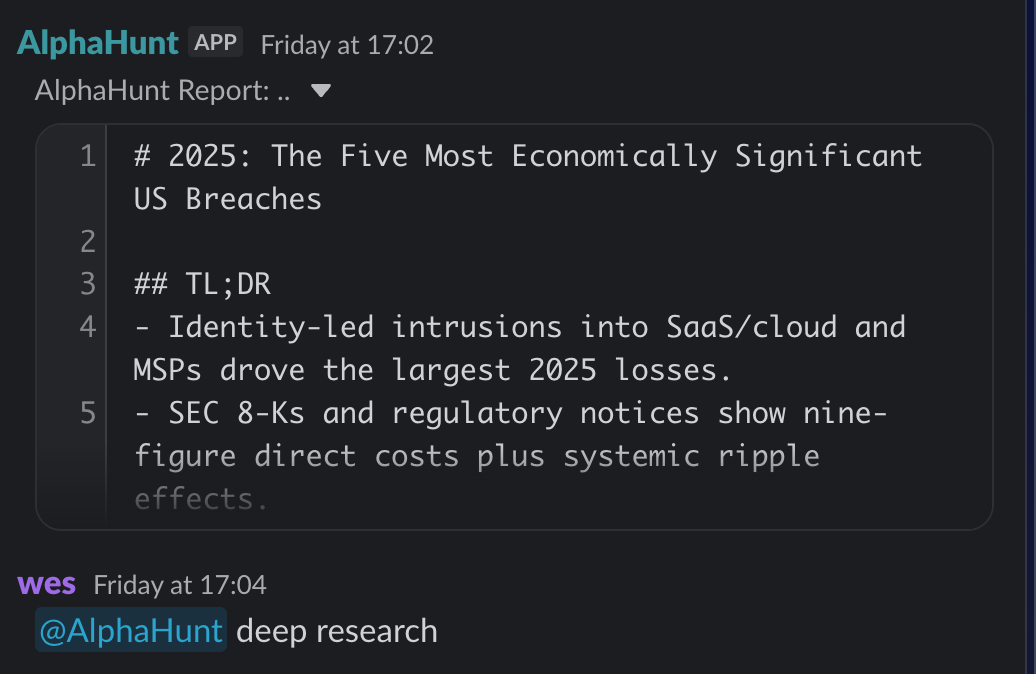
2025’s Five Most Economically Significant US Breaches: Impact, Drivers, and Actions That Changed Outcomes
TL;DR
- Identity-led intrusions into distributors, govtech, healthcare, and platform vendors drove the largest US losses in 2025.
- Outage duration and token/credential revocation speed were the biggest multipliers of economic damage.
- First-party 8‑K disclosures and hospital status pages confirm material operational disruptions with nine-figure cost potential.
- Vendor off-ramps, consent governance, and just-in-time admin sharply limited blast radius and recovery time.
- Lessons: Treat MSP/control planes and research pipelines as tier-0, pre-stage revocation, and drill manual continuity for revenue- or safety-critical services.
Top Incidents Ranked by Estimated Economic Impact (USD)
| Rank | Organization | Sector | Incident Window (2025) | Estimated Impact (range) | What Drove Costs | Primary confirmations |
|---|---|---|---|---|---|---|
| 1 | Ingram Micro | Tech distribution/MSP | 2025-07 | $350M–$550M | Global order-to-cash outage: halted processing/shipping; surge logistics; IR; churn risk | SEC 8‑K; TechCrunch outage details |
| 2 | Conduent (state services) | Govtech/services | 2025-01 → 2025-11 | $150M–$300M | Multi-state service disruption; >10M notifications; legal/regulatory; program reprocessing | TechCrunch outage; HIPAA Journal breach/costs |
| 3 | Kettering Health | Healthcare | 2025-05 → 2025-06 | $80M–$150M | System-wide outage; canceled procedures/diversions; IR; data access; recovery staffing | Kettering status page; CNN; The Record; HIPAA Journal |
| 4 | F5 | Software/platform | 2025-08 → 2025-10 | $60M–$120M | Stolen BIG‑IP source code + undisclosed vulns; emergency patching; customer support; trust | CyberScoop on 8‑K; follow-up on impacts |
| 5 | Sensata Technologies | Industrial/manufacturing | 2025-04 | $40M–$90M | Ransomware encrypted devices; shipping/receiving/manufacturing disruption; expedited recovery | The Register on SEC 8‑K disclosure |
Notes on ranges: These are conservative, source-bounded estimates triangulating outage scope/duration, sector margins, disclosure language, and analog incidents. Where filings quantified partial costs (e.g., segment of notification spend), those are treated as lower bounds and do not include broader business interruption unless stated.
Methods: How We Estimated Impact Ranges
- Context summary: Public filings and first-party statements anchor scope/timeline; reputable reporting fills operational details. Economic impact = direct breach/IR + business interruption + recovery/notifications + legal/regulatory + probable churn, conservatively bounded.
- Approach:
- Anchor each incident with first-party artifacts (SEC 8‑K, official status/press) to confirm timing, disruption class, and materiality.
- Map outage type to sector revenue loss/day and recovery pattern using hospital elective revenue, distributor order-to-cash dependencies, and software vendor emergency patch cycles.
- Add documented/anticipated notification and IR costs; include litigation/regulatory exposure if disclosed or typical for scale.
- Bound with analogs and exclude speculative multipliers.
- Caveats:
- Some companies explicitly state “no material impact” for a quarter; that can exclude forward costs or externalities.
- Ranges emphasize internal costs; sectoral spillovers (e.g., supplier/customer costs) are qualitatively discussed, not monetized.
![[FORECASTS] From Password Sprays to Tenant Sabotage: The 8-Week Iran Cyber Risk for U.S. and Israeli Orgs - UPDATED: 2026-03-26](/content/images/size/w600/2026/03/z-6.png)
![[SIGNALS WEEKLY] Ransomware’s New Priority Targets—Hypervisors, Recovery Paths, and Control Planes](/content/images/size/w600/2026/03/z-5.png)
![[FORECAST] Will RedNovember be publicly reported to exploit at least one zero-day vulnerability in 2026? Updated 2026-03-24](/content/images/size/w600/2026/03/z-4.png)
![[DEEP RESEARCH] How Malware Uses Solana and EVM Chains to Rotate C2 Without Burning Infrastructure](/content/images/size/w600/2026/03/z-3.png)