
CISA Flags Dell RecoverPoint Zero-Day: Backup Systems as the New Beachhead
Your backup system isn’t your parachute. It’s a beachhead. 🏖️ Mandiant/GTIG report UNC6201 exploiting Dell RP4VM (CVE-2026-22769, CVSS 10.0). Hardcoded credential → OS-level control + root persistence.


TL;DR
- Mandiant + Google Threat Intelligence Group (GTIG) report that UNC6201 (tracked as a suspected PRC-nexus cluster) is exploiting a Dell RecoverPoint for Virtual Machines (RP4VM) zero-day: CVE-2026-22769.
- Dell rates CVE-2026-22769 as Critical (CVSS 10.0). The issue involves a hardcoded credential that—if known—can enable unauthenticated remote access, OS-level control, and root-level persistence.
- CISA KEV inclusion is indicated via NVD’s CISA-ADP enrichment (the NVD record references the KEV catalog entry for this CVE).
- Strategic risk: if an adversary compromises recovery tooling, they can undermine restore trust, expand blast radius into VMware management planes, and complicate (or delay) incident recovery.
AlphaHunt
Stop doomscrolling, start decisioning. We chewed through the muck so your team doesn’t have to. → Subscribe!
Like this? Forward this to a friend!
(Have feedback? Did something resonate with you? Did something annoy you? Just hit reply! :))
What’s happening
Backup and recovery platforms sit in a privileged position: they often have broad visibility, elevated access, and “break glass” pathways that bypass normal controls.
Mandiant/GTIG report UNC6201 activity involving:
- Exploitation of RP4VM via CVE-2026-22769 (hardcoded credential condition).
- Post-exploitation behavior aimed at persistence and lateral movement, including movement into VMware environments.
- Deployment of malware families including SLAYSTYLE, BRICKSTORM, and GRIMBOLT.
Important nuance: the report notes the initial access vector was not confirmed. Treat RP4VM exploitation as a confirmed exploitation path used during operations (not necessarily the first foothold in every case).
Who is UNC6201
- UNC6201 is a cluster label used by Mandiant/GTIG for activity they assess as suspected PRC-nexus.
- Public reporting does not provide a definitive 1:1 mapping to a single, widely branded APT name.
- For executive decisioning: treat this as a tracked cluster with PRC-aligned characteristics, without over-claiming attribution.
AlphaHunt Converge - Plug in your Flight Crew
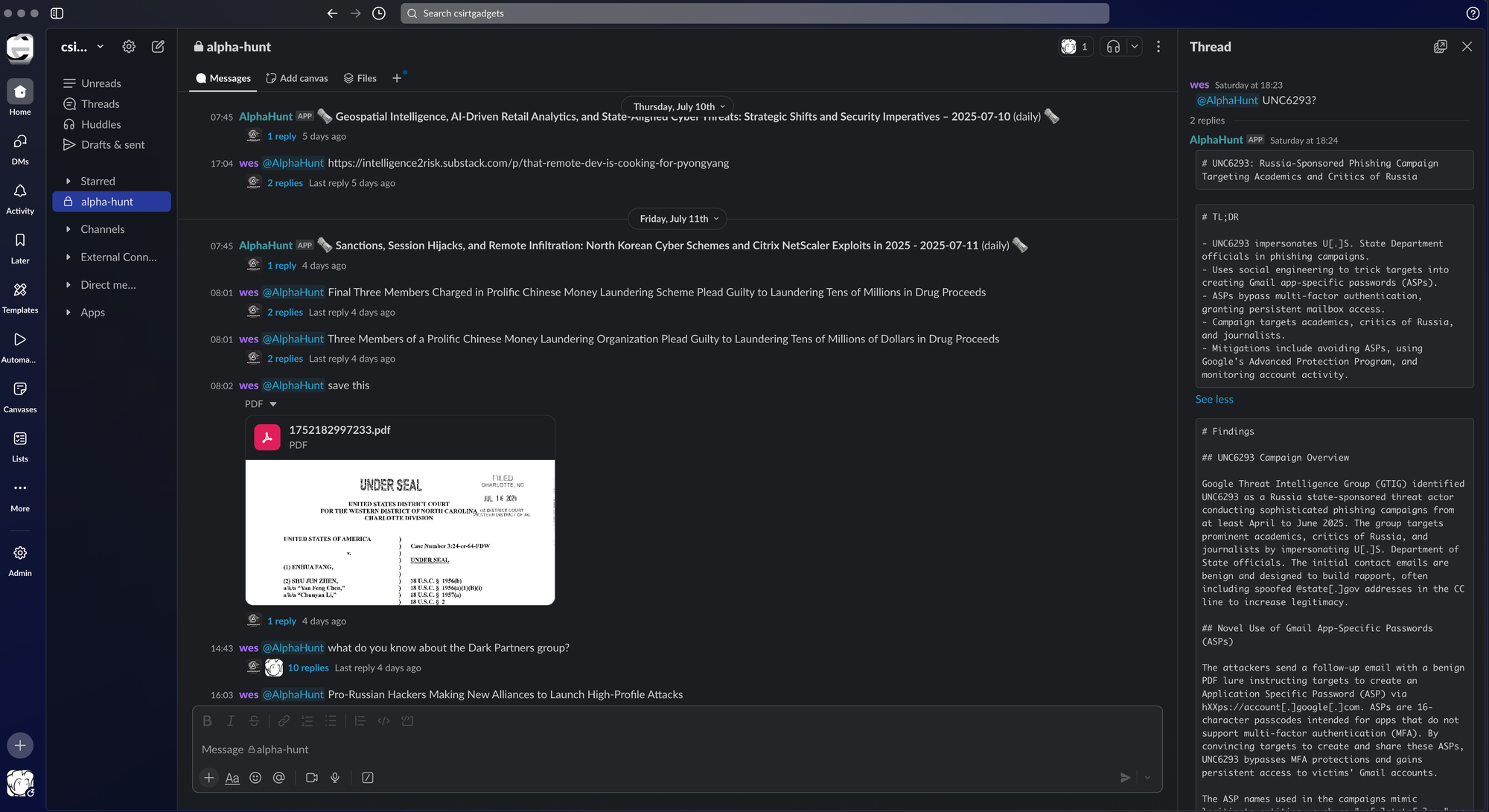
Get intelligence where it counts. No dashboards. No detours. AlphaHunt Converge teases out your intent, reviews the results and delivers actionable intel right inside Slack. We turn noise into signal and analysts into force multipliers.
Anticipate, Don’t Chase.
Why this matters to strategic stakeholders (“So what?”)
This is less about one CVE and more about what RP4VM represents in the enterprise.
- Recovery infrastructure is a control plane. If an adversary controls recovery tooling, they may influence what can be restored, what can be trusted, and how quickly you can recover.
- VMware pivoting expands blast radius. Compromise of VMware management planes can turn a localized incident into a platform-wide event.
- Operational resilience becomes a security dependency. A compromised recovery system can create false confidence in restore plans—discovering your spare tire was slashed only when you need it most.
Exposure conditions (what must be true for risk)
1) You’re running a vulnerable RP4VM version
Per Dell’s advisory, affected versions include:
- 5.3 SP4 P1
- 6.0 / 6.0 SP1 / 6.0 SP1 P1 / 6.0 SP1 P2 / 6.0 SP2 / 6.0 SP2 P1 / 6.0 SP3 / 6.0 SP3 P1
2) The attacker can reach the management surface (directly or indirectly)
Reported exploitation involves Apache Tomcat Manager access and WAR deployment. Practical exposure depends on whether an attacker can reach that management surface:
- Directly (misconfiguration / overly permissive access), or
- Indirectly (an internal foothold + lateral movement + weak segmentation)
3) “Internal-only” isn’t a safety boundary
Dell emphasizes RP4VM is intended for trusted internal networks—not public/untrusted networks. That’s a design assumption, not a security guarantee. If segmentation and access controls are weak, “internal” can still be attacker-reachable.
Executive decisions and actions (what we need this week)
Do now
- Authorize an emergency maintenance window to apply Dell’s remediation guidance for RP4VM:
- Upgrade to 6.0.3.1 HF1, and/or
- Use Dell’s remediation script guidance (per the advisory)
If patching is delayed (temporary risk posture)
- Isolate RP4VM from VMware management networks and other sensitive planes.
- Restrict access to management interfaces (least privilege, jump hosts only, explicit allow-lists).
Assign owners + deadlines
- Backup/Recovery owner: remediation + integrity validation + restore testing
- Virtualization owner: management-plane hardening, credential review, log retention
- Security owner: threat hunting scoped to RP4VM + VMware pivots; incident decisioning
Re-establish “restore trust” post-fix
- Perform an isolated restore test (known-good target, controlled conditions).
- Rotate credentials accessible from RP4VM where feasible (especially privileged accounts tied to management operations).
What’s emerging in tradecraft (why defenders should expect evolution)
Based on the reporting, themes to expect:
- Infrastructure-resident persistence: Persistence mechanisms described for RP4VM suggest a focus on staying resident in systems that aren’t monitored like endpoints.
- VMware-aware stealth: Techniques described include VMware-specific pivoting methods (e.g., “Ghost NICs”) and iptables-based single-packet authorization behavior on compromised infrastructure—signaling that baselining + management-plane monitoring matter.
- Malware refresh under pressure: Reporting describes evolution from BRICKSTORM usage toward GRIMBOLT, consistent with iterative improvement and counter-detection pressure.
Suggested Pivots
Where are the RP4VM-to-vCenter trust paths in our environment, and which ones are implicit rather than documented?
- Why: In these scenarios, topology is victimology. The easiest paths into vCenter/ESXi determine whether this stays contained or becomes enterprise-wide.
- What to expect: A prioritized map of high-risk pathways (firewalls, jump hosts, service accounts) and the minimum connections RP4VM truly requires.
Which RP4VM and vCenter artifacts best differentiate “attempted exploitation” from “validated pivot into VMware management”?
- Why: This distinction drives scope, containment sequencing, legal/comms posture, and whether recovery assurances remain credible.
- What to expect: A concise artifact checklist (logs + integrity checks + admin event patterns) aligned to the reported intrusion chain.
What does victimology across BRICKSTORM reporting suggest about mission focus, and how does that compare to our sector exposure?
- Why: Sector patterns can illuminate likely objectives and help prioritize monitoring and third-party risk conversations.
- What to expect: A reality check on whether our sector matches historically reported BRICKSTORM targeting—without over-attributing every RP4VM incident to a single vertical.
![[GAME THEORY] The Contractor Is Becoming the Intrusion Supply Chain](https://storage.ghost.io/c/06/e5/06e5730b-7d78-4713-9cec-6cba31d297f5/content/images/size/w600/2026/10/alphahunt-game-theory-the-contractor-is-becoming-the-intrusion-supply-chain-hero-2026-10-12.png)
![[SIGNALS WEEKLY] Edge Compromise, Real-Time Phishing, and Evidence Gaps](https://storage.ghost.io/c/06/e5/06e5730b-7d78-4713-9cec-6cba31d297f5/content/images/size/w600/2026/10/alphahunt-signals-weekly-edge-compromise-real-time-phishing-and-evidence-gaps-hero-2026-10-13.png)
![[GAME THEORY] The exploit is only one part of the business](https://storage.ghost.io/c/06/e5/06e5730b-7d78-4713-9cec-6cba31d297f5/content/images/size/w600/2026/10/alphahunt-game-theory-the-exploit-is-only-one-part-of-the-business-hero-2026-10-13.png)
![[GAME THEORY] The OAuth Prompt Is Becoming the New Diplomatic Pouch](https://storage.ghost.io/c/06/e5/06e5730b-7d78-4713-9cec-6cba31d297f5/content/images/size/w600/2026/10/alphahunt-game-theory-the-oauth-prompt-is-becoming-the-new-diplomatic-pouch-hero-2026-10-08.png)