![[GAME THEORY] Ransomware Did Not Need a Better Exploit. It Needed a Better Business Model.](https://storage.ghost.io/c/06/e5/06e5730b-7d78-4713-9cec-6cba31d297f5/content/images/size/w600/2026/08/alphahunt-game-theory-ransomware-did-not-need-a-better-exploit-it-needed-a-better-business-model-hero-2026-08-24.png)
gametheory
[GAME THEORY] Ransomware Did Not Need a Better Exploit. It Needed a Better Business Model.
RaaS wins on repeatable access and recovery pressure. Here is how defenders can break the cheap path before encryption.
gametheory
RaaS wins on repeatable access and recovery pressure. Here is how defenders can break the cheap path before encryption.
![[FORECAST] The SaaS connector is where trust becomes blast radius.](https://storage.ghost.io/c/06/e5/06e5730b-7d78-4713-9cec-6cba31d297f5/content/images/size/w600/2026/08/alphahunt-forecast-the-saas-connector-is-where-trust-becomes-blast-radius-hero-2026-08-21.png)
forecasts
A 30% forecast—and a practical way to reduce the cross-tenant blast radius before the next connector compromise.
![[DEEP RESEARCH] The account stealing your data may not be human](https://storage.ghost.io/c/06/e5/06e5730b-7d78-4713-9cec-6cba31d297f5/content/images/size/w600/2026/07/alphahunt-deep-research-the-account-stealing-your-data-may-not-be-human-hero-2026-07-27.png)
deep
The user may start the incident. OAuth apps, tokens, and integrations can turn it into quiet, scalable data theft.
![[SIGNALS WEEKLY] Converging Threats Across SaaS, Web Edge, and OT](https://storage.ghost.io/c/06/e5/06e5730b-7d78-4713-9cec-6cba31d297f5/content/images/size/w600/2026/07/signals-weekly-converging-threats-hero-2026-07-14.png)
weekly
OAuth consent made SaaS data theft look normal. Niche web plugins kept handing attackers first doors. OT debug ports reminded everyone that “engineering access” can age into exposure.
![[FORECAST] Device-Bound Sessions Are Coming. Defaults Are the Hard Part.](https://storage.ghost.io/c/06/e5/06e5730b-7d78-4713-9cec-6cba31d297f5/content/images/size/w600/2026/05/z-2.png)
forecasts
“Secure by default” sounds great until it meets BYOD, VDI, federated SSO, and the help desk exception list from hell. Device-bound sessions help. Waiting for every SaaS vendor to flip the default is not a strategy.
![[FORECAST] Two New App-Layer Campaigns by Year-End? Watch the Attribution Line](https://storage.ghost.io/c/06/e5/06e5730b-7d78-4713-9cec-6cba31d297f5/content/images/size/w600/2026/04/z-6.png)
forecasts
Teams keep hardening the front door while the “trusted integration” gets waved through reception with a box truck. No core-platform exploit required. Just approval fatigue with API access.
identity
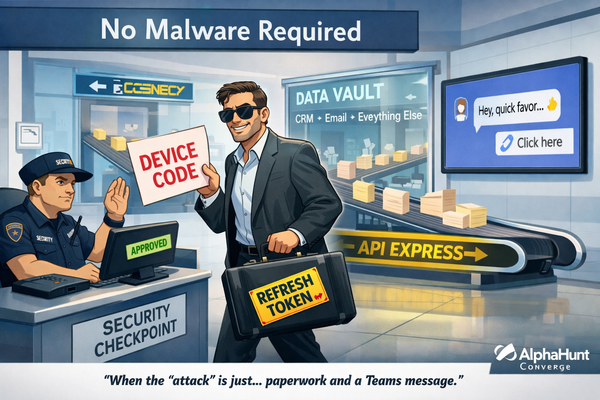
No malware. Still owned. 🧾🔑💬 Device-code phishing + Teams as the “lobby” + stolen OAuth tokens = API-speed SaaS exfil. If you’re hunting binaries, you’re late.
![[DEEP RESEARCH] Zero-Days Are a Distraction: 2025’s Biggest Losses Were Stolen Tokens + OAuth](https://storage.ghost.io/c/06/e5/06e5730b-7d78-4713-9cec-6cba31d297f5/content/images/size/w600/2025/12/zz-3.png)
sass
Most downtime and spend stemmed from OAuth/SaaS abuse and edge appliances—not catastrophic zero-days. Here’s what drove real operating impact and the fastest ways to shrink it.
oauth
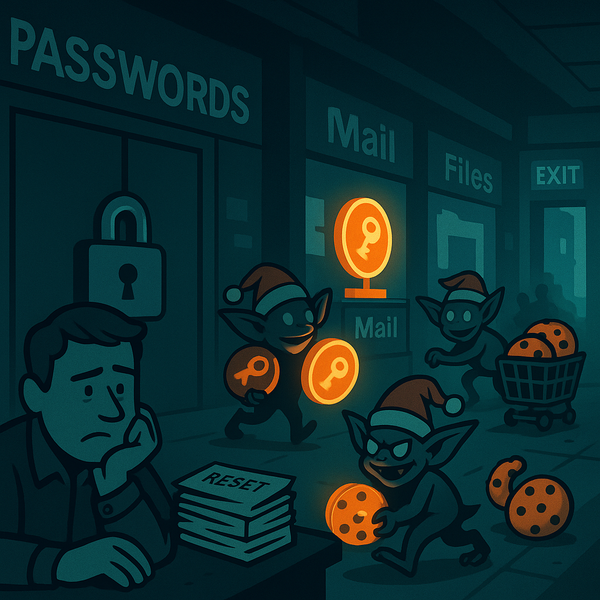
2026’s nastiest SaaS breaches will ride valid tokens + “trusted” apps. We already got the trailer with the Salesloft/Drift OAuth blast radius. And the browser? Yeah, it’s part of the perimeter now. 😬🔑💬
ecrime
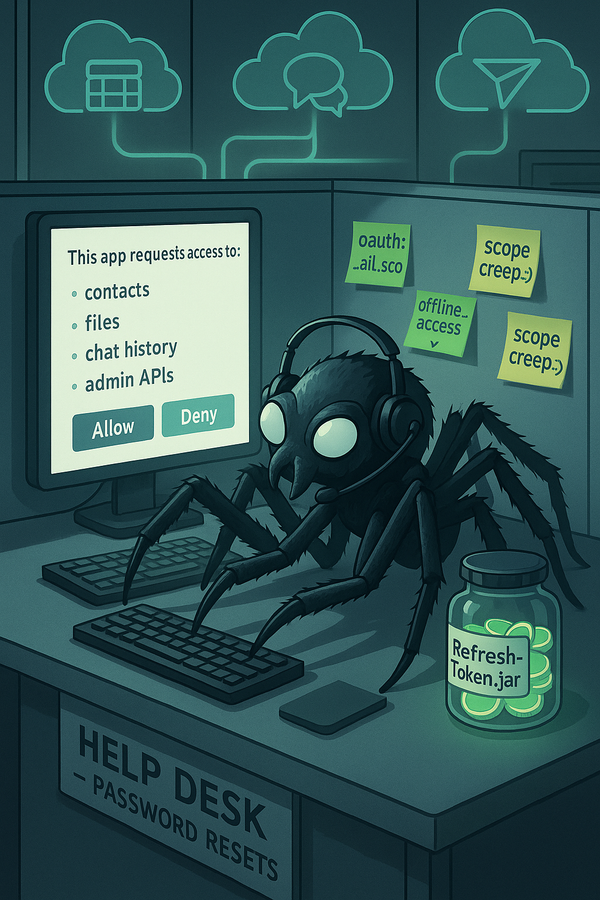
Three financially motivated clusters—UNC3944 (“Scattered Spider”), UNC6040, and UNC6395—are driving a surge in SaaS and cloud data theft via social engineering, OAuth abuse, and supply-chain attacks. Their evolving TTPs and anti-forensics are raising the stakes for defenders..